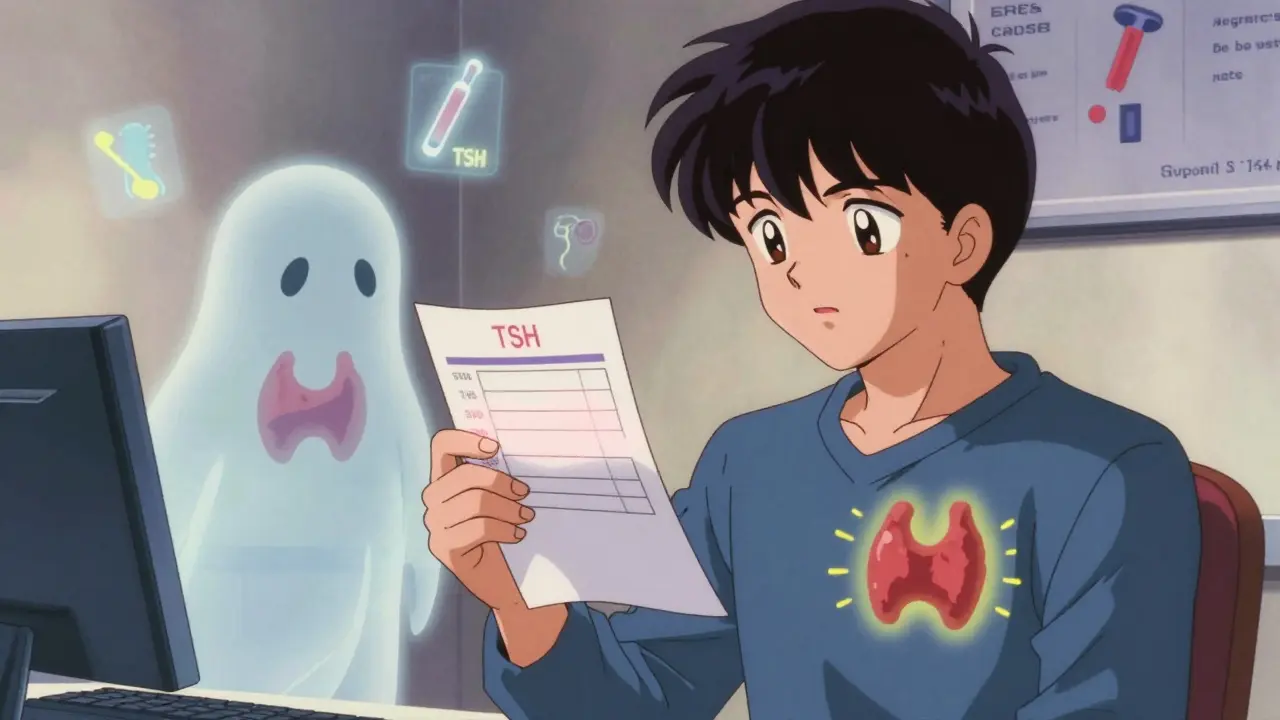
When your TSH is high but your thyroid hormone levels are normal, what do you do? That’s the question millions of people face every year. Subclinical hypothyroidism - where TSH is above normal but free T4 is still in range - isn’t a clear-cut diagnosis. It doesn’t always cause symptoms. It doesn’t always progress. And treating it isn’t always the right move. In fact, for many, treatment can do more harm than good.
What Exactly Is Subclinical Hypothyroidism?
Subclinical hypothyroidism (SCH) means your thyroid-stimulating hormone (TSH) is elevated, but your free thyroxine (T4) stays within the normal range. It’s not full-blown hypothyroidism. You’re not yet sick. But your body is sending out warning signs. TSH is the pituitary’s way of saying, "Hey thyroid, work harder." When it’s high, something’s off - even if your hormones look fine on paper.
This condition shows up in about 4% to 20% of adults, depending on age and lab standards. Older adults are far more likely to have it. In fact, over half of people over 70 have a TSH above 4.5 mIU/L - and many never develop symptoms. The key is understanding that not every high TSH needs treatment. Some are just part of aging.
To confirm SCH, doctors need two TSH tests taken 2 to 3 months apart. One high reading isn’t enough. Labs vary. Some use an upper limit of 4.12 mIU/L. Others go as high as 5.0. That’s why context matters. Your lab’s normal range is your baseline.
When Should You Treat It?
The big debate: treat when TSH is just a little high - say between 4.0 and 10.0 - or wait until it’s clearly out of bounds? The answer isn’t one-size-fits-all.
TSH over 10 mIU/L - most guidelines agree here. If your TSH is above 10, treatment with levothyroxine is usually recommended. Studies show clear benefits: lower risk of progression to overt hypothyroidism, better cholesterol levels, and fewer symptoms over time. The Cleveland Clinic found that 70% of people with TSH above 8 mIU/L will hit TSH >10 within four years. That’s a strong signal to act.
TSH between 5 and 10 mIU/L - this is where things get messy. Some doctors treat. Others watch. Why? Because the evidence is mixed.
A 2017 JAMA study of 737 older adults found no improvement in energy, mood, or quality of life after a year of levothyroxine. But a 2020 study in Thyroid showed a 32% drop in fatigue and brain fog in people under 50 with TSH 7-10 and positive thyroid antibodies. So age and antibody status matter.
Positive TPO antibodies - this is your hidden clue. If your immune system is attacking your thyroid, you’re far more likely to progress. People with positive antibodies have 2.3 times higher risk of becoming overtly hypothyroid. If you’re young, have antibodies, and your TSH is above 7, treatment often makes sense. If you’re over 65 and antibody-negative? Probably not.
Who Should Avoid Treatment?
Not everyone benefits. Some people actually get worse.
Older adults - especially those over 65 - are at higher risk of overtreatment. A 2021 meta-analysis found that treating people over 65 with TSH under 10 increased their risk of death by 12.3%. Why? Levothyroxine can trigger atrial fibrillation, bone loss, and heart strain. In older bodies, even small doses can be too much.
People with no symptoms - this is huge. Many patients with SCH report fatigue, weight gain, or cold intolerance. But studies show 30-40% of these symptoms show up in people with normal thyroid function too. If you feel fine, treatment won’t help. You’re just adding a pill to your routine with no upside.
And then there’s the cost. In the U.S., unnecessary levothyroxine prescriptions cost $1.2 billion a year. Most of that is for people who don’t need it. Testing and monitoring add more. If you’re not going to benefit, why do it?
How Treatment Works - and How Not to Mess It Up
If you and your doctor decide to treat, levothyroxine is the standard. Start low: 25 to 50 micrograms daily. That’s less than what’s used for overt hypothyroidism. Why? Because your thyroid still works - you just need a nudge.
Don’t rush. Wait 6 to 8 weeks before retesting TSH. Dose changes should be small - 25 mcg at a time. Too fast, too much, and you risk heart problems or anxiety.
Also, watch your other meds. Iron, calcium, and even coffee can block absorption. Take levothyroxine on an empty stomach, at least 30-60 minutes before food or supplements. And never switch brands without checking with your doctor. Different formulations aren’t always interchangeable.
What to Do Before You Start
Before you take one pill, get these tests:
- TPO antibodies - tells you if your immune system is involved
- Lipid panel - high cholesterol often improves with treatment
- Heart health check - especially if you’re over 50
- Thyroid symptom score - use a 10-item scale like the Thyroid Symptom Rating Scale to measure fatigue, mood, cold sensitivity
Don’t rely on how you feel. Use numbers. If your symptom score is low and TSH is 6.5? Watchful waiting is better than rushing to treatment.

What the Guidelines Really Say
There’s no global consensus. Different groups give different advice:
- American Thyroid Association (ATA): Treat only if TSH >10
- American Association of Clinical Endocrinologists (AACE): Consider treatment if TSH >7, especially with antibodies
- American Academy of Family Physicians (AAFP): Treat TSH >10 or if antibodies are positive
- European Thyroid Association: Treat TSH >10; evidence for lower levels is weak
- Royal Australian College of GPs: Don’t treat TSH 4-10 routinely
That’s why you might get different advice from your GP versus an endocrinologist. About 68% of primary care doctors stick to TSH >10. But 82% of endocrinologists look at antibodies, symptoms, and age too.
The Future: Precision Thyroid Care
Things are changing. New tools are emerging.
Roche Diagnostics launched a TSH velocity calculator in 2023. It looks at how fast your TSH is rising - not just the number. A rise of 1 mIU/L per month? That’s a red flag. It predicts progression better than a single test.
And research is shifting. A 2022 study of 27,000 people suggested the upper limit for normal TSH should be 2.5 for people under 50. If that becomes standard, nearly 1 in 4 young adults would be labeled with SCH. That’s not necessarily better - it could mean more people on pills who don’t need them.
The SHINE trial - tracking 1,000 people with TSH 4-10 over five years - will deliver results in late 2024. It’s the largest study ever on whether treating mild SCH improves heart health. We’ll know more soon.
Final Advice: Don’t Panic, Don’t Assume
If your TSH is high but you feel fine - wait. Get your antibodies checked. Talk to your doctor about your age, your heart, and your symptoms. Don’t let a number alone decide your treatment.
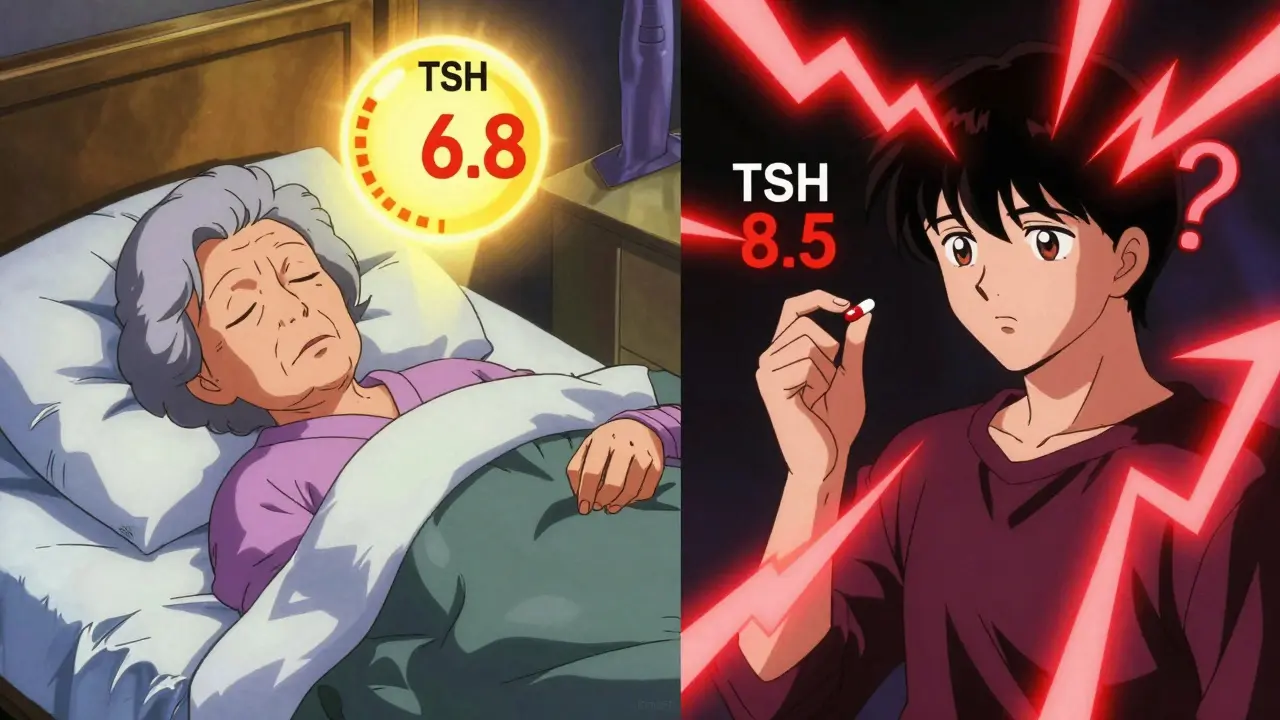
If you’re under 50, have antibodies, and your TSH is above 7 - treatment might help. If you’re over 65 with a TSH of 6.8 and no symptoms - skip the pill. Monitor. Retest in six months.
Subclinical hypothyroidism isn’t a disease. It’s a signal. And signals aren’t always alarms. Sometimes they’re just whispers.
Is subclinical hypothyroidism the same as hypothyroidism?
No. Hypothyroidism means low free T4 and high TSH - your thyroid isn’t making enough hormone. Subclinical hypothyroidism means your TSH is high but your free T4 is still normal. Your thyroid is still working - just struggling. It’s a warning, not a failure.
Can subclinical hypothyroidism go away on its own?
Yes, sometimes. Up to 20% of people with mild TSH elevation (4-6 mIU/L) return to normal within a year without treatment. This is more common in younger people and those without thyroid antibodies. Monitoring is key - you don’t need to treat every case.
Why do some doctors treat TSH 5-10 and others don’t?
It depends on training, experience, and how they interpret the evidence. Some follow strict guidelines (TSH >10). Others use clinical judgment - looking at symptoms, antibodies, age, and risk factors. Endocrinologists are more likely to treat earlier than primary care doctors. There’s no universal rule - that’s why shared decision-making matters.
Does levothyroxine cause weight loss in subclinical hypothyroidism?
Not reliably. Studies show no consistent weight loss in people with SCH who take levothyroxine. Weight gain is often blamed on thyroid issues, but in most cases, it’s unrelated. Treating SCH won’t help you lose weight unless you were truly hypothyroid. Don’t use it as a weight-loss tool.
How often should TSH be retested if not treated?
If you’re not on medication and your TSH is between 5 and 10, retest every 6 to 12 months. If it’s stable, you can extend to every 1-2 years. If it keeps climbing, especially above 7, that’s a sign to reconsider treatment. For those with antibodies, more frequent checks (every 6 months) are recommended.
Can lifestyle changes fix subclinical hypothyroidism?
No. Diet, supplements, or stress reduction won’t fix an elevated TSH caused by autoimmune thyroiditis or age-related decline. But they can help with symptoms like fatigue or brain fog. Sleep, exercise, and reducing inflammation support overall health - even if they don’t change your TSH.

Comments (8)
John Sonnenberg February 7 2026
This post is spot on. I had a TSH of 8.2 last year and my PCP wanted to throw levothyroxine at me like it was a magic bullet. I refused. Got my antibodies tested - positive. But I felt fine. No fatigue, no weight gain, no brain fog. Two years later, TSH is still 8.1. No progression. No symptoms. Medicine is too quick to pathologize normal variation. Especially when the evidence is this muddy.Tori Thenazi February 7 2026
I've been saying this for years. The thyroid industry is a racket. Big Pharma knows that if they can convince people that every slightly elevated TSH is a crisis, they can sell billions in levothyroxine. And don't get me started on how labs manipulate reference ranges. The 'normal' range was widened to make more people 'abnormal' so they can be treated. It's not science - it's profit. Your body isn't broken just because a number is 0.5 above the arbitrary line.Elan Ricarte February 8 2026
Let’s be real - the entire endocrine system is treated like a broken toaster these days. You’ve got doctors treating TSH like it’s a stock ticker. ‘Buy low, sell high.’ Meanwhile, real people are getting overmedicated, developing palpitations, losing bone density, and wondering why they feel worse after starting the pill. And then there’s the ‘antibody’ rabbit hole - sure, positive TPO means higher risk, but correlation isn’t causation. I’ve seen 70-year-olds with TSH 9.3 and zero symptoms. They’re hiking, gardening, playing grandkids. Do you really think a 25 mcg pill is going to improve their quality of life? Or just make them a walking pharmacy ad?Scott Conner February 10 2026
so if tsh is high but t4 is normal... why does the body even make more tsh? is it just the pituitary being overly dramatic? like a mom yelling at a kid to clean their room even though they already did? also why do labs have such different ranges? one place says 5.0 is max, another says 4.12? who even decided these numbers? some dude in a lab coat with a magic 8-ball?Marie Fontaine February 11 2026
I had SCH for 3 years and never took meds. Felt fine. Got my TPO tested - negative. Retested every 8 months. TSH stayed at 6.2. Then I started yoga, slept better, cut out processed sugar - and guess what? My TSH dropped to 4.8. Not because of a pill. Because I listened to my body. You don’t need a doctor to fix what you can fix yourself. 💪Ryan Vargas February 12 2026
The fundamental error in modern endocrinology is the reification of a single biomarker as a proxy for systemic health. TSH is not a disease - it is a regulatory signal, a feedback variable in a complex, nonlinear, homeostatic system. To treat an elevated TSH without considering the dynamic interplay of thyroid hormone kinetics, receptor sensitivity, deiodinase activity, and circadian rhythm is not medicine - it is reductionist dogma dressed in white coats. The fact that 30-40% of individuals reporting 'hypothyroid symptoms' have normal thyroid function underscores the epistemological crisis in clinical practice: we confuse correlation with causation, and statistical noise with physiological truth. We are pathologizing adaptation.Simon Critchley February 13 2026
The TSH velocity metric is the future. Single-point TSH measurements are archaic. You’re not diagnosing a condition - you’re tracking a trajectory. A rise of 1 mIU/L/month? That’s a red flag. A stable TSH at 7.5 for 18 months? That’s just your new baseline. The old guidelines are built on cross-sectional data. We need longitudinal, individualized monitoring. And let’s not forget the confounding variables - sleep deprivation, chronic stress, selenium deficiency, even gut dysbiosis can elevate TSH transiently. You can’t treat a number without context. Endocrinology needs a paradigm shift - from static thresholds to dynamic modeling.Joseph Charles Colin February 14 2026
As a clinician who’s managed hundreds of SCH cases, I’ll say this: if you’re under 50, have positive TPO, and your TSH is above 7 - treat. You’re likely progressing. But if you’re over 65, asymptomatic, and antibody-negative? Don’t touch it. The risks outweigh the benefits. I’ve seen patients on levothyroxine develop atrial fibrillation because their dose was too high. I’ve seen others get scared into lifelong medication over a number that didn’t mean anything. The key is individualization. No two patients are the same. Use the tools - antibodies, symptom score, lipid panel, TSH trend. And never treat based on fear. Treat based on evidence. And sometimes… the best treatment is no treatment at all.