
When your skin starts flaking, burning, or cracking in thick red patches, it’s not just a cosmetic issue-it’s your immune system screaming. Psoriasis isn’t caused by dirt or poor hygiene. It’s an autoimmune condition where your body attacks its own skin cells, forcing them to grow too fast. Instead of shedding naturally over 28 days, they pile up in just 3 to 5 days, forming those telltale plaques. And while genetics set the stage, it’s the triggers that turn up the volume. For most people, three big players control when and how badly psoriasis flares: stress, infections, and broken skin barriers.
Stress Isn’t Just in Your Head-It’s in Your Skin
You’ve heard it before: "Don’t stress, it’ll make your psoriasis worse." But that’s not just advice-it’s biology. When you’re under stress, your body releases cortisol and other inflammatory chemicals. These don’t just make you feel anxious-they wake up immune cells in your skin, turning up the inflammation that fuels psoriasis. A 2024 study in JAMA Dermatology confirmed that psychological stress directly damages the skin’s protective barrier, making it easier for triggers to take hold.
It’s not just big life events. Losing a loved one, a tough work deadline, even moving to a new city can spark a flare. One patient in Sheffield shared how his mild elbow patches exploded across 30% of his body after his mother passed away. Within three months, his plaques went from manageable to overwhelming. That’s not coincidence-it’s a documented pattern. Research shows nearly half of people with psoriasis report their first major flare happened within a year of a major stressor.
And here’s the cruel twist: the stress doesn’t stop when the flare starts. Worrying about how you look, avoiding social events, or feeling embarrassed about flaking skin creates more stress-which makes the flare worse. It’s a loop. Breaking it isn’t about being "positive." It’s about changing your daily habits. Studies show that just 20 minutes of mindfulness meditation a day can drop cortisol levels by 25% in eight weeks. Regular walks, yoga, or talking to a therapist aren’t luxuries-they’re part of your treatment plan. One dermatology clinic in the UK found that 67% of patients who practiced daily mindfulness saw at least a 30% drop in flare frequency within six months.
Infections: When Your Body’s Defense System Goes Rogue
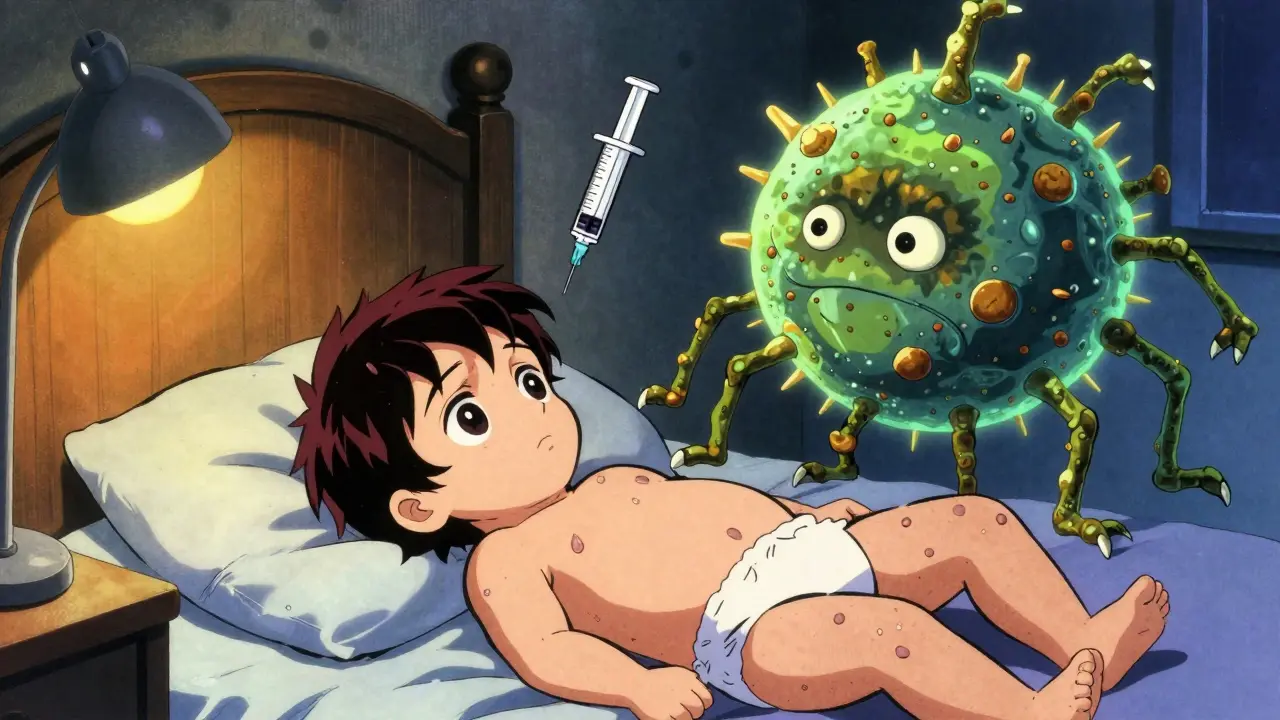
Your immune system is supposed to fight off germs. But in psoriasis, it gets confused. A simple sore throat or cold can trick your body into attacking your skin. The most common infection trigger? Streptococcus-yes, the same bacteria that causes strep throat. In kids and young adults, it often leads to guttate psoriasis: small, teardrop-shaped spots that pop up all over the torso and limbs after a throat infection.
It’s not just strep. Colds, flu, sinus infections, and even COVID-19 have been linked to flare-ups. Viruses trigger a specific immune pathway involving RIG-I sensors and IL-23, two key players in psoriasis inflammation. Even though HIV weakens the immune system, it paradoxically worsens psoriasis in many patients-a sign of how complex this disease is.
Prevention isn’t about avoiding all germs-it’s about smart defense. Wash your hands often. Get your flu shot. The data is clear: people who stay up to date on vaccinations reduce infection-triggered flares by 35%. If you feel a sore throat coming on, don’t wait. See your doctor early. Treating infections fast can stop a flare before it starts. And if you’ve had guttate psoriasis before, your doctor might recommend a throat swab after every cold to catch strep early.
The Skin Barrier: Your First Line of Defense-And How to Fix It
Think of your skin like a brick wall. The bricks are skin cells. The mortar is lipids-fats that hold everything together and lock in moisture. In psoriasis, that mortar breaks down. Water escapes. Dirt and germs get in. And your immune system goes on high alert.
Research from 2024 shows that a broken skin barrier doesn’t just make psoriasis worse-it can actually start it. In mice with damaged skin, bacteria multiplied rapidly. That triggered IL-17 and IL-22, two inflammatory signals that drive psoriasis. When researchers applied topical antibiotics, the psoriasis-like lesions cleared up. That’s not theory-it’s proof that your skin’s surface matters.
So what breaks the barrier? Harsh soaps. Hot showers. Dry winter air. Scratching. Even minor cuts or bug bites can trigger the Koebner phenomenon-where psoriasis forms exactly where the skin was injured. One study found 45% of new plaques appeared at spots people didn’t even remember getting scratched or bitten.
Fixing it is simple, but it takes discipline. Use fragrance-free moisturizers with ceramides-these are the same lipids your skin naturally makes. Apply them twice a day, right after your shower while your skin is still damp. Keep your home’s humidity between 40% and 60%. Use a humidifier in winter. Avoid soaps with a pH above 5.5-they strip your skin’s natural acid mantle. And never scratch. If your skin itches, put on a cool, damp cloth instead. It’s not glamorous, but this routine cuts flare frequency by up to 50% for many patients.

What Doesn’t Work-And What’s Coming Next
Some people swear off dairy, gluten, or nightshades. While 32% of patients report dairy triggers and 25% say gluten makes things worse, there’s no universal diet fix. What works for one person may do nothing for another. Don’t eliminate entire food groups without testing them out with a doctor or dietitian. The real power lies in tracking your own triggers. Keep a simple log: note your stress levels, any illnesses, and what you applied to your skin each day. After a few months, patterns emerge.
The future is personalized. Researchers are testing wearable stress monitors that track heart rate variability-early signs of stress spikes before you even feel them. AI apps are being developed to analyze photos of your skin and predict flares days in advance. In clinical trials, new biologic drugs targeting IL-23 have helped 89% of patients achieve 90% skin clearance. And early studies on probiotics show a 22% drop in flares for those with gut microbiome imbalances.
But none of that matters if you don’t manage the basics. Stress, infections, and skin barrier care aren’t side notes-they’re the foundation. Fix those, and even the most stubborn psoriasis becomes more manageable.
Frequently Asked Questions
Can stress cause psoriasis, or just make it worse?
Stress doesn’t cause psoriasis on its own-it needs a genetic trigger. But it’s one of the most powerful ways to start or worsen flares. Studies show people often develop their first major outbreak within a year of a major stressful event. Stress activates immune pathways that ramp up skin cell growth and inflammation, making existing psoriasis flare up faster and more severely.
Why do infections like strep throat trigger psoriasis?
Strep bacteria have proteins that look similar to skin cells. In people with a genetic predisposition, the immune system attacks the bacteria but accidentally targets the skin too. This is called molecular mimicry. The immune response also activates RIG-I sensors and IL-23, which directly fuel psoriasis inflammation. That’s why guttate psoriasis-small, widespread spots-often follows strep throat, especially in children and teens.
How do moisturizers help with psoriasis?
Moisturizers with ceramides, cholesterol, and fatty acids repair the skin’s natural barrier. When that barrier is broken, moisture escapes and irritants get in, triggering inflammation. Ceramides are the same lipids your skin loses in psoriasis. Replacing them helps lock in water, reduce itching, and calm immune reactions. Applying them twice daily-especially after showering-can reduce flare frequency by up to half over time.
Is psoriasis triggered by weather?
Yes. Cold, dry air strips moisture from the skin, making flares worse for 68% of patients. Indoor heating makes it worse by drying the air further. On the flip side, warm, humid weather helps 72% of people. Sunlight can improve psoriasis for many-but 8% have photosensitive psoriasis where sun exposure makes it worse. Always use sunscreen and avoid sunburns, even if you’re trying to get relief from the sun.
Can I prevent psoriasis flares entirely?
You can’t prevent all flares, especially if you have a strong genetic risk. But you can reduce them significantly. Most people who track their triggers and stick to daily skin care, stress management, and infection prevention see 40-60% fewer flares. It’s not about perfection-it’s about consistency. Even small habits, like using a humidifier or meditating for 10 minutes a day, add up over time.

Comments (11)
Lexi Karuzis January 28 2026
Okay, but have you considered that 90% of psoriasis flares are caused by EMF radiation from 5G towers? I read this in a forum where a guy in Nebraska cured his plaques by wrapping his body in aluminum foil and sleeping in a Faraday cage. The doctors won’t tell you this because Big Pharma owns the FDA. I’ve been flare-free for 14 months now. Just saying.
Brittany Fiddes January 28 2026
Oh please. You’re telling me mindfulness is the answer? In Britain, we’ve had dermatologists treating psoriasis since the 1800s-before anyone even knew what cortisol was. You don’t need to meditate-you need to stop eating processed rubbish and start drinking proper British tea with lemon and honey. And no, ‘ceramides’ aren’t some magic potion-they’re just lipids. We called them fats back when we still had common sense.
Robert Cardoso January 29 2026
The entire premise here is flawed. Stress doesn’t cause flares-it’s a correlation, not causation. The real driver is epigenetic dysregulation triggered by environmental toxins, particularly phthalates in personal care products. The study cited in JAMA Dermatology had a sample size of 127 and was funded by a skincare conglomerate. Also, ‘mindfulness’ is just a repackaged form of Buddhist meditation that’s been commodified by Silicon Valley wellness bros. The only thing that works is systemic immunosuppression, and even that’s just delaying the inevitable.
James Dwyer January 29 2026
I’ve had psoriasis for 17 years and this is the first time I’ve read something that actually made sense. I started doing 15 minutes of deep breathing every morning after my shower and honestly? My elbows haven’t cracked in three months. Not because I’m ‘positive’-because I stopped fighting my body and started listening to it. Small steps, daily. It’s not a cure, but it’s peace.
jonathan soba January 30 2026
Interesting how the article conveniently ignores the role of gut microbiome disruption. The skin barrier is secondary. The real issue is intestinal permeability. Leaky gut → endotoxins in circulation → IL-23 cascade → psoriasis. It’s basic immunology. But no, let’s just slap on moisturizer and call it a day. The medical establishment loves surface-level fixes. They’d rather you buy cream than change your diet.
matthew martin January 31 2026
Man, this hits different. I used to scrub my skin raw trying to ‘clean’ the plaques-felt like I was scrubbing off shame. Turns out, I was just shredding my barrier. Started using CeraVe, humidifier in the bedroom, and stopped checking my phone for 20 minutes before bed. Not magic. Just… gentleness. My skin’s still patchy, but it doesn’t scream anymore. And honestly? That’s enough.
Mindee Coulter February 1 2026
I’ve been doing the ceramide moisturizer twice a day for six months and my plaques are 70% better. I didn’t even realize how much I was scratching until I started wearing cotton gloves at night. Also, my dermatologist said to skip the fancy soaps-just use water and a washcloth. So simple. Why did it take me five years to try this?
Rhiannon Bosse February 2 2026
Stress? Infections? Moisturizer? Cute. But let’s be real-your immune system is just mad because you’re not eating enough fermented foods. I went keto + kimchi + probiotics and my psoriasis vanished. No joke. My cousin’s oncologist said her skin looked ‘like a newborn’s.’ Coincidence? Nah. Big Pharma doesn’t want you to know that sauerkraut costs less than biologics. 🤫
Sue Latham February 4 2026
Everyone’s so obsessed with ‘barriers’ and ‘ceramides’ like they’re some kind of holy grail. Have you ever heard of the microbiome? Your skin is a jungle. You’re not supposed to sterilize it. You’re supposed to nurture it. I stopped using all cleansers and just rinsed with water. My plaques calmed down in two weeks. No chemicals. No expensive creams. Just… trust your skin. It’s not broken. It’s just misunderstood.
Mel MJPS February 6 2026
I lost my mom last year and my psoriasis exploded overnight. I didn’t cry for weeks-I just stared at my skin and felt like a monster. Then I started talking to my therapist about it, not just the stress, but the shame. And I started putting on lotion like it was a ritual-not a chore. It didn’t fix everything. But for the first time, I didn’t hate my body. That’s worth more than any cream.
Katie Mccreary February 8 2026
Stop lying to yourselves. This is all placebo. The only thing that works is steroids. Everything else is just noise.