When a brand-name drug loses its patent, you’d expect generic versions to flood the market and drive prices down. But in reality, many patients wait years longer than they should. Why? Because patent litigation in the generic drug market has become a high-stakes game - not just about legal rights, but about who controls access to life-saving medicine.
How the System Was Supposed to Work
The Hatch-Waxman Act of 1984 was designed to balance two things: protecting innovation and speeding up affordable drugs. It created a clear path for generic manufacturers to file an Abbreviated New Drug Application (ANDA). But here’s the twist: if they believe a patent is invalid or not being infringed, they can file what’s called a Paragraph IV certification. That’s a legal challenge. And when they do, the brand-name company has just 45 days to sue.If they do, the FDA hits pause. No approval for the generic. Not for 30 months. That’s the regulatory stay. The idea was to give both sides time to resolve disputes - not to block competition indefinitely. But over time, the system got twisted.
The Orange Book: A Tool for Delay?
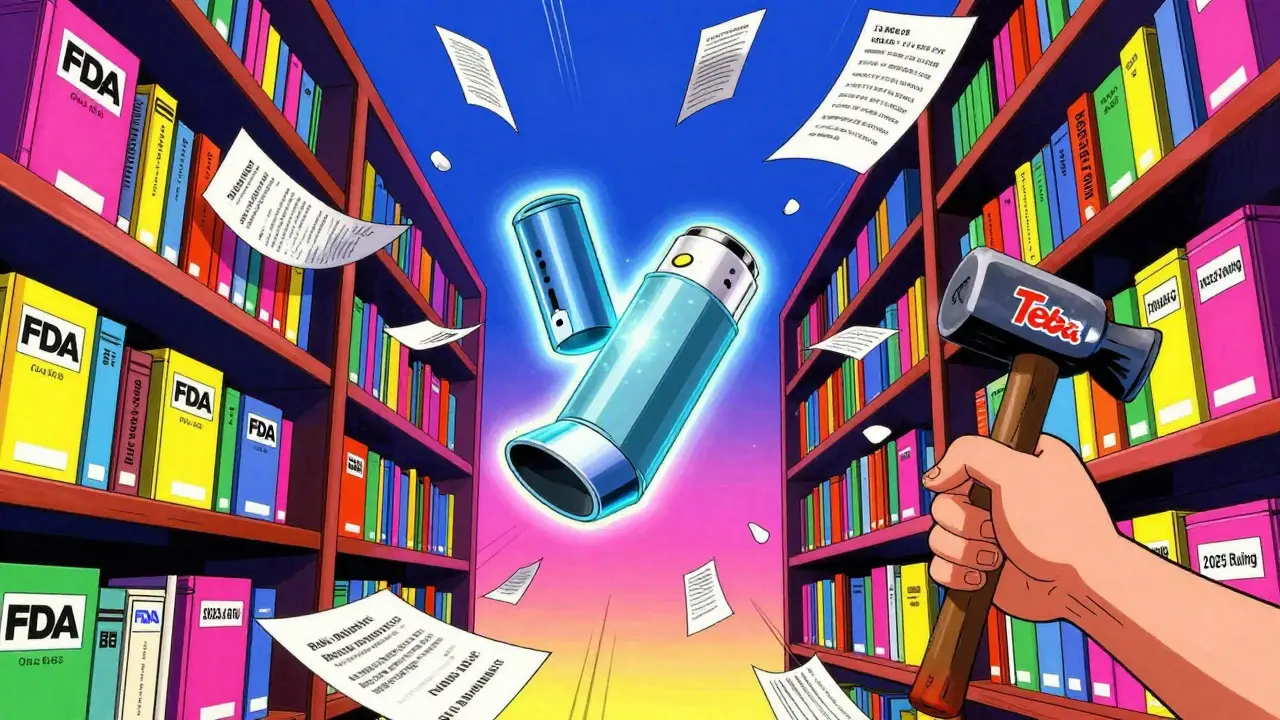
The FDA’s Orange Book lists patents tied to brand-name drugs. Only patents covering the active ingredient, how it’s made, how it’s used, or how it’s formulated should be there. But companies have found loopholes. They list patents on things like inhaler valves, pill coatings, or packaging devices - stuff that has nothing to do with the actual medicine.In 2025, Judge Chesler ruled in Teva vs. Amneal that six patents on the dose counter of ProAir® HFA couldn’t stay on the Orange Book. Why? Because the drug is albuterol sulfate inhalation aerosol. The counter? Not part of the drug. It’s a delivery tool. That ruling was a wake-up call. Experts estimate 15-20% of current Orange Book listings might be invalid under this logic.
Still, brand companies keep listing them. The Association for Accessible Medicines (AAM) found companies routinely use this tactic to string out litigation - one patent after another. It’s called serial patent litigation. One drug, 15 patents filed over 7 years. Each one triggers a new 30-month delay. That’s how a drug that should have generics in 2018 still doesn’t have them in 2026.
Where the Lawsuits Are Happening
Not all courts are created equal. The Eastern District of Texas has become the go-to venue for pharmaceutical patent cases. In 2024, it handled 38% of all patent lawsuits - more than double the next busiest district. Why? Because it’s fast, predictable, and has judges with deep experience in patent law. Generic companies hate it. Brand companies love it.It’s not just about speed. The rules here favor patent holders. Plaintiffs get more discovery, more time to build their case, and a jury pool that’s historically been sympathetic to innovation. That’s why even companies outside Texas file here. It’s forum shopping - and it’s working.
Settlements: Real Help or Pay-For-Delay?
You’ve heard the term pay-for-delay. It sounds dirty. And sometimes, it is. That’s when a brand company pays a generic maker to stay off the market - sometimes millions of dollars - just to avoid competition.But here’s the twist: not all settlements are bad. The IQVIA Institute found that when brand and generic companies settle, generics enter the market five years earlier on average than if they fought it out in court. Why? Because litigation drags on. Settlements cut the timeline. The FTC says these deals are anti-competitive. IQVIA says they’re practical.
The truth? It depends on the deal. Some settlements include cash payments with no product launch date. Those are shady. Others include licensing deals, shared distribution, or joint R&D. Those can actually help patients get cheaper drugs faster. The line between good and bad is thin - and hard to police.
The Numbers Don’t Lie
In 2024, patent litigation in the U.S. hit a record: 2,594 cases filed. Damages awarded? Over $4.3 billion. That’s not just lawyers getting rich - it’s patients paying more.The FTC estimates improper patent listings delay generic entry for about 1,000 drugs every year. That costs the system $13.9 billion annually. Think about that: $13.9 billion. That’s enough to cover insulin for every diabetic in the U.S. for nearly a year.
And it’s getting worse. The average time from brand approval to first generic entry has doubled since 2005 - from 14 months to 28 months. For cancer drugs? It’s worse. Oncology drugs now take an average of 5.7 years after patent expiry before generics appear. Eliquis has 67 patents. Ozempic and Wegovy together have 152. That’s not innovation. That’s a legal wall.
What’s Changing Now?
The FDA is stepping in. By Q2 2026, brand companies will have to certify under penalty of perjury that every patent they list in the Orange Book actually meets the law. No more guessing. No more padding. If they lie, they could face criminal charges.Meanwhile, generic manufacturers are turning to the Patent Trial and Appeal Board (PTAB) for inter partes reviews (IPRs). These are cheaper, faster challenges to patent validity. IPR filings jumped 47% from 2023 to 2024. But the Supreme Court’s 2025 ruling in Smith & Nephew v. Arthrex made it harder for generics to qualify. Now, they need to show they’re actually at risk of being sued - not just hoping to get in early. That’s a new hurdle.
The FTC and Department of Justice held joint hearings in March 2025. Twelve generic manufacturers testified. Their message? “We’re not trying to break the system. We’re trying to fix it.” They want Congress to limit how many patents can be listed per drug. They want to ban serial litigation. They want real consequences for companies that abuse the Orange Book.
What’s Next?
The data shows one thing: litigation is growing. Lex Machina predicts a 25-30% annual increase in pharmaceutical patent cases through 2027. Why? Because biologics and biosimilars are exploding. These drugs come with an average of 78 patents - nearly double the 37 for regular pills. More patents. More lawsuits. More delays.Patients aren’t asking for fancy new drugs. They’re asking for affordable ones. The system was built to help them. But now, it’s being used to keep them waiting.
There’s no magic fix. But if we clean up the Orange Book, ban serial litigation, and hold companies accountable for abuse - we could cut generic delays by half. That’s not just a legal change. It’s a health emergency.
What is the Hatch-Waxman Act and how does it relate to generic drugs?
The Hatch-Waxman Act of 1984 created a legal pathway for generic drug manufacturers to bring cheaper versions of brand-name drugs to market. It allows generics to file an Abbreviated New Drug Application (ANDA) without repeating costly clinical trials. In return, brand companies get extended patent terms to make up for time lost during FDA approval. The Act also lets generics challenge patents through Paragraph IV certifications, triggering litigation and a 30-month regulatory stay if sued.
What is the Orange Book and why does it matter?
The Orange Book is the FDA’s official list of patents linked to brand-name drugs. Only patents covering the active ingredient, formulation, method of use, or manufacturing process should be included. But companies often list patents on unrelated components - like inhaler valves or pill coatings - to delay generic entry. Courts are now cracking down, as seen in the 2025 Teva vs. Amneal ruling, which stripped six patents from the Orange Book for not claiming the actual drug.
What is serial patent litigation?
Serial patent litigation is when a brand company files multiple lawsuits over time using different patents - often ones issued later or held back - to block generic competition. Each lawsuit triggers a new 30-month FDA delay. Some drugs have faced over a dozen lawsuits, delaying generic entry for 7-10 years past the original patent expiry. The Association for Accessible Medicines documented this tactic in ten case studies, calling it a deliberate strategy to extend market exclusivity.
Are all patent settlements bad?
No. While some settlements involve cash payments to delay generic entry - known as "pay-for-delay" - others help patients get access faster. The IQVIA Institute found that settlements, on average, bring generics to market over five years earlier than prolonged litigation. The key difference is whether the settlement includes a clear launch date. If it does, it’s often beneficial. If it includes cash with no timeline, it’s likely anti-competitive.
Why is the Eastern District of Texas so important in patent cases?
The Eastern District of Texas has become the top venue for pharmaceutical patent lawsuits, handling 38% of all cases in 2024. It’s known for fast-tracked procedures, experienced judges, and juries that often side with patent holders. Even companies with no ties to Texas file here because it’s predictable and favorable to plaintiffs. This has led to accusations of forum shopping, but courts have not restricted it - yet.
How do biologics change the patent litigation game?
Biologics - complex drugs made from living cells - come with far more patents than traditional pills. While small-molecule drugs average 37 patents, biologics average 78. This creates "patent thickets" that make it nearly impossible for biosimilars to enter without facing years of litigation. The IQVIA Institute reports that oncology drugs, many of which are biologics, average 237 patents per product. These cases are more technical, more expensive, and take longer to resolve - further delaying affordable alternatives.
What’s the impact of improper Orange Book listings?
Improper listings delay generic entry for about 1,000 drugs each year, costing the U.S. healthcare system $13.9 billion annually, according to the FTC. Drugs like Eliquis (67 patents) and semaglutide (152 patents) have dozens of overlapping patents, many covering non-essential features. These listings prevent competition, keep prices high, and force patients and insurers to pay more than necessary - even after patents should have expired.
Can inter partes review (IPR) help generics win patent fights?
Yes - but it’s getting harder. IPRs at the Patent Trial and Appeal Board (PTAB) allow generics to challenge patent validity without going to court. They’re faster and cheaper. IPR filings against pharma patents jumped 47% from 2023 to 2024. But the Supreme Court’s 2025 decision in Smith & Nephew v. Arthrex raised the bar: generics must now prove they’re at real risk of being sued, not just hoping to enter the market early. This new standing requirement has slowed IPR use, especially for smaller manufacturers.

Comments (14)
Jimmy V March 14 2026
Patent thickets are just corporate greed in a lab coat. They’re not innovating-they’re litigating. The system was built to save lives, not to let Big Pharma stretch monopolies for a decade. 152 patents on Ozempic? That’s not science. That’s a spreadsheet.
Richard Harris March 15 2026
i read this whole thing and… wow. just wow. the orange book thing never clicked for me before. how can a pill coating delay a generic for 3 years? it’s insane. and the eastern district of texas? i had no idea it was such a hotspot. this is wild.
Sally Lloyd March 17 2026
you think this is about patents? think deeper. who funds the judges in texas? who writes the laws? the same people who own the pharma companies. this isn’t a loophole-it’s a design. they’ve been planning this for decades. the FDA’s new rules? a distraction. they’ll just find another way.
Emma Deasy March 18 2026
Let me just say-this is a national disgrace. A SYSTEMATIC, CYNICAL, and DELIBERATE manipulation of the patent system to extort billions from sick people. The FTC’s $13.9 billion estimate? That’s not a statistic-it’s a body count. Every single day that a diabetic pays $400 for insulin instead of $15? That’s a death sentence. And the people doing this? They sleep in mansions. They send their kids to Ivy League schools. They donate to charities. They pray. And they do this.
There is no moral high ground here. There is only guilt. And silence.
tamilan Nadar March 19 2026
in india we call this 'patent evergreening' and it's been happening since the 90s. we had to pass section 3(d) to stop it. no one should patent a pill shape. no one. the us is just late to the game. also, the eastern district of texas? they have more patent cases than all of europe combined. it's a joke.
Adam M March 20 2026
Generic manufacturers are just as bad. They file Paragraph IV certifications like they’re playing monopoly. Half of them don’t even have the drug ready. They’re just gambling on litigation. Stop pretending you’re the hero.
Rosemary Chude-Sokei March 21 2026
While I appreciate the thoroughness of this breakdown, I must emphasize that the moral imperative here transcends legal technicalities. The human cost is not merely economic-it is existential. When a cancer patient is forced to choose between rent and medication, we are not witnessing market inefficiency. We are witnessing systemic violence.
The Hatch-Waxman Act was noble. Its corruption is not accidental. It is engineered. And until we treat pharmaceutical access as a fundamental human right-not a commodity subject to litigation arbitrage-we will continue to bury our dead in silence.
Noluthando Devour Mamabolo March 23 2026
OMG this is so real. 🥺 I just found out my mom’s insulin went up $200 because the generic got delayed by a patent on the… syringe cap?? I’m crying. The PTAB thing? That’s our only hope. But now the Supreme Court made it harder? 😭 We need CHANGE. #JusticeForMedicine
Ali Hughey March 23 2026
Let’s be honest-the whole system is a puppet show. The FDA? Controlled. The courts? Bought. The media? Silent. The ‘reforms’ coming in 2026? A PR stunt. The same people who wrote the laws are the ones who own the patents. And guess what? They’re already drafting the next loophole. This isn’t a fix. It’s a delay. And the clock is ticking on your life.
They’re not afraid of lawsuits. They’re afraid of you knowing.
Kelsey Vonk March 24 2026
I’ve been thinking about this a lot lately. It’s not just about drugs-it’s about trust. We used to believe that science served humanity. Now it feels like humanity serves the patent ledger. The fact that we’ve normalized this? That’s the real tragedy. We’ve stopped asking: ‘Why does this have to be so hard?’
Maybe the answer isn’t more laws. Maybe it’s a collective refusal to accept it.
Emma Nicolls March 25 2026
i didnt even know the orange book was a thing. wow. so they can just slap a patent on a dropper and stop generics for 30 months? that’s insane. and the settlements thing? i thought all of them were shady. turns out some actually help? mind blown. also i love that we’re finally talking about this
Kandace Bennett March 26 2026
Wow. Just wow. I mean, I knew Big Pharma was evil, but I didn’t realize they were this… brazen. This isn’t capitalism. This is feudalism with a PhD. And you know what? I’m sick of Americans pretending we’re the land of the free. We’re the land of the overpriced insulin. #AmericaIsBroken
Tim Schulz March 26 2026
So let me get this straight: a company files 152 patents on a weight-loss drug… and we’re supposed to be impressed by ‘innovation’? 🤡 The only thing being innovated here is the art of legal extortion. I’d like to see one of these CEOs explain this to a single mom who has to ration her child’s asthma inhaler.
Also-Eastern District of Texas? I bet they have a statue of a patent lawyer holding a stack of cash. And a tiny flag that says ‘Made in USA’.
Jinesh Jain March 28 2026
in india we dont have this problem because we dont allow product patents on drugs. only process patents. so generics are made legally. why cant the us do the same? its not rocket science. its just willpower.