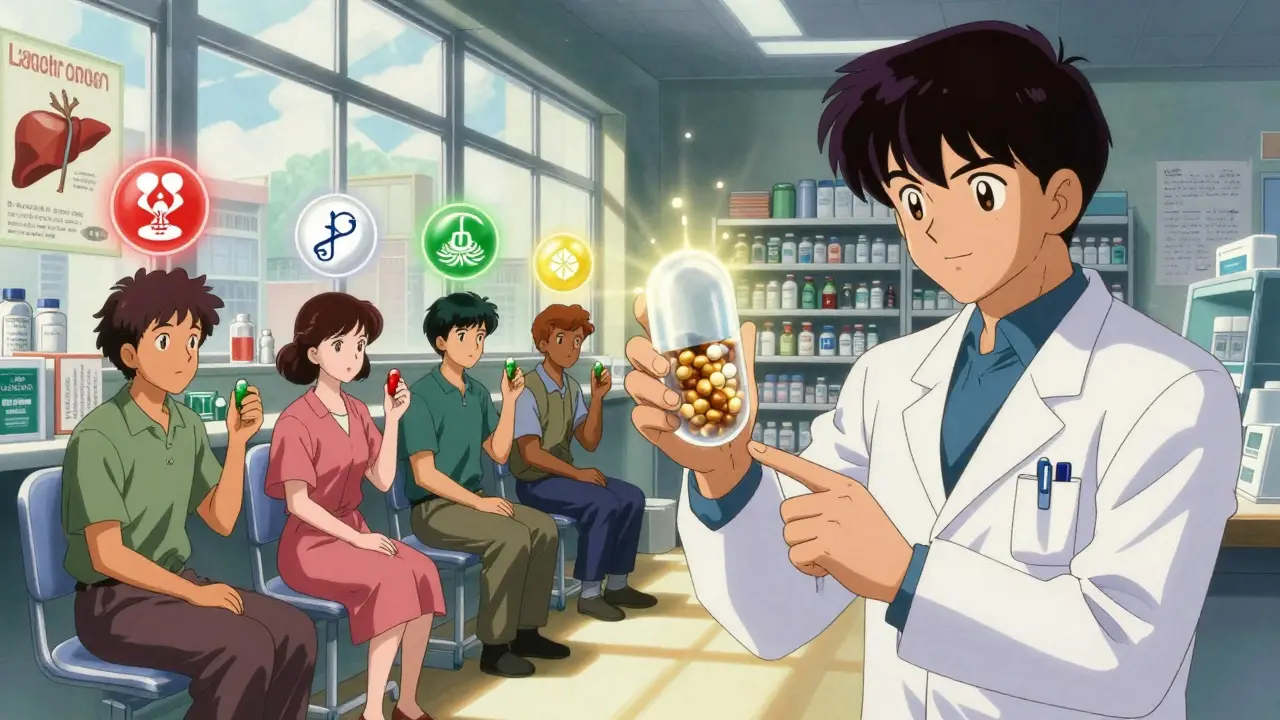
When a patient picks up a generic pill, they don’t just see a cheaper version of a brand-name drug. They see a color, a shape, a size - and sometimes, a hidden ingredient that goes against their beliefs. For many people around the world, the difference between a branded pill and its generic twin isn’t just about price. It’s about trust, identity, and faith.
Why a Generic Pill Might Not Be Accepted
Generic medications make up 70% of all medicines sold in Europe by volume, according to IQVIA’s 2024 report. In the U.S., they’re the default choice for most prescriptions. But that doesn’t mean everyone takes them. In fact, 28% of African American patients say they believe generics are less effective than brand-name drugs, compared to just 15% of non-Hispanic White patients, based on a 2022 FDA survey. Why? It’s not just about misinformation. It’s about culture. In some communities, the physical appearance of a pill matters deeply. A red capsule might be seen as powerful. A white tablet might feel sterile or weak. In parts of Asia and Latin America, certain colors are tied to healing traditions - green for balance, gold for vitality. When a generic version changes the color or shape from what a patient is used to, they may think it’s a different drug entirely. One pharmacist in Chicago told a 2023 study: “I had a patient refuse her blood pressure pill because it was oval instead of round. She said her mother always took the round one - and she lived to 92.” Then there’s what’s inside. Generic drugs contain the same active ingredient as their brand-name counterparts, but the fillers - the excipients - can vary. Gelatin capsules, for example, are common. But for Muslims, gelatin made from pork is forbidden. For Jews following kosher laws, animal-derived ingredients must be certified. One pharmacist recalled spending two hours calling manufacturers just to find a liquid version of a cholesterol medication because the capsule contained non-halal gelatin. “I didn’t want her to stop taking it,” he said. “But I couldn’t give her something that broke her faith.”The Hidden Ingredients That Matter
Excipients - the inactive ingredients like dyes, binders, and preservatives - are rarely discussed in patient education. But for people from certain cultural or religious backgrounds, they’re everything. A 2023 study in the Journal of Community Pharmacy found that 63% of pharmacists in urban U.S. clinics receive at least one question per week about whether a medication contains pork, alcohol, or animal products. Take diabetes medications. Many patients from South Asian communities prefer sugar-free formulations because of cultural beliefs around purity and bodily health. But generic versions often use sucrose as a filler. A patient might not know the difference - and might simply stop taking the pill. The same goes for alcohol-based liquid suspensions, which are common in pediatric generics. In conservative Muslim or Orthodox Jewish households, even trace amounts of ethanol can be unacceptable. And it’s not just religion. Some African and Caribbean communities avoid medications with artificial dyes because of historical mistrust. In the 1970s, experimental drugs were tested without consent on Black communities in the U.S. That trauma still echoes. When a patient sees a bright blue tablet with no clear labeling, they may assume it’s “experimental” or “unsafe.”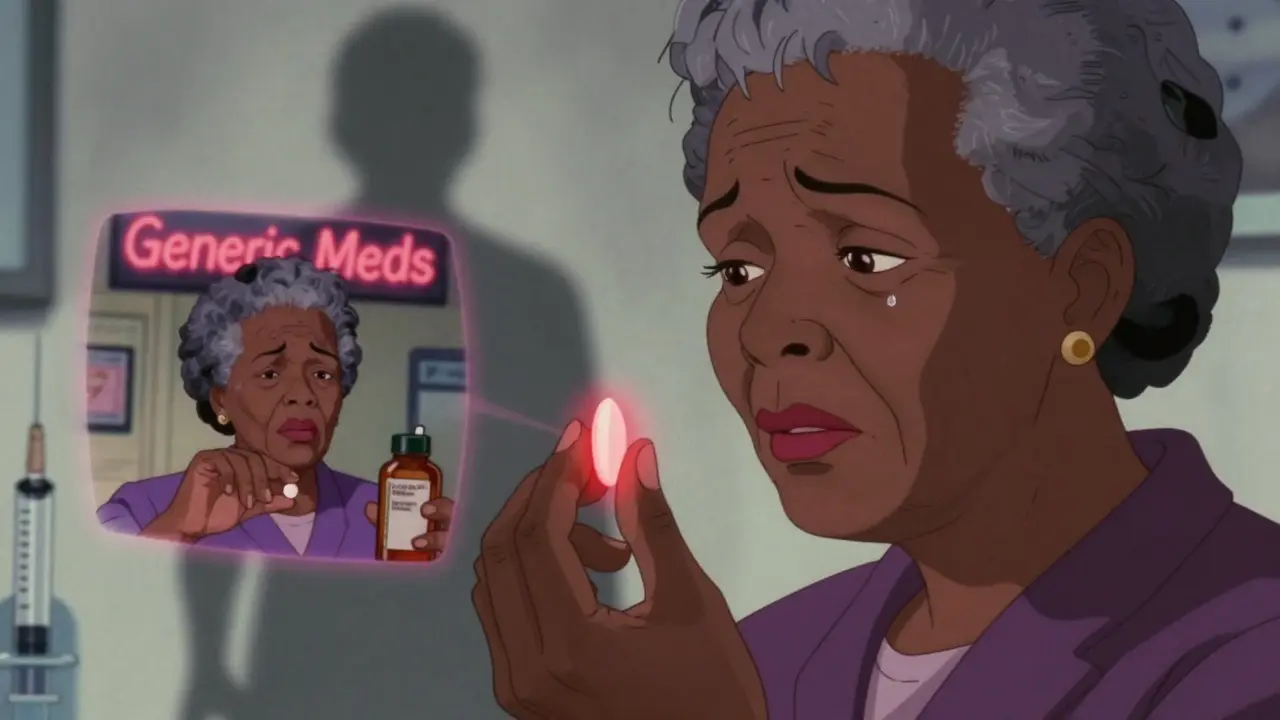
Language, Labels, and Trust
Many generic packages come with instructions printed only in English. For patients who speak Spanish, Mandarin, Arabic, or Somali, that’s a barrier. A 2022 study from the National Institutes of Health found that limited English proficiency was linked to 37% higher rates of non-adherence to generic medications. Even when translated, the language used can feel clinical or cold. Phrases like “inactive ingredients” or “excipients” mean nothing to someone who’s never studied pharmacology. One pharmacy chain in New York started using simple pictograms on their generic labels: a heart for cardiovascular meds, a liver for liver drugs, a hand holding a pill for oral use. They paired it with short audio clips in six languages. Within six months, refill rates for generics rose 22% in their Latino and Arabic-speaking patient groups. Trust matters more than dosage. If a patient doesn’t believe the pharmacist understands their values, they won’t believe the medicine works. That’s why cultural competence isn’t about translation - it’s about connection.What’s Being Done - and What’s Not
Some companies are starting to act. Teva Pharmaceutical launched a “Cultural Formulation Initiative” in 2023 to document all excipients in their 150+ generic products. By late 2024, they plan to label every capsule with clear indicators: “Halal-certified,” “Kosher,” “Alcohol-free,” “No animal derivatives.” Sandoz, the Novartis spin-off, announced a global framework in early 2024 to standardize cultural labeling across all their generics. But progress is uneven. Only 37% of generic drug labels in the U.S. list excipients in detail - compared to 68% in the EU, where regulations are stricter. And only 22% of U.S. community pharmacies have staff trained to answer cultural questions about medications, according to the American Pharmacists Association. Most pharmacies still rely on pharmacists remembering what’s in each generic - a system that breaks down when 50 new generics hit the market every year. One pharmacist in Detroit said: “I’ve got 300 prescriptions a day. I can’t memorize whether this generic has gelatin or not. I need a database. I need labels. I need help.”
How to Improve Care - Right Now
You don’t need a major policy change to start making a difference. Here’s what works:- Ask. Don’t assume. Ask patients: “Have you taken this medicine before? Was there anything about it you didn’t like?”
- Check the label. If you’re unsure about excipients, look up the manufacturer’s website. Some now list halal/kosher status.
- Use alternatives. If a capsule has pork gelatin, ask if a tablet or liquid version is available. Many generics come in multiple forms.
- Train your team. Even 30 minutes of cultural awareness training - covering religious restrictions, color meanings, and trust-building language - improves adherence.
- Partner with community leaders. Mosques, churches, and cultural centers can help spread accurate information about generics. One clinic in Minneapolis partnered with Somali imams to host monthly Q&A sessions. Refill rates for generics jumped 40% in six months.
The Bigger Picture
This isn’t just about pills. It’s about dignity. When a patient feels respected - when their beliefs are seen as valid, not inconvenient - they’re more likely to stick with treatment. That’s especially true for chronic conditions like hypertension, diabetes, and asthma, where adherence makes the difference between life and hospitalization. The U.S. alone has $12.4 billion in unmet pharmaceutical needs among minority populations, according to market analysts. Most of it comes down to one thing: people not taking their meds. And the reason? Not cost. Not availability. Culture. The companies that win in the next decade won’t be the ones with the cheapest generics. They’ll be the ones who understand that a pill isn’t just chemistry. It’s a symbol. And symbols matter.Why do some patients refuse generic medications?
Patients may refuse generics because of differences in color, shape, or size compared to the branded version they’re used to. Some believe these changes mean the drug is weaker or less effective. Others refuse due to inactive ingredients like pork-derived gelatin or alcohol, which conflict with religious or cultural beliefs. Historical mistrust in the healthcare system, especially among Black and Hispanic communities, also plays a role.
What are excipients, and why do they matter in generics?
Excipients are inactive ingredients in medications - things like gelatin, dyes, preservatives, and fillers. While generics contain the same active drug as brand-name versions, their excipients can differ. For some patients, these ingredients violate religious rules (e.g., pork gelatin in halal or kosher diets) or cultural beliefs about purity. Without clear labeling, patients may unknowingly take a medication they cannot accept.
Are there generic medications that are halal or kosher-certified?
Yes - but they’re rare. A few manufacturers, including Teva and Sandoz, are starting to label generics as halal or kosher-certified. These versions use plant-based capsules, alcohol-free liquids, and synthetic dyes. However, most generics still don’t carry this labeling. Patients often need to ask pharmacists or check manufacturer websites directly to find suitable options.
How can pharmacists better support culturally diverse patients?
Pharmacists can improve care by asking patients about cultural or religious concerns, using visual aids or translated labels, and keeping a list of alternatives for common medications. Training on religious dietary restrictions (like halal, kosher, vegan) and color symbolism in different cultures helps. Some pharmacies now use digital databases that flag excipient concerns - reducing search time from hours to seconds.
Is there a difference in generic adherence between racial groups?
Yes. According to a 2022 FDA survey, 28% of African American patients expressed concerns about generic effectiveness, compared to 15% of non-Hispanic White patients. Hispanic patients also report higher rates of mistrust. These gaps are linked to historical medical discrimination, language barriers, and lack of culturally tailored education - not to the actual quality of the medication.
What’s being done to fix these issues?
Major generic manufacturers like Teva and Sandoz are now documenting excipient details and labeling products as halal, kosher, or alcohol-free. The FDA and EU regulators are pushing for clearer labeling. The 2022 Food and Drug Omnibus Reform Act (FDORA) also requires better inclusion of diverse populations in clinical trials and patient education. Still, only 22% of U.S. pharmacies have formal training programs for cultural competence in generics.

Comments (9)
Mike Hammer February 15 2026
Been a pharmacist for 15 years. Saw a guy in Detroit refuse his diabetes med because the pill was green. He said his uncle in Punjab took white ones and lived to 97. We had to special-order a different batch. Turns out the dye was plant-based. But he didn’t care. To him, color = trust. We’re not just dispensing pills. We’re dispensing peace of mind.
And yeah, I’ve had to call 3 manufacturers just to find a gelatin-free version of a statin. No one talks about this. But it’s happening every damn day.
Josiah Demara February 17 2026
This whole post is a masterclass in overthinking. 70% of prescriptions in Europe are generic. That’s because they work. The same active ingredient. Same bioequivalence. The rest is superstition dressed up as culture. You don’t get to rewrite pharmacology because someone’s grandma took a blue pill in 1962. If you’re refusing meds based on color or gelatin, you’re not being culturally aware-you’re being dangerously irrational. There’s a reason we have FDA standards. They exist to prevent nonsense like this.
Sarah Barrett February 17 2026
The way this article frames cultural beliefs as ‘barriers’ feels... off. These aren’t barriers. They’re boundaries. And boundaries deserve respect, not a checklist of ‘how to fix them.’
I’ve sat with Somali elders who refused insulin because the liquid had ethanol. Not because they didn’t understand science. Because their faith says life must be lived with integrity-even in medicine. We didn’t ‘solve’ it. We found a syrup without alcohol. Took two weeks. Worth every minute.
It’s not about making pills fit culture. It’s about making culture fit the pill. And that starts with listening, not lecturing.
Charlotte Dacre February 17 2026
Oh wow. So now we’re treating medication like a cultural artifact? Next they’ll want the pill to come in a sacred shape. Maybe a little incense with the prescription? I mean, if we start catering to every symbolic preference, we’ll need a whole new FDA department: The Bureau of Pill Aesthetics. At this rate, the only ‘effective’ drug will be the one that looks like a Hindu deity holding a tiny umbrella.
Kaye Alcaraz February 19 2026
Every single point here is vital. Every single one.
Patients aren’t noncompliant. They’re unheard.
Pharmacists aren’t failing. They’re overwhelmed.
And systems aren’t broken. They’re just blind.
We need mandatory cultural competency training. Not as a checkbox. As a core skill. Like calculating dosages. Like reading lab results.
It’s not extra work. It’s the work.
Mandeep Singh February 20 2026
Let me tell you something from India-where we’ve been managing polypharmacy for centuries. In rural Punjab, patients refuse pills that look like they came from a ‘Western lab.’ They want the red capsule because their grandfather took it for hypertension and lived till 94. They don’t care about bioequivalence studies. They care about lineage. And you know what? That’s not irrational. That’s ancestral wisdom. We’ve been doing this long before FDA guidelines existed. Why do we keep treating their intuition like an error? Why not let them choose the formulation that feels right? Science doesn’t have a monopoly on healing.
And don’t even get me started on gelatin. In India, 40% of the population avoids animal products for spiritual reasons. We’ve been making vegetarian capsules since the 1980s. Why aren’t we exporting that model? Because profit > principle. And that’s the real crisis here.
Betty Kirby February 21 2026
So let me get this straight. We’re supposed to redesign the entire pharmaceutical supply chain because some people think color affects efficacy? This isn’t healthcare. It’s performance art. And now we’re expected to carry 20 versions of the same drug because one group doesn’t like the shade of blue? What’s next? Sugar-free insulin for people who believe glucose is ‘impure’? This is how systems collapse. When you prioritize symbolism over science, you don’t heal people-you infantilize them.
Erica Banatao Darilag February 23 2026
i read this and just... cried. not because im emotional. but because i saw my mom in every paragraph. she refused her blood pressure med for 8 months because it was oval. she said the round one was ‘her pill’-the one her sister took before she passed. we finally got a different brand that matched. she took it the same day. no explanation. no lecture. just... recognition.
medicine shouldnt have to be a battle just to feel seen.
Daniel Dover February 23 2026
Simple. Ask. Listen. Adapt. Done.