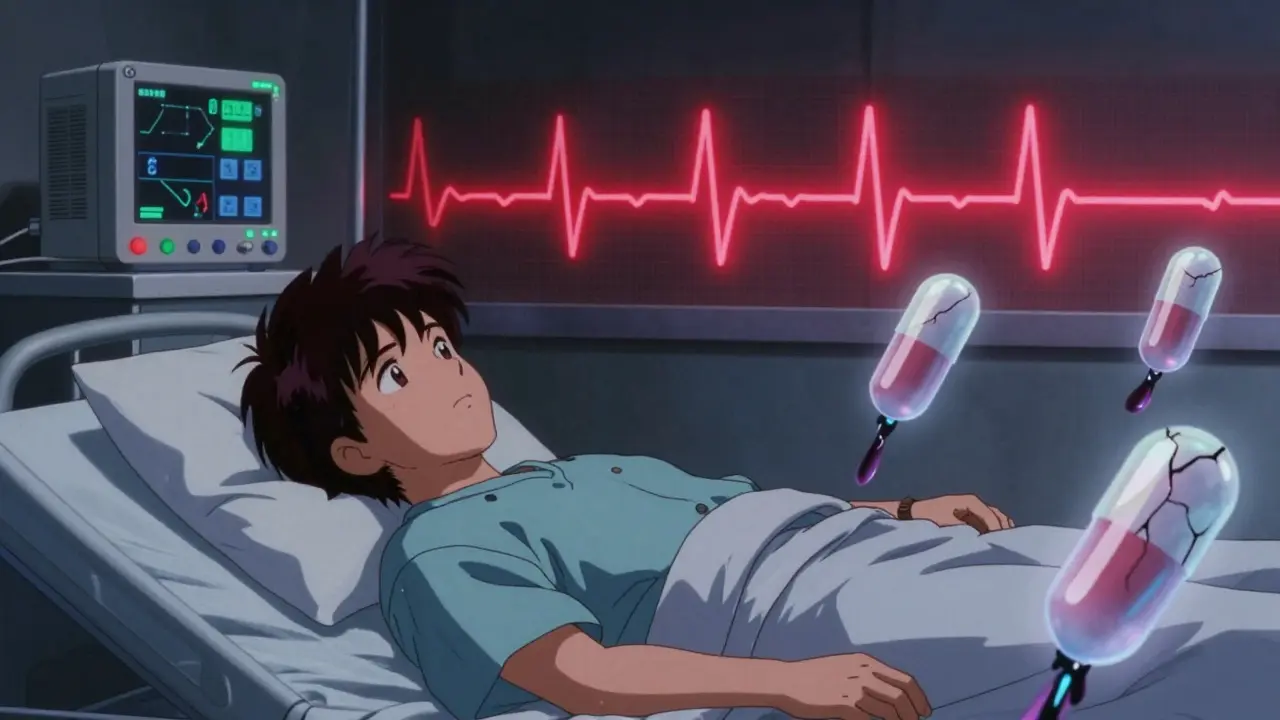
When you're nauseous and vomiting, the last thing you want is another problem. But some of the most common antiemetics - the drugs meant to stop nausea - can quietly mess with your heart rhythm and leave you so drowsy you can't stand up. This isn't theoretical. People have died from this. And it's happening more often than you think.
What antiemetics actually do - and what they can break
Antiemetics work by blocking signals in your brain that trigger nausea. Some target serotonin receptors, others block dopamine. But here's the catch: many of these same receptors are also found in your heart. When you block them there, you can slow down the electrical reset between heartbeats. That’s called QT prolongation.The QT interval on an ECG measures how long it takes your heart’s ventricles to recharge after each beat. If it gets too long, your heart can slip into a dangerous rhythm called torsades de pointes. It’s rare, but when it happens, it’s often fatal. And several antiemetics are known to trigger it.
The biggest offender? ondansetron. At doses over 8 mg IV, it consistently lengthens the QT interval. Studies show it can push the interval up by 17-20 milliseconds - enough to raise concern, especially if you’re already on other heart-affecting drugs. One 2005 study with 85 post-surgery patients found ondansetron caused the longest QT prolongation compared to other antiemetics. That’s why emergency departments are now rethinking its use in older patients or those with heart conditions.
But it’s not just ondansetron. droperidol used to be pulled from the market because of QT risks. Now we know the danger is much lower at antiemetic doses (under 4 mg). Still, it’s on the list. So is haloperidol - though at the usual 1 mg dose, the risk is minimal. Metoclopramide and domperidone also carry warnings, especially in older adults or those with kidney problems.
Here’s the twist: palonosetron doesn’t do this at all. It’s newer, lasts longer (up to 40 hours), and works better than ondansetron in preventing nausea after chemo or surgery. And crucially, it doesn’t touch your QT interval. That makes it the safest choice if you’re already on heart meds, have low potassium, or have a history of arrhythmias.
Drowsiness isn’t just annoying - it’s dangerous
You might think drowsiness is just a side effect you can live with. But in older patients, or those recovering from surgery, it can lead to falls, confusion, or even aspiration. And not all antiemetics are equal here.Promethazine is a classic sedative. It knocks you out. That’s why it’s often used in night-time nausea, but it’s a bad fit for someone who needs to stay alert. Prochlorperazine, on the other hand, has low sedation risk - a rare win among dopamine blockers.
Olanzapine, originally an antipsychotic, is now used off-label for nausea. It’s not as strong as ondansetron, but it’s much gentler on the heart and doesn’t cause much drowsiness. That’s why it’s gaining ground in palliative care - patients stay clearer-headed.
And then there’s dimenhydrinate and meclizine - the old-school motion sickness pills. They’re not as powerful for chemo or post-op nausea, but they’re safe for the heart and cause moderate drowsiness. Sometimes, the lesser option is the smarter one.

It’s not the drug - it’s the combo
Here’s what most doctors miss: it’s rarely one drug that causes trouble. It’s the stack.A 2022 review found that 91% of serious QT prolongation cases involved patients taking two or more drugs that affect the heart’s rhythm. That’s why giving ondansetron IV to someone already on an antibiotic like moxifloxacin or an antidepressant like citalopram is a recipe for disaster.
IV administration makes things worse. Oral ondansetron rarely causes QT issues. But when you inject it, the drug hits your system fast and hard. That’s why hospitals are moving away from routine IV ondansetron unless absolutely necessary.
And don’t forget electrolytes. Low potassium or magnesium? That’s like pouring gasoline on a fire. Even a mild QT effect from an antiemetic can turn deadly if your body’s mineral levels are off. Always check potassium before giving high-risk antiemetics.
What to use instead
If you’re worried about QT prolongation or drowsiness, here’s your practical guide:- Best for QT safety: Palonosetron - no QT effect, longer lasting, more effective than ondansetron.
- Best for low drowsiness: Prochlorperazine, olanzapine - minimal sedation, good efficacy.
- Safe for older adults: Domperidone - low QT risk at standard doses, but avoid in severe liver disease.
- Alternative for mild nausea: Meclizine, dimenhydrinate - safe heart profile, moderate sedation.
- Avoid if possible: IV ondansetron >8 mg, promethazine, metoclopramide - high risk for both QT and drowsiness.
For patients with cancer or after major surgery, palonosetron is becoming the new standard. It costs more, but you’re not just saving money - you’re avoiding ICU admissions.
When to check an ECG
You don’t need to check an ECG for every patient. But you should if:- The patient is over 65
- They’re on other QT-prolonging drugs (antibiotics, antidepressants, antifungals)
- They have heart disease, kidney failure, or low potassium
- You’re giving IV ondansetron at 8 mg or higher
- They’ve had a previous arrhythmia
Baseline ECG before treatment, then one after if symptoms develop - that’s all it takes. You don’t need a cardiologist. Just a machine and a minute.
Bottom line: Safety isn’t about avoiding drugs - it’s about choosing the right one
Antiemetics save lives. But they can also end them if you don’t think about the heart and the brain together. Ondansetron isn’t evil. Droperidol isn’t a monster. But using them blindly? That’s the problem.The answer isn’t to stop using them. It’s to match the drug to the patient. Use palonosetron for high-risk cases. Use prochlorperazine if drowsiness matters. Skip IV ondansetron unless you have to. And always, always check for drug interactions and electrolytes.
This isn’t about fear. It’s about awareness. The data is clear. The risks are real. And the safer alternatives exist.
Which antiemetic has the highest risk of QT prolongation?
Ondansetron, especially when given intravenously at doses above 8 mg, has the highest documented risk of QT prolongation among commonly used antiemetics. Studies show it can extend the QT interval by 17-20 milliseconds on average. While this doesn’t always lead to arrhythmia, the risk spikes in patients with heart conditions, low potassium, or those taking other QT-prolonging drugs.
Is droperidol still dangerous for the heart?
At antiemetic doses (under 4 mg), droperidol carries minimal risk of QT prolongation. Early concerns led to a black box warning, but large studies like DORM-1 and DORM-2 showed no increased rate of torsades de pointes compared to placebo or midazolam. The risk is far lower than once believed, but caution is still advised in patients with existing heart rhythm problems or electrolyte imbalances.
Can I use ondansetron safely if I have a normal heart?
Yes - if you’re young, healthy, have normal electrolytes, and aren’t on other heart-affecting medications, the risk of QT prolongation from oral ondansetron is very low. Even IV ondansetron at standard doses (4-8 mg) is often safe in healthy patients. But if you’re over 65, have kidney disease, or are on statins, antidepressants, or antibiotics like azithromycin, the risk rises significantly. Always check your meds before giving ondansetron.
What’s the best antiemetic for elderly patients?
Palonosetron is the top choice for elderly patients because it doesn’t prolong the QT interval and has a long duration of action. If palonosetron isn’t available, prochlorperazine or olanzapine are good alternatives - they cause less sedation than promethazine and carry lower cardiac risk than metoclopramide or ondansetron. Avoid domperidone in patients with liver impairment, and never use IV ondansetron without checking electrolytes first.
Why is IV ondansetron riskier than oral?
IV ondansetron delivers the full dose instantly into your bloodstream, causing a rapid spike in drug concentration. This overwhelms the heart’s potassium channels all at once, increasing the chance of QT prolongation. Oral ondansetron is absorbed slowly, giving the body time to adjust. That’s why oral doses rarely cause issues, while IV doses - especially above 8 mg - are linked to most reported cases of torsades de pointes.

Comments (12)
Andrew Freeman January 14 2026
ondansetron is fine if you dont have a heart condition stop scaremongeringJason Yan January 15 2026
This is one of those posts that makes you realize medicine isn't about following protocols but about seeing the person. We treat labs and symptoms but forget the whole body is talking. QT prolongation isn't just a number on a screen-it's a silent alarm. And drowsiness? That's not just 'oh they're sleepy'-it's someone falling in the bathroom because they took something that was supposed to help them feel better. The real win here isn't just palonosetron-it's thinking before you prescribe. Slowing down to see the connections between the heart, the brain, the kidneys, the meds stacked like Jenga blocks. That's the art.shiv singh January 16 2026
you doctors are just trying to sell more expensive drugs. ondansetron has been used for decades and people are fine. now you want to switch to palonosetron because it costs 10x more and your hospital wants to profit. stop pretending this is about safety its about moneyRobert Way January 18 2026
i had ondansetron after my surgery and i was fine but i also had like 3 other meds and i think one was for anxiety maybe? anyway i didnt know about the qt thing until now and now im scared to take anything ever againSarah Triphahn January 20 2026
wow another post pretending to be medical advice but really just fear porn. you say 'people have died' but you dont say how many. out of how many millions? this is why people distrust medicine. you take one rare case and turn it into a crisis. also olanzapine? really? that's an antipsychotic. you want to give people antipsychotics for nausea? next you'll be prescribing lithium for headachesVicky Zhang January 21 2026
I just want to say thank you for writing this. I’m a nurse and I’ve seen so many elderly patients fall because they were given promethazine for nausea and then passed out standing up. It’s heartbreaking. And I’ve had to explain to families why we switched from ondansetron to palonosetron after their mom had a weird heart flutter. This isn’t hype. This is real life. The fact that we have safer options and still default to the old ones? That’s the problem. You’re not just treating nausea-you’re protecting someone’s life. Please keep sharing this. We need more voices like yours.Allison Deming January 23 2026
The normalization of pharmacological risk without adequate patient education is a systemic failure. While the data presented is accurate and well-sourced, the underlying issue is not drug selection but the erosion of clinical judgment in favor of protocol-driven care. The fact that IV ondansetron is routinely administered without baseline electrolyte checks or ECG review speaks to a culture that prioritizes speed over safety. This is not an isolated incident-it is emblematic of modern healthcare’s commodification of care. We must return to the principle of primum non nocere, not merely as a motto, but as a mandatory practice.Susie Deer January 24 2026
this is why america is dying. we got better cheaper drugs and now we got all these fancy expensive ones because doctors got scared of lawsuits. in my country we just give the old stuff and people live just fineTooAfraid ToSay January 24 2026
you know what's worse than QT prolongation? the fact that half the people reading this will ignore it because they think 'i'm young and healthy' and then end up in the ER because they took ondansetron with their zpack and their antidepressant and now their heart is doing the cha-cha. this isn't fearmongering. this is the truth wrapped in a hospital gownDylan Livingston January 25 2026
How quaint. A medical post that assumes patients are rational actors who care about pharmacokinetics. Let me guess-you also believe people read consent forms and understand drug interactions. The average person doesn’t know what a QT interval is. They know 'it made me feel better' or 'it made me pass out.' This is why we need regulation, not education. If the drug is dangerous in combination, ban the combinations. Don’t burden patients with the cognitive load of being their own pharmacists while they’re vomiting in a hospital bed.says haze January 25 2026
The irony is that we’ve created a system where the safest option-palonosetron-is also the most expensive, which means it’s often inaccessible to the very populations most at risk: elderly, underinsured, and marginalized. This isn’t a clinical dilemma. It’s a moral one. We have the knowledge. We have the tools. But we don’t have the political will to make safe care equitable. So we give patients a choice between risk and poverty. That’s not medicine. That’s a market failure dressed in a white coat.Alvin Bregman January 26 2026
i read this whole thing and i think the main point is dont give iv ondansetron to old people or people on lots of meds and check their potassium thats it really. everything else is just details. also palonosetron sounds good if you can get it