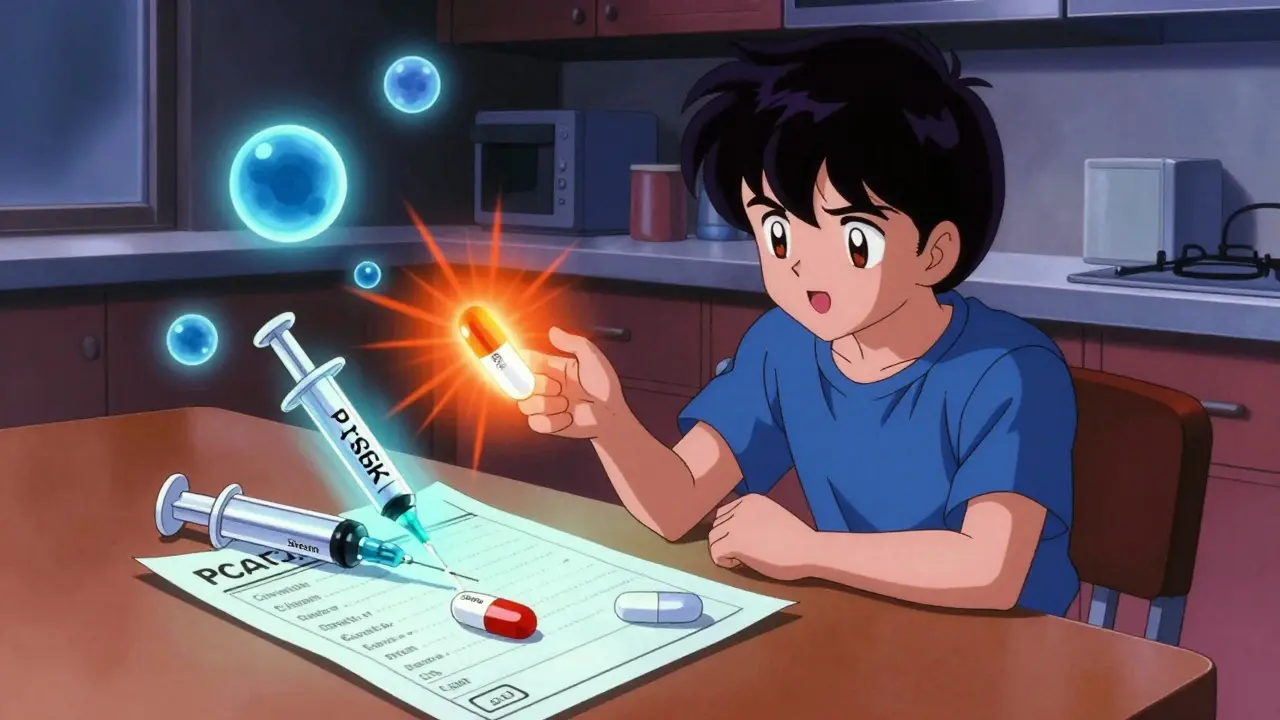
When it comes to lowering LDL cholesterol, two drug classes dominate the conversation: statins and PCSK9 inhibitors. Both work to reduce heart attack and stroke risk, but they’re as different as a daily pill and a monthly injection. If you’ve been told your cholesterol is too high and your doctor is weighing options, you’re not alone. Millions of people face this choice every year - and the decision isn’t just about numbers on a lab report. It’s about how you feel, how much you can afford, and what your body can handle.
How Statins Work - and Why So Many People Take Them
Statins have been the go-to treatment for high cholesterol since the late 1980s. They work by blocking an enzyme in your liver called HMG-CoA reductase, which is responsible for making cholesterol. Less production means your liver pulls more LDL - the "bad" cholesterol - out of your blood. It’s simple, effective, and cheap. Most statins are taken once a day, often at night. Generic versions like atorvastatin and simvastatin cost as little as $4 to $10 a month in the U.S. That’s why over 40 million Americans are on them. They’ve been studied for over 30 years. Long-term data shows they reduce heart attacks by about 25% and strokes by 15-20% in people with existing heart disease. But they’re not perfect. About 5 to 10% of people report muscle pain, weakness, or cramps - a condition called statin-associated myopathy. Some report brain fog or trouble sleeping. These aren’t just anecdotal. On Drugs.com, 32% of negative reviews mention persistent muscle pain, and 18% mention memory issues. For many, these side effects are mild and manageable. For others, they’re enough to stop taking the drug entirely.PCSK9 Inhibitors: A Different Approach
PCSK9 inhibitors - like alirocumab and evolocumab - work completely differently. Instead of stopping your liver from making cholesterol, they help your liver clean up more of it from your blood. They block a protein called PCSK9, which normally destroys LDL receptors. With fewer of these receptors destroyed, your liver can pull out more LDL. The result? A 50 to 61% drop in LDL cholesterol, on average. These drugs are injected under the skin, either every two weeks or once a month. You can’t swallow them. They’re not absorbed through the gut like statins. Instead, they circulate in your bloodstream for weeks at a time. That’s why they last so long - and why they don’t interact with liver enzymes like statins do. That also means fewer drug interactions. They were approved by the FDA in 2015. At first, they were expensive - up to $14,000 a year. But prices have dropped, and insurance coverage has improved. Still, most insurers require proof that you’ve tried and failed on statins before approving them. That’s because statins are cheaper and have decades of safety data.Side Effects: What You Really Need to Know
Statins and PCSK9 inhibitors have very different side effect profiles. Statins can cause:- Muscle pain or weakness (5-10% of users)
- Increased blood sugar levels (slight risk of new-onset diabetes)
- Liver enzyme changes (rarely serious)
- Higher risk of hemorrhagic stroke in people with prior stroke history (22% increased risk, per UCLA research)
- Don’t cause muscle pain
- Don’t raise blood sugar
- Don’t affect liver enzymes
- Don’t increase stroke risk

Outcomes: Do They Actually Save Lives?
Both drugs reduce heart attacks and strokes - but PCSK9 inhibitors do it more aggressively. The FOURIER trial (evolocumab) and ODYSSEY trial (alirocumab) showed that adding a PCSK9 inhibitor to a statin reduced major cardiovascular events by 15-20% over two years in high-risk patients. That’s significant. But here’s the catch: those trials were done on people who were already on high-dose statins. So the benefit is extra protection on top of statins, not a replacement. In patients with familial hypercholesterolemia - a genetic condition that causes extremely high LDL from birth - PCSK9 inhibitors are life-changing. One patient in the FH Foundation registry dropped from an LDL of 286 mg/dL on high-dose rosuvastatin to 58 mg/dL after adding alirocumab. That’s a 79% drop. No statin alone could have done that. For people without genetic disorders, the benefit is smaller. If your LDL is already under 70 mg/dL on a statin, adding a PCSK9 inhibitor might not be worth it. But if you’re at very high risk - say, you’ve had a heart attack, have diabetes, or have blocked arteries - and your LDL is still above 70, then yes, the extra drop matters.Cost and Access: The Real-World Hurdle
This is where things get messy. A month of generic atorvastatin? $5. A month of evolocumab? $400 to $1,200 before insurance. Even with insurance, copays can hit $300 a month. Many patients report spending months fighting insurers for approval. Eighty-seven percent of U.S. insurers require documentation of statin intolerance or failure to reach LDL targets before covering PCSK9 inhibitors. Manufacturers help. Amgen and Sanofi offer patient support programs with free injections, insurance navigation, and even home delivery. Ninety-two percent of users say these programs made a difference. But if you’re uninsured or underinsured, PCSK9 inhibitors are out of reach. Statins win on cost. Every time.
Who Should Use What?
There’s no one-size-fits-all answer. But here’s a practical guide:- Start with statins if you’re newly diagnosed, have moderate risk, and no muscle pain.
- Switch to PCSK9 inhibitors if you can’t tolerate statins, have familial hypercholesterolemia, or your LDL stays above 70 mg/dL despite max statin therapy.
- Consider combination therapy if you’ve had a heart attack, have diabetes plus heart disease, and your LDL is still high - even on high-dose statins.
- Avoid PCSK9 inhibitors if you can’t afford them, hate needles, or your risk is low and your LDL is under control.

Comments (8)
Madhav Malhotra January 11 2026
Just had my first PCSK9 shot last month after statins wrecked my quads. The injection sting? Yeah, it’s a vibe. But no more waking up feeling like I ran a marathon in my sleep. Also, my mom in Delhi just started one too - she’s 68, diabetic, and now her LDL is under 50. Who knew needles could feel like freedom? 🙌
Sean Feng January 13 2026
Statins work fine for most people. Stop making this a drama. If you can’t handle a $5 pill then maybe you’re not ready for adulting.
Priscilla Kraft January 14 2026
Hey Sean - I get where you’re coming from, but for people with statin myopathy, this isn’t about laziness. It’s about being able to walk to the mailbox without crying. I’m a nurse and I’ve seen patients cry because they couldn’t lift their arms. PCSK9 isn’t a luxury - it’s a lifeline for them. 💙
Vincent Clarizio January 16 2026
Let’s be real - we’re living in a pharmacological dystopia where a drug that reduces cardiovascular mortality by 20% is treated like a luxury good because Big Pharma decided to price-gouge on biologics while the FDA rubber-stamped it like it was a new flavor of Gatorade. Statins are the aspirin of the 21st century - cheap, ubiquitous, and taken for granted. But when you’re one of the 1 in 10 whose muscles turn to jelly after a week of atorvastatin, you’re not just ‘non-compliant’ - you’re a casualty of a system that values cost over consequence. And don’t even get me started on the insurance bureaucracy. It’s like trying to unlock a safe with a spoon while wearing oven mitts. We’re not talking about ‘preference’ here. We’re talking about biological betrayal. And the fact that we have a drug that can drop LDL by 60% and we’re still making people beg for it? That’s not healthcare. That’s performance art.
Christian Basel January 16 2026
Per the 2023 AHA/ACC guidelines, PCSK9i should be reserved for ASCVD risk enhancers with LDL-C ≥70 mg/dL on maximally tolerated statin therapy. The incremental benefit in primary prevention is marginal, and the cost-effectiveness threshold is not met in low-risk cohorts. The injection burden and adherence challenges further limit real-world utility. Statins remain first-line due to superior adherence metrics and long-term safety profile.
Alex Smith January 17 2026
So let me get this straight - you’re telling me we’ve got a drug that cuts LDL in half, doesn’t wreck your muscles, and doesn’t turn you into a diabetic, but you need a PhD in insurance appeals just to get it? And you call this ‘healthcare’? 🤡
Roshan Joy January 18 2026
My uncle in Mumbai had familial hypercholesterolemia. He was on 80mg rosuvastatin and still had LDL at 220. After switching to alirocumab, it dropped to 62. He says the only thing harder than the injection is explaining to his friends why he’s not on ‘that cholesterol pill’. But he’s alive. And he’s walking. That’s what matters. 🙏
Adewumi Gbotemi January 20 2026
Here in Nigeria, statins are hard to find and expensive. But if someone can get them, they should try. If they get pain, then maybe they ask doctor about other thing. Not all people have choice. But we still try.