PPI-Antifungal Interaction Checker
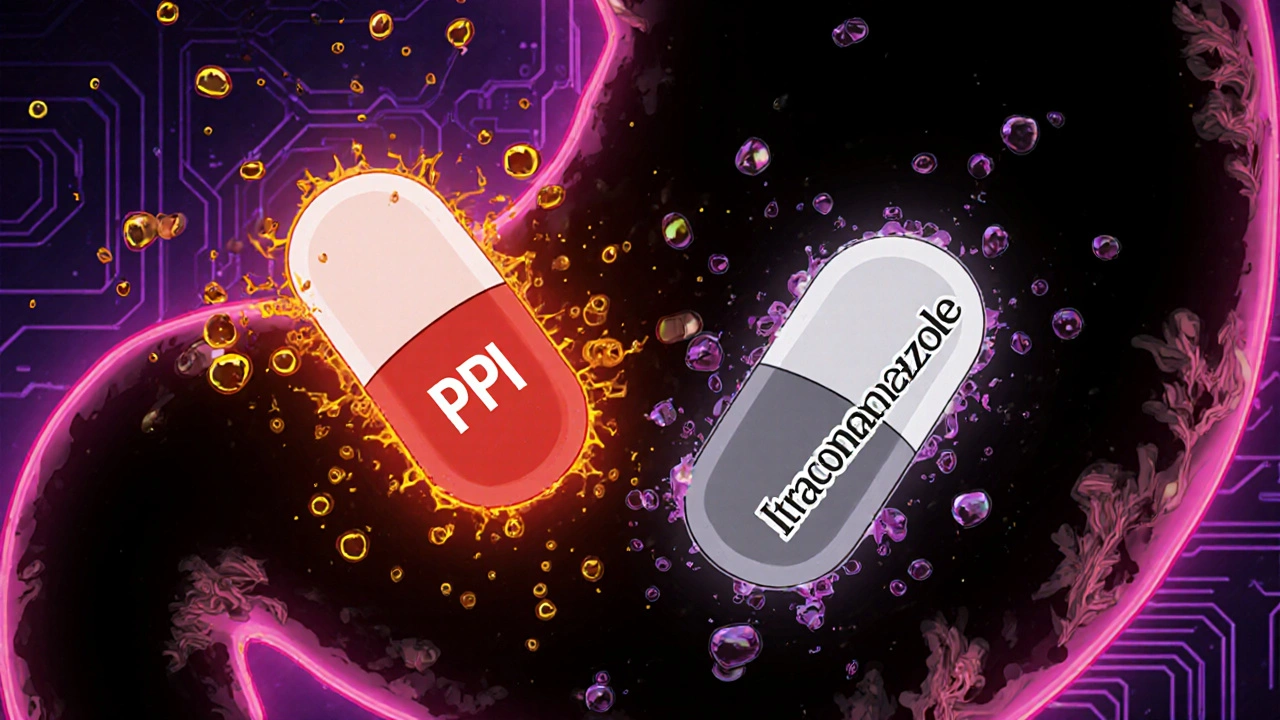
When you take a proton pump inhibitor (PPI) for heartburn and an antifungal for a stubborn yeast infection at the same time, you might think you’re just following your doctor’s orders. But what if those two pills are working against each other? It’s not just a theoretical concern-it’s happening in real patients, every day. And the consequences can be serious: treatment failure, longer hospital stays, and even life-threatening infections.
Why PPIs Disrupt Antifungal Absorption
Proton pump inhibitors like omeprazole, pantoprazole, and esomeprazole work by shutting down the acid-producing pumps in your stomach. That’s great if you have GERD. But it’s a problem for certain antifungals, especially ketoconazole and itraconazole. These drugs need a low pH-around 1.5 to 2.5-to dissolve properly. When a PPI raises your stomach pH to 4 or higher, these antifungals don’t break down. They just sit there, undissolved, and pass through your gut without being absorbed. A 2023 study in JAMA Network Open looked at 1,243 patients and found that when PPIs were taken with itraconazole, the total amount of drug absorbed dropped by 60%. That’s not a small drop. It’s enough to push blood levels below the minimum needed to kill fungi. For ketoconazole, the problem is even worse. At a stomach pH of 6.8, its solubility drops from 22 mg/mL to just 0.02 mg/mL. In plain terms: it becomes nearly insoluble. No dissolution means no absorption. No absorption means no treatment.Not All Antifungals Are Affected the Same Way
Here’s where things get interesting. Fluconazole doesn’t care about stomach acid. It’s highly water-soluble, even at neutral pH. Its bioavailability stays around 90% whether your stomach is acidic or not. That’s why fluconazole is often the go-to choice when a patient is already on a PPI. The FDA’s 2024 prescribing update confirms this: no dose adjustment is needed. Voriconazole sits in the middle. It doesn’t rely on stomach acid to get absorbed, so PPIs don’t block its uptake. But here’s the twist: PPIs interfere with how voriconazole is broken down in the liver. Both drugs are metabolized by the same liver enzymes-CYP2C19 and CYP3A4. When you take a PPI like pantoprazole, it competes with voriconazole for these enzymes. The result? Voriconazole builds up in your blood. A 2015 study showed voriconazole clearance drops by 25-35%. That means higher risk of side effects: hallucinations, vision changes, liver damage.The Paradox: PPIs Might Actually Help Fight Fungi
Here’s the part that flips everything on its head. A 2024 study in PMC10831725 discovered something unexpected. While PPIs reduce absorption of some antifungals, they might also directly weaken fungi. Researchers found that omeprazole-independent of its acid-blocking effect-blocks a key enzyme in fungal cells called plasma membrane ATPase (Pam1p). This enzyme helps fungi pump out toxins, including antifungal drugs. When PPIs inhibit Pam1p, the fungus can’t get rid of fluconazole as easily. The drug stays inside longer and works better. In lab tests, omeprazole cut the minimum dose of fluconazole needed to kill resistant Candida glabrata by 4 to 8 times. That’s not just a minor boost-it’s a game-changer. It suggests that in some cases, combining a PPI with fluconazole might actually improve outcomes, even if absorption is slightly reduced. This is why experts like Dr. Mahmoud Ghannoum say we’re standing at the edge of a new treatment strategy: using PPIs not just as acid reducers, but as antifungal enhancers.
What Doctors Do When Both Drugs Are Needed
In practice, most clinicians avoid the problem entirely. A 2023 survey of 217 infectious disease pharmacists found that 87% of them switch to echinocandins-like caspofungin-when a patient on a PPI needs antifungal treatment. Echinocandins work differently. They don’t need stomach acid to absorb. They’re given intravenously. No interaction risk. But sometimes, switching isn’t possible. Maybe the patient can’t get IV meds. Or the infection is in the lungs, where echinocandins don’t penetrate well. In those cases, timing matters. The University of California San Francisco recommends giving itraconazole at least two hours before the PPI. That gives the antifungal a chance to absorb before the stomach becomes too alkaline. Mayo Clinic suggests a 4-6 hour gap for ketoconazole. But even then, absorption still drops by 45%. It’s not a fix-it’s damage control. For voriconazole, the answer is monitoring. The Cleveland Clinic requires blood level checks within 72 hours of starting a PPI. If voriconazole levels are too high, the dose is cut by 25-50%. If too low, the PPI may need to be paused or switched to a different acid reducer.Regulatory Warnings and Real-World Mistakes
The FDA added a black box warning to itraconazole in June 2023: “Concomitant administration with proton pump inhibitors is contraindicated.” The European Medicines Agency followed suit. These aren’t gentle suggestions. They’re legal red flags. Yet, a 2024 audit by the Institute for Safe Medication Practices found that over 22% of itraconazole prescriptions in U.S. pharmacies were still being paired with PPIs. Why? Many prescribers don’t know. Others assume the interaction is minor. Some patients are on PPIs long-term for ulcers or chronic reflux and aren’t told to stop them. The cost of these errors is huge. A 2024 study in JAMA Internal Medicine estimated that inappropriate PPI-azole combinations cost the U.S. healthcare system $327 million a year. That’s from failed treatments, extended hospital stays, emergency visits, and unnecessary lab tests.
What’s Coming Next
Researchers aren’t waiting for doctors to get better at avoiding interactions. They’re redesigning the drugs. A new formulation of itraconazole-called SUBA-itraconazole-uses tiny particles that dissolve regardless of pH. A 2023 Phase I trial showed 92% bioavailability even with a PPI. That’s a breakthrough. The FDA is funding similar projects under its Antifungal Development Initiative. Meanwhile, a Phase II trial at Johns Hopkins (NCT05876543) is testing whether adding omeprazole to standard fluconazole can treat resistant fungal infections. Results are expected in late 2025. If it works, we might start seeing PPIs prescribed alongside antifungals-not despite the interaction, but because of it.What You Need to Know
If you’re on a PPI and prescribed an antifungal:- Ask: Which antifungal? Fluconazole? Safe. Itraconazole or ketoconazole? High risk.
- If it’s itraconazole or ketoconazole: Don’t take them with your PPI. Ask if you can switch to fluconazole or an echinocandin.
- If you must take both: Ask your pharmacist to time the doses. Itraconazole should come at least 2 hours before the PPI.
- If you’re on voriconazole: Make sure your blood levels are checked after starting the PPI.
- Never assume your doctor knows. Bring up the interaction yourself.
This isn’t about avoiding medication. It’s about using it right. The science is clear: some antifungals and PPIs don’t play nice. But the future might change that. Until then, awareness saves lives.
Can I take fluconazole with a proton pump inhibitor?
Yes, fluconazole can be safely taken with proton pump inhibitors. Unlike ketoconazole or itraconazole, fluconazole doesn’t require stomach acid to be absorbed. Its bioavailability remains high (90%±5%) regardless of gastric pH. The main concern with fluconazole and PPIs isn’t absorption-it’s liver enzyme interactions. Fluconazole can inhibit CYP2C9, which may affect blood thinners like warfarin. If you’re on warfarin, your doctor may need to lower your dose by 20-30%.
Why is itraconazole contraindicated with PPIs?
Itraconazole needs a highly acidic environment to dissolve and be absorbed. Proton pump inhibitors raise stomach pH to levels where itraconazole becomes almost insoluble. Studies show this cuts its absorption by up to 60%, leading to blood concentrations below the therapeutic threshold needed to fight fungal infections. The FDA issued a black box warning in 2023, stating that combining these drugs is contraindicated because it can lead to treatment failure and worsening infection.
What happens if I take ketoconazole with a PPI?
Taking ketoconazole with a PPI can cause your blood levels of ketoconazole to fall below the level needed to kill fungi. At a stomach pH above 5, ketoconazole’s solubility drops by over 99%. Even if you space the doses apart, studies show absorption still drops by 45%. This puts you at high risk for fungal infection relapse. Ketoconazole is rarely prescribed today due to liver toxicity, but if you are on it, PPIs should be avoided entirely.
Can PPIs make antifungals stronger?
Yes-under specific conditions. A 2024 study found that omeprazole, a PPI, can inhibit a fungal enzyme called Pam1p, which helps fungi expel antifungal drugs like fluconazole. This makes the fungus more vulnerable. In lab tests, omeprazole reduced the dose of fluconazole needed to kill resistant Candida by 4-8 times. This is being tested in clinical trials to see if combining PPIs with fluconazole can treat drug-resistant fungal infections. It’s not standard practice yet, but it’s a promising new direction.
Are there antifungals that don’t interact with PPIs?
Yes. Fluconazole and voriconazole don’t rely on stomach acid for absorption. However, voriconazole interacts with PPIs through liver enzymes, requiring blood level monitoring. The safest alternatives are echinocandins like caspofungin or micafungin. These are given intravenously and have no known absorption or metabolic interactions with PPIs. They’re often preferred in hospitalized patients who need antifungals and are on acid-reducing medications.

Comments (13)
Nicole M November 14 2025
I had no idea PPIs could wreck antifungals like this. My doctor prescribed me omeprazole for reflux and then ketoconazole for a fungal rash last year. I thought the rash was just stubborn. Turns out I was just wasting my time and money.
Never again. I’m asking about fluconazole next time.
Arpita Shukla November 15 2025
Actually, the mechanism is more nuanced. The solubility drop isn’t just about pH-it’s about the ionization state of the azole molecule. Ketoconazole’s pKa is around 4.2, so at pH >5, it’s mostly unionized and lipid-soluble, which paradoxically should help absorption-but no, it doesn’t, because the dissolution rate plummets. The real issue is kinetic, not thermodynamic.
Also, voriconazole’s CYP2C19 inhibition by PPIs is highly polymorphic. Poor metabolizers get toxic levels even without PPIs. So the interaction isn’t just additive-it’s multiplicative in certain genotypes.
Benjamin Stöffler November 16 2025
And yet… we persist. We live in a world where we optimize for convenience-pills in a cup, no thought, no timing, no awareness-and then wonder why medicine fails.
Science has given us precision tools, but human behavior? Still stuck in the Stone Age.
We don’t need more drugs-we need better habits. We need to stop treating our bodies like vending machines.
But who wants to read a 10-page pamphlet on drug interactions when you can just pop a pill and scroll TikTok?
It’s not the PPIs that are the problem.
It’s us.
Mark Rutkowski November 18 2025
This whole thing feels like a beautiful, tragic dance between chemistry and chaos.
Our bodies are these intricate ecosystems-and we’re the clumsy giants stomping around with a sledgehammer labeled ‘treatment.’
But then… there’s this flicker of hope: omeprazole turning from enemy to ally by messing with fungal pumps? That’s not just science.
That’s poetry.
Maybe the answer isn’t just avoiding interactions-but learning how to choreograph them.
Imagine a future where we don’t just prescribe drugs-but orchestrate their symphony.
That’s the kind of medicine I’d trust my life to.
Ryan Everhart November 18 2025
So let me get this straight-you’re telling me I’ve been taking omeprazole for 5 years, and now I’m supposed to stop it because I might get a yeast infection?
Meanwhile, my doctor still prescribes it for ‘heartburn’ even though I haven’t had symptoms since 2019.
And nobody told me any of this.
Wow. Just… wow.
David Barry November 19 2025
Let’s be real-the entire pharmaceutical industry is built on exploiting these gaps. PPIs are billion-dollar blockbusters. Azoles are generic. So who benefits from keeping the interaction hidden? Hint: not the patient.
And now they’re selling us ‘SUBA-itraconazole’ as a ‘breakthrough’? At 5x the price? Of course they are.
It’s not science. It’s capitalism with a lab coat.
Alyssa Lopez November 19 2025
OMG I JUST REALIZED I’M ON PPI + ITRACONAZOLE RIGHT NOW. MY DR. SAID IT WAS FINE BECAUSE I’M ‘NOT THAT SICK.’
WTF IS WRONG WITH THIS SYSTEM. I’M GONNA CALL THE FDA.
AND WHY ISNT THIS ON THE DRUG LABEL IN BIG RED LETTERS??
THEY’RE KILLING PEOPLE AND NOBODY CARES.
Alex Ramos November 21 2025
Just had a patient on voriconazole + pantoprazole come in with visual hallucinations. Blood level was 12.8 mcg/mL (normal: 1–5). We dropped the dose, held the PPI for 48h, and boom-back to normal.
Pro tip: Always check levels when combining. Don’t guess.
And if you’re on long-term PPI? Ask your pharmacist about alternatives like H2 blockers-they’re way less disruptive to azoles.
Also, fluconazole + PPI? Totally fine. No drama. 🙌
edgar popa November 21 2025
wait so fluconazole is safe with ppi? that’s a relief. i’ve been takin both for months and thought i was gonna die. phew.
Eve Miller November 23 2025
It is unconscionable that this interaction is not universally recognized by prescribers. The FDA black box warning exists for a reason, and yet, 22% of prescriptions still violate it. This is not negligence-it is malpractice. Patients deserve better. Physicians must be held accountable. Education is not optional. It is mandatory.
Gary Hattis November 24 2025
In India, we’ve been using fluconazole with PPIs for years-no issues. But I’ve also seen patients on ketoconazole in rural clinics, given with omeprazole, because that’s all the pharmacy had.
It’s not ignorance-it’s lack of access.
So while we talk about blood levels and CYP enzymes in the U.S., in other places, the question is: ‘Do we have anything at all?’
Maybe the real solution isn’t just better science-it’s better equity.
Esperanza Decor November 26 2025
This is why I love medicine-it’s never just one thing.
You think you’re fixing one problem, and suddenly you’re in a whole new game.
But here’s the good news: we’re figuring it out.
SUBA-itraconazole? Clinical trials with omeprazole as an enhancer? That’s not just innovation-that’s hope.
Keep pushing. Keep asking. Keep learning.
We’re getting there.
Deepa Lakshminarasimhan November 27 2025
Did you know the FDA and Big Pharma have known about this since 2015? But they didn’t act because PPI sales were too high.
Now they’re pushing ‘SUBA-itraconazole’ like it’s a miracle-when all they had to do was say ‘don’t mix them.’
And now they’re testing omeprazole as an antifungal enhancer? That’s not science.
That’s a cover-up.
They’re trying to rebrand the problem as a solution.
Wake up.
This is all controlled.