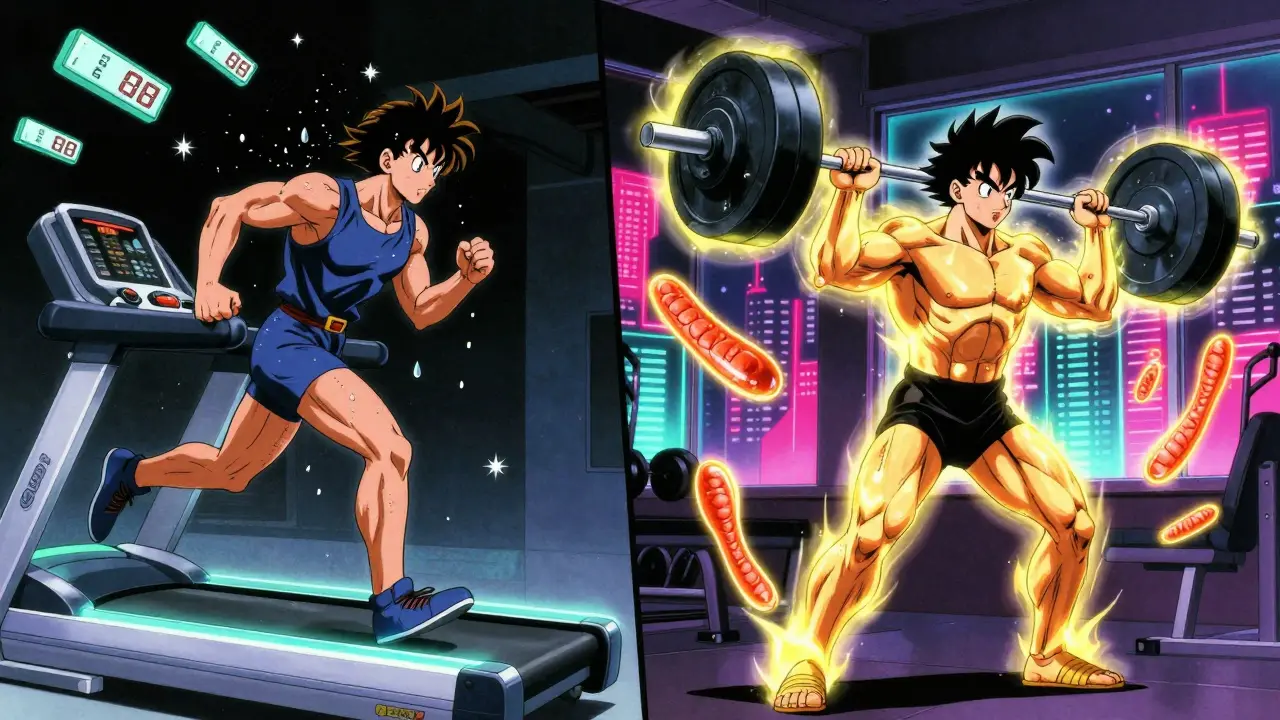
When it comes to losing weight, most people assume the answer is simple: do more cardio. Run longer, cycle harder, sweat more on the treadmill. But what if the scale isn’t moving - even after months of running? And what if you’re getting stronger, your clothes fit better, but the number on the scale hasn’t budged? That’s not a failure. It’s biology.
Cardio Burns Calories Now - Strength Burns Them Later
Cardiovascular exercise - running, swimming, cycling, brisk walking - is the classic go-to for weight loss. It’s easy to see why. Thirty minutes of jogging at a moderate pace burns 300-400 calories for someone weighing 155 pounds, according to Harvard Medical School’s 2023 metabolic data. That’s a clear, immediate payoff. You finish your workout, you’ve burned a decent chunk of your daily intake, and you feel like you’ve done something.
Strength training, on the other hand, looks weak in comparison. Thirty minutes of lifting weights? Maybe 90-150 calories. That’s less than a banana. So why do so many people who stick with it end up looking leaner, even if they don’t lose much weight?
The answer is metabolism. When you lift weights, you’re not just burning calories during the workout. You’re building muscle. And muscle doesn’t just sit there. It burns energy - even when you’re asleep. One kilogram of muscle uses about 13-15 calories per day at rest. Fat? Only 4.5-5. That means if you gain 2kg of muscle, you’re burning an extra 26-30 calories every single day. That’s like walking an extra 15 minutes daily, without ever leaving your couch.
And it gets better. After a hard strength session, your body keeps burning calories for up to 48 hours. This is called EPOC - excess post-exercise oxygen consumption. It’s your body’s way of repairing muscle, restoring energy, and cooling down. A 2024 study from the Cleveland Clinic found that intense strength training can boost your metabolism for nearly two full days. Cardio doesn’t do that. Once you stop running, your calories burned stop too.
The Real Numbers: What Studies Show
Let’s cut through the noise with real data. In a 2022 randomized trial published in Obesity, researchers split 120 overweight adults into three groups: cardio-only, strength-only, and a combo group. After six months:
- Cardio-only lost 9.7% body fat - but also lost 0.3kg of muscle
- Strength-only lost 7.1% body fat - but gained 2.3kg of muscle
- Combo group lost 12.4% body fat - and gained 1.8kg of muscle
The combo group didn’t just lose more fat. They kept their muscle. That’s the secret. Muscle doesn’t just make you look toned - it keeps your metabolism high. Without it, you lose weight, but you also lose the ability to burn calories efficiently. That’s why so many people hit a plateau - their body becomes a leaner, but slower, machine.
Another study from 2012 tracked 473 sedentary adults over eight months. The cardio group lost 4.3% of their body weight. The strength group? Only 1.6%. But here’s the twist: the strength group gained 1.4kg of lean muscle. The cardio group lost 0.2kg. That’s not just a number - it’s your body’s long-term fuel tank.
Why People Quit - And What Actually Keeps Them Going
Most people give up on weight loss not because they’re lazy. They give up because they don’t see results - or they see the wrong kind of results.
Cardio users often say: “I ran five times a week for three months and the scale didn’t move.” That’s because cardio doesn’t change your body composition fast enough. You’re burning calories, but your body holds onto fat as a survival mechanism. And after 8-12 weeks, your body adapts. You burn fewer calories doing the same workout. Plateau city.
Strength training users hear: “I gained weight.” That’s because muscle is denser than fat. You might gain 1-2kg of muscle while losing 3kg of fat. The scale goes up. But your jeans? They’re looser. Your shoulders look broader. Your arms are firmer. This is called body recomposition - and it’s the real goal.
Reddit threads from over 1,200 people who tried both methods revealed something telling:
- 73% of cardio users said they saw “immediate scale movement” - but 58% hit a plateau within 12 weeks
- 82% of strength users said their clothes fit better, even when the scale didn’t budge
- 67% of strength trainers noticed a “metabolic boost” after three months - they started burning more calories at rest
And here’s the kicker: people who combined both modalities were 72% more likely to keep the weight off after 18 months, according to a 2023 MyFitnessPal survey of 25,000 users. The combo group didn’t just lose weight - they built a body that stayed lean.

The Best of Both Worlds: How to Mix Them
You don’t have to choose. You need both.
The American College of Sports Medicine recommends this for most people:
- 150 minutes of moderate cardio per week - that’s 30 minutes, five days a week
- 120 minutes of strength training - two full-body sessions, or three upper/lower splits
For beginners, start smaller: 20-30 minutes of walking or cycling three times a week, plus two 20-minute strength sessions using bodyweight or light dumbbells. Focus on form, not weight. Squats, push-ups, rows, lunges - these are your foundation.
Progression is key. In strength training, if you’re not increasing the weight or reps every week, you’re not stimulating growth. Aim for a 2.5-5% increase in load every 7-10 days. If you’re lifting the same weights for three weeks straight, you’re not getting stronger - you’re just going through the motions.
And don’t forget protein. Only 32% of people trying to lose weight hit the recommended 1.6-2.2 grams per kilogram of body weight. That’s about 110g of protein daily for a 70kg person. Without enough protein, your body breaks down muscle for fuel - even if you’re lifting. Eggs, chicken, tofu, Greek yogurt, lentils - get them in every meal.
What About HIIT? Is It the Secret Weapon?
High-Intensity Interval Training (HIIT) - short bursts of all-out effort followed by rest - is the middle ground. A 20-minute HIIT session can burn as many calories as 40 minutes of steady jogging. And it spikes EPOC even higher than traditional strength training.
One 2023 study in the European Journal of Applied Physiology found HIIT burned 25-30% more calories than steady-state cardio and triggered 12-15% greater post-workout calorie burn. Plus, it takes less time. That’s why it’s so popular.
But HIIT isn’t magic. It’s hard on the body. If you’re new to exercise, or recovering from injury, start with steady cardio and strength first. Save HIIT for when your joints and muscles can handle it. One or two HIIT sessions a week, mixed with two strength and one longer cardio session, is plenty.

The Bigger Picture: It’s Not Just About Exercise
Dr. James Levine from Mayo Clinic says the real fat-burning secret isn’t the gym - it’s how much you move outside of it. He calls it NEAT - Non-Exercise Activity Thermogenesis. That’s walking to the bus, taking the stairs, standing while you work, fidgeting, gardening. NEAT can burn 2-3 times more calories than a structured workout.
So if you’re sitting at a desk all day, then running for 30 minutes, you’re still in a calorie deficit - but barely. Stand up every 30 minutes. Walk while you talk on the phone. Park farther away. These tiny habits add up.
And sleep matters. Poor sleep lowers leptin (the hormone that tells you you’re full) and raises ghrelin (the one that makes you hungry). One night of bad sleep can increase cravings for carbs and sugar by 45%. You can’t out-exercise bad sleep.
Final Answer: Do Both - and Be Patient
Cardio is great for burning calories fast. Strength training is better for burning fat long-term. Neither alone is enough for sustainable weight loss. The most effective approach? Combine them.
Here’s what works:
- Do cardio 3-5 times a week for heart health and calorie burn
- Do strength training 2-3 times a week to build muscle and boost metabolism
- Get enough protein - at least 1.6g per kg of body weight
- Move more outside the gym - walk, stand, take the stairs
- Sleep 7-8 hours a night
Weight loss isn’t a race. It’s a rebuild. You’re not just losing fat. You’re building a body that stays lean because it’s stronger, smarter, and more efficient. That’s not something you get from running alone. That’s something you build - one rep, one walk, one good night’s sleep at a time.
Is cardio or strength training better for losing belly fat?
Neither targets belly fat specifically - fat loss happens all over the body. But strength training helps preserve muscle while you lose fat, which keeps your metabolism high. Cardio burns more calories during the workout. The best approach is combining both: cardio to create a calorie deficit, strength to protect muscle and boost long-term fat burning. People who do both lose more belly fat over time than those who do only one.
Why am I gaining weight while strength training?
You’re likely gaining muscle, not fat. Muscle is denser than fat, so it takes up less space but weighs more. It’s common to gain 1-2kg in the first few weeks of strength training due to water retention and muscle repair. If your clothes are fitting better and your body looks tighter, you’re making progress - even if the scale goes up. Don’t rely on the scale alone. Take measurements, photos, or notice how your energy and strength change.
How long until I see results from strength training for weight loss?
You’ll notice strength gains in 2-4 weeks. Visible changes in body composition - like clothes fitting better - usually show up after 6-8 weeks. Real fat loss with muscle gain takes 3-6 months. The biggest metabolic boost from increased muscle mass kicks in after 12 weeks of consistent training. Patience is part of the process.
Can I lose weight with strength training alone?
Yes, but it’s slower. Strength training burns fewer calories during the workout than cardio, so you’ll need to be stricter with your diet to create a calorie deficit. But if you stick with it, you’ll build muscle, which raises your resting metabolism. Over time, this leads to sustainable fat loss. Many people find it easier to stick with strength training long-term because it feels more rewarding - you get stronger, not just tired.
Should I do cardio before or after strength training?
Do strength training first. Your muscles need the most energy for lifting heavy. If you do cardio first, you’ll be too tired to lift properly, which reduces muscle growth and increases injury risk. Save cardio for after, or on separate days. If you’re short on time, try a 10-minute cardio warm-up before strength, then 20 minutes of steady cardio after.
Do I need to join a gym to lose weight with strength training?
No. Bodyweight exercises like squats, push-ups, lunges, planks, and glute bridges are highly effective. Resistance bands and dumbbells at home work just as well as gym machines. The National Institute on Aging’s ‘Go4Life’ program offers free, evidence-based routines you can do anywhere. Consistency matters more than equipment.