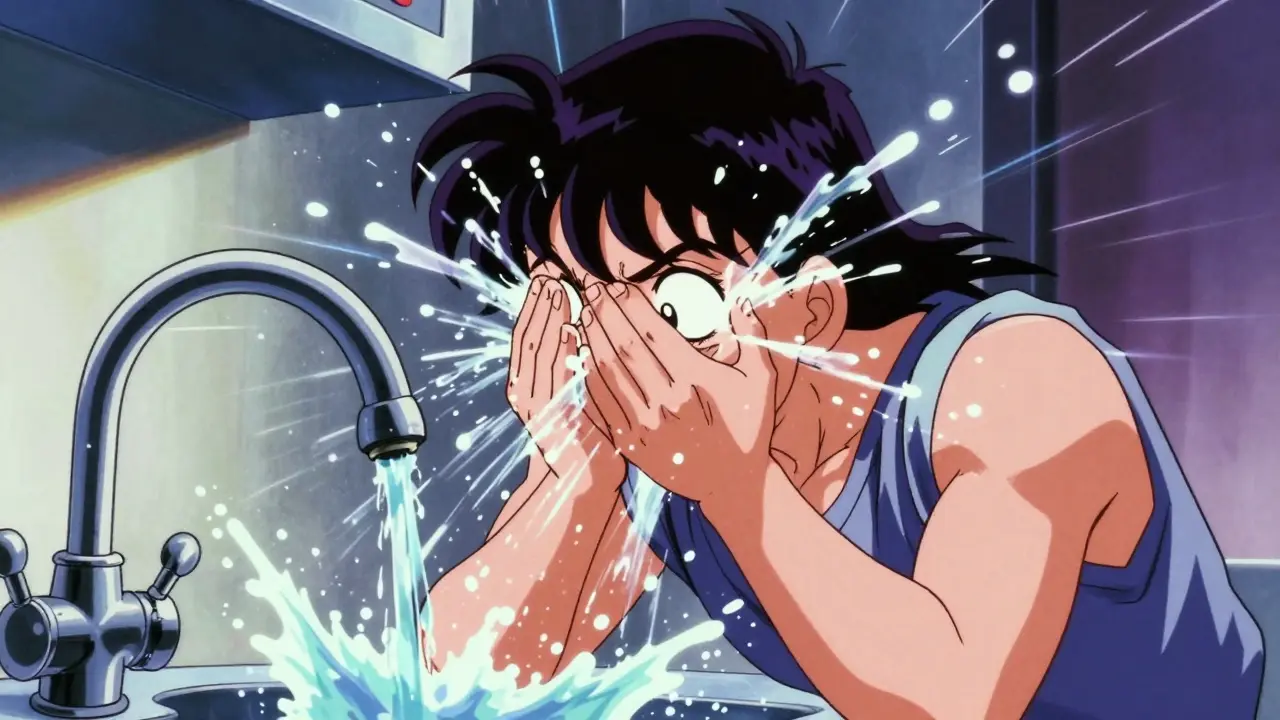
One second. That’s all it takes for a splash of cleaner, battery acid, or even shampoo to turn your vision into a medical emergency. Chemical eye injuries don’t wait for you to find a first aid kit or call for help-they start damaging your cornea the moment they touch your eye. And if you don’t act fast, you could lose sight permanently. This isn’t rare. About 1 in 5 eye injuries treated in emergency rooms come from chemical splashes. Alkali burns-from things like drain cleaners or cement-are especially dangerous because they eat through tissue like a hot knife through butter. But here’s the good news: chemical eye injury outcomes depend almost entirely on what you do in the first 60 seconds.
Why Speed Is Everything
Research shows that starting irrigation within 10 seconds of exposure cuts the risk of permanent vision loss by 76%. That’s not a guess. It’s from a 2017 meta-analysis in the British Journal of Ophthalmology. Every second you wait, the chemical keeps burning. Alkalis penetrate deeper than acids. They don’t just sit on the surface-they seep into the layers of your eye, destroying cells before you even feel the pain. By the time your eye stings, it’s already too late for some damage to be undone.Most people freeze. They rub their eye. They blink hard. They run to find a towel. That’s exactly what you must not do. Rubbing spreads the chemical. Blinking traps it under your eyelid. Waiting for someone else to help? That’s the worst mistake. You are the only person who can save your own vision in those first moments.
Step-by-Step First Aid: What to Do Right Now
- Flush immediately with water. Don’t wait for saline. Don’t look for a first aid kit. Turn on the nearest tap-kitchen, bathroom, even a garden hose if you’re outside. Tap water works just as well as sterile saline, according to Dr. Reay Brown from Bascom Palmer Eye Institute. The goal isn’t to use the "best" fluid-it’s to use any fluid, right now.
- Hold your eye open. Use your fingers to pull your upper and lower eyelids apart. Keep them wide. If you’re alone, tilt your head sideways so the injured eye is down. This stops the chemical from flowing into your good eye. Don’t close your eye. Don’t cover it. Flood it.
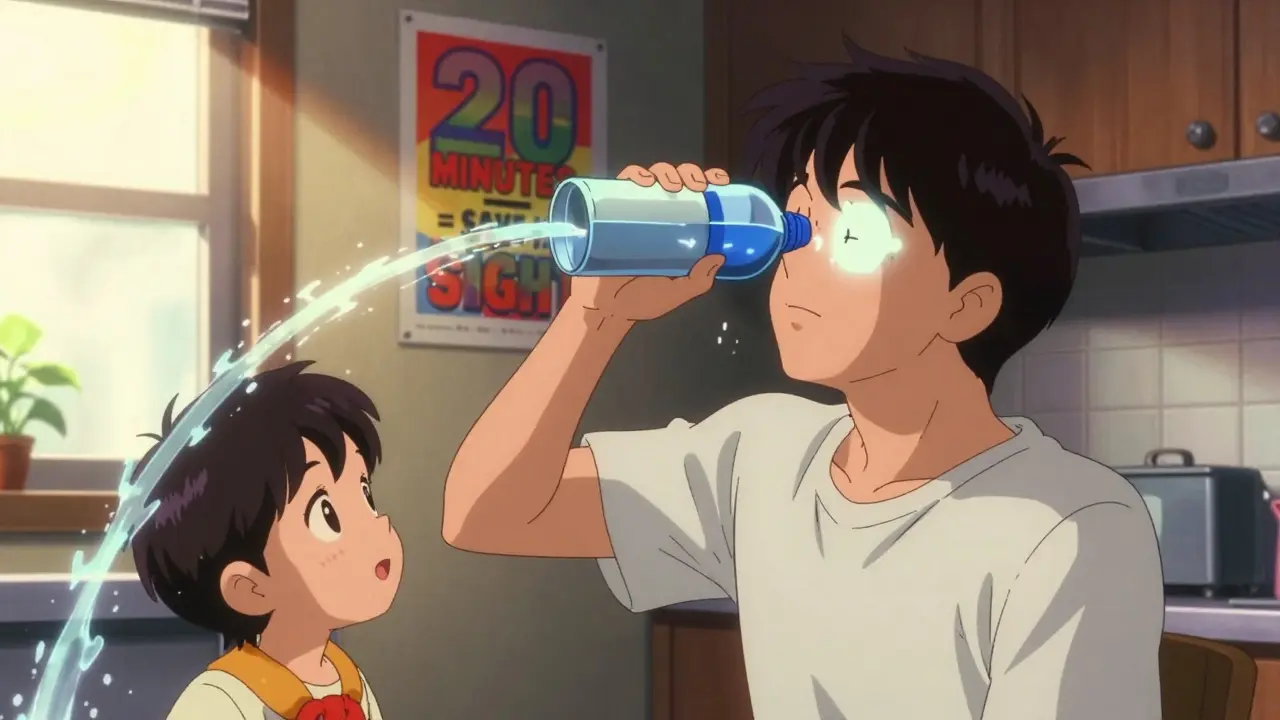
- Keep flushing for at least 20 minutes. Healthdirect Australia, the CDC, and the American Red Cross all agree: 20 minutes is the minimum. Some guidelines say 15, others say 10. But if you’re unsure, go longer. A 2023 study in the Journal of Emergency Medicine found that 57% of people stopped flushing too soon-often after just 5 minutes. That’s not enough. Alkali burns need more time. If you’re using an eyewash station, make sure the water flows continuously for the full 20 minutes. Don’t stop just because it hurts. The pain means it’s working.
- Remove contact lenses if you can. If your eye isn’t swollen shut and you can see the lens, gently slide it out. If you can’t, don’t force it. Keep flushing. The water will flush the lens out naturally. The CDC doesn’t mention this, but Healthdirect Australia and Nationwide Children’s Hospital do: removing the lens helps the water reach the surface. But never delay flushing to remove it.
- Don’t use pressure. No rubbing. No squeezing. No pressing on your eyeball. Even a light touch can make a corneal abrasion worse or push chemicals deeper.
What Not to Do
People make the same mistakes over and over. A 2022 study of 1,247 workplace eye injuries found that 68% of victims rubbed their eyes. Nearly a third applied pressure. Over 80% used too little water. And more than half stopped flushing before the damage was stopped. Here’s what you must avoid:
- Don’t wait for someone to help you.
- Don’t use eye drops or ointments-they trap chemicals.
- Don’t try to neutralize the chemical with vinegar or baking soda. That’s dangerous. You’re not a chemist. You’re trying to save your eye, not run a lab.
- Don’t cover the eye with a bandage before flushing. That seals in the chemical.
- Don’t assume it’s "just a little sting." If you feel burning, it’s serious.
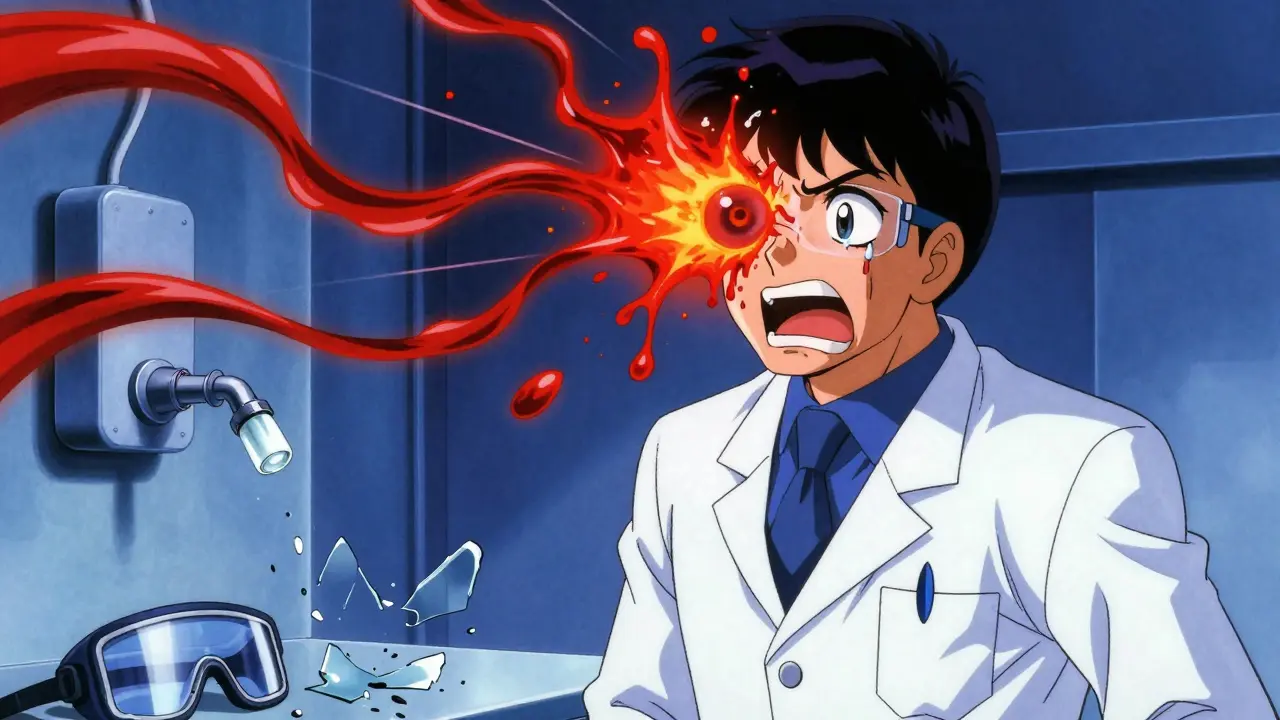
Workplace vs. Home: Different Rules, Same Goal
If you work with chemicals, your workplace should have an ANSI Z358.1-2021 compliant eyewash station. That means it delivers tepid water (between 60°F and 100°F) at 0.4 gallons per minute, and it activates in under a second. Cold water makes people stop flushing early. Hot water burns. Tepid water keeps you flushing long enough to save your vision.
But 22.8% of workplaces with chemical hazards don’t even have a station within 10 seconds of reach, according to OSHA’s 2023 audit. That’s unacceptable. If you’re in a lab, factory, or salon, check: Is the station unobstructed? Is the water running? Is it tested weekly? If not, report it. Your eyes are worth more than a broken machine.
At home? There’s no requirement for an eyewash station. But you can still prepare. Keep a bottle of saline or even a clean water spray bottle near your cleaning supplies. Store it where you use chemicals-under the sink, in the garage, in the laundry room. Don’t keep it locked away. In an emergency, you won’t have time to search.
What Happens After Flushing?
Even if you feel better after 20 minutes, you still need to go to the ER. Chemical injuries can keep damaging your eye for hours after the splash. Corneal ulcers, scarring, and even glaucoma can develop days later. You might not feel pain right away, but the damage is still happening.
At the hospital, they’ll check your eye’s pH with litmus paper. Normal is 7.0 to 7.4. If it’s still acidic or alkaline, they’ll keep flushing. Some hospitals now use a special solution called Diphoterine, approved by the FDA in 2022. It binds to chemicals instead of just washing them away. It cuts irrigation time by 40%. But it’s not in every ER yet. So don’t wait for it. Flush with water first.
Who’s at Risk-and How to Prevent It
Chemical eye injuries aren’t just for factory workers. They happen to:
- Parents cleaning with bleach near kids
- Barbers using hair dye
- Homeowners mixing drain cleaners
- Nurses handling disinfectants
- Students in science labs
Prevention is simple: wear safety goggles. Not just any goggles-ones that seal around your eyes. Regular glasses won’t protect you. A 2023 study found that 89% of eye injuries in healthcare settings happened because workers weren’t wearing proper eye protection.
And if you work around chemicals, get trained. The American Red Cross found that people who did hands-on first aid training were 3.2 times more likely to flush correctly than those who just read a pamphlet. Ask your employer for a demo. Do it yourself at home. Practice flushing your eye with water while holding your lids open. Make it routine.
The Cost of Waiting
Every year, chemical eye injuries cost U.S. employers over $327 million in medical bills and lost work. The average workers’ comp claim is $14,286. For some, it’s worse. Nearly 1 in 5 patients need a corneal transplant within five years. Each transplant costs $27,700. And that’s just the money. The real cost is losing your sight-your independence, your job, your life.
But here’s the truth: almost all of these injuries are preventable. And almost all of them can be stopped with one thing: quick, thorough, 20-minute irrigation.
Can I use saline instead of tap water for a chemical eye splash?
Tap water works just as well as saline for immediate first aid. In fact, research from Dr. Reay Brown at Bascom Palmer Eye Institute shows saline offers no advantage over plain water in the critical first minutes. The key isn’t the type of fluid-it’s the speed and volume. If you don’t have saline, use tap water. If you have saline and water, use either. Don’t waste time searching.
How long should I flush my eye after a chemical splash?
Flush for at least 20 minutes. Some guidelines say 15, others say 10. But 20 minutes is the safest minimum. Alkali burns-like those from drain cleaners or cement-can keep damaging your eye for hours. Stopping early is the most common mistake. Even if your eye feels better after 5 minutes, keep going. The pain means the chemical is still active.
Should I remove my contact lenses during a chemical splash?
Only if you can do it safely and quickly. If your eye isn’t swollen shut and you can see the lens, gently remove it. If you can’t, don’t force it. Keep flushing. The water will wash the lens out naturally. Delaying irrigation to remove the lens can cost you your vision. The priority is flushing-not lens removal.
Is it safe to use vinegar or baking soda to neutralize the chemical?
No. Never try to neutralize a chemical in your eye. You don’t know the exact substance, and mixing chemicals can create heat or toxic reactions. Water doesn’t react-it just washes. The goal is dilution and removal, not chemical warfare. Stick to water. Always.
Do I still need to go to the ER if my eye feels fine after flushing?
Yes. Even if your eye feels normal, chemical damage can progress silently. Corneal ulcers, scarring, and increased eye pressure can develop hours or days later. A doctor needs to check your eye’s pH, look for hidden damage, and prescribe protective drops. Never assume you’re fine just because the pain is gone.
What to Do Next
If you work with chemicals, check your workplace eyewash station today. Is it accessible? Is it working? Is it tested? If not, speak up. If you’re at home, keep a bottle of water or saline near your cleaning supplies. Practice the 20-minute flush with a friend. Make it a habit. Teach your kids. Post a reminder near your bleach bottle.
Chemical eye injuries don’t care if you’re busy, tired, or in a hurry. They strike in a second. But they can be stopped in seconds too. You don’t need special tools. You don’t need training. You just need to act-fast, and without stopping. Your vision depends on it.

Comments (13)
Jasmine Yule December 30 2025
Just had a friend get bleach in her eye last month-she flushed for 30 minutes straight while screaming into a towel. No hospital until after. Still has minor scarring. Don’t wait for ‘feeling better.’ This post is 100% right. 20 minutes is the bare minimum. I’m telling everyone I know.
Also-why the hell are we still not teaching this in high school? Like, mandatory. Every kid should know how to flush their eye before they learn how to drive.
Lisa Dore December 31 2025
This is the kind of info that should be plastered on every cleaning product label. I used to think ‘eye protection’ was overkill until my cousin lost vision in one eye from oven cleaner. She didn’t even know she was supposed to flush for 20 minutes. She did 3.
Thank you for this. Sharing with my book club. And my mom. And her neighbor who mixes bleach and ammonia like it’s a cocktail.
Sharleen Luciano January 1 2026
How quaint. You assume everyone has access to running water. What about people in rural areas? Or in countries where plumbing is unreliable? Or those who work in places where the eyewash station is locked behind a keycard? This advice is textbook privileged. You’re not saving lives-you’re preaching to the converted.
And don’t get me started on the ‘tap water is fine’ nonsense. The CDC recommends sterile saline for a reason. Tap water has chlorine, fluoride, and god knows what else. You’re not a doctor, but you’re acting like one. Pathetic.
Jim Rice January 2 2026
Actually, I’ve done this wrong before. Rubbed my eye. Thought it was just soap. Ended up with a corneal abrasion. Took 3 weeks to heal. And guess what? The ER doctor told me I was lucky it wasn’t alkali.
So yeah, you’re right. But here’s the real problem: no one cares until it happens to them. I’ve worked in labs for 12 years. I’ve seen 7 people ignore the eyewash station because ‘it’s not worth the time.’
And now I’m the guy who yells at people for not wearing goggles. You’re welcome.
Henriette Barrows January 3 2026
My sister’s a nurse and she told me about this exact thing last week. She said most patients don’t even know they’re supposed to keep flushing after the pain stops. I thought she was exaggerating. Then I watched her demo it on a mannequin during training.
It’s so simple, but also so hard to do when you’re terrified. I’m going to buy a spray bottle and keep it by my bleach. And I’m making my kid practice with me. Not for fun-because I don’t want to be that parent who lost their child’s vision because they were too scared to hold the eyelids open.
Duncan Careless January 4 2026
Good stuff. But you missed one thing: temperature matters. Cold water makes people stop. Hot water burns. Tepid is key. If you don’t have a proper station, run the tap for a minute first to get it to room temp. Don’t just blast ice water-your instinct will be to pull away.
Also, if you’re in the UK, the NHS says 15 minutes is acceptable if you’re in a controlled environment. But 20 is better. Always better.
Joe Kwon January 5 2026
Just want to add a quick clinical note: alkali burns trigger a cascade of cytokine release that leads to neovascularization and limbal stem cell deficiency. That’s why even after irrigation, you need urgent ophthalmology consult-because the damage is molecular, not just superficial.
Also, Diphoterine? It’s not FDA-approved for ‘every ER.’ It’s approved for industrial use and is still cost-prohibitive for most community hospitals. Don’t expect it. Just flush. And flush hard.
Nicole K. January 5 2026
People are so careless. My neighbor let her toddler play with laundry pods. One burst in his eye. He cried. She gave him milk. MILK. Like it’s a magic cure. He needed a transplant. Now he’s blind in one eye. And she still doesn’t get it. This isn’t ‘accident.’ This is negligence. And it’s not okay.
Fabian Riewe January 6 2026
I’m a barber. I use hair dye every day. I’ve had it splash twice. First time? I rubbed. Bad move. Second time? I flushed for 25 minutes. No damage. No scar. No drama.
Wear goggles. Always. Even if you’re ‘just doing a quick touch-up.’
And if you’re scared to hold your eyelids open? Practice with a friend. Use a mirror. Make it a thing. Like brushing your teeth. You don’t wait for disaster to learn.
Amy Cannon January 6 2026
It is of paramount importance to underscore the fact that the anatomical integrity of the ocular surface is contingent upon the expeditious and sustained application of aqueous irrigation, which serves to mitigate the physicochemical degradation of corneal epithelial cells by neutralizing and diluting noxious agents. The human cornea, being avascular and densely innervated, exhibits a unique vulnerability to alkaline penetration, which can result in irreversible stromal liquefaction if irrigation is prematurely terminated.
Furthermore, while tap water is often deemed acceptable in resource-limited settings, its osmolarity and particulate content may introduce secondary inflammatory stimuli. The ideal scenario, therefore, remains the use of sterile, isotonic saline under controlled, continuous flow conditions-preferably via a calibrated eyewash station compliant with ANSI Z358.1-2021 standards. To suggest otherwise is to risk compounding injury through suboptimal intervention.
And yes, I did my thesis on this. In 2017. At Johns Hopkins. You’re welcome.
Himanshu Singh January 8 2026
Wow this is so important! I work in a lab in India and we have eyewash station but no one use it. I will tell my collogues. Also, I practice flushing with water every morning now. My boss think I am crazy but I say: better crazy than blind. 😊
Alex Ronald January 9 2026
My daughter’s science teacher had them all practice flushing with water during class. No drama. No panic. Just a 20-minute drill with goggles on. She said it felt weird at first, but now she doesn’t think twice about it.
That’s the secret, isn’t it? Make it normal. Like fire drills. We don’t wait for the building to burn down to practice exiting. Why do we wait for an eye to burn before we practice flushing?
Just… teach it. Everywhere.
Teresa Rodriguez leon January 9 2026
I’m so mad. My brother lost his eye because he didn’t flush long enough. He thought 5 minutes was enough. He didn’t even know he was supposed to hold his lids open. He just blinked and cried. And now he can’t drive. Can’t work. Can’t see his kids’ faces.
And this post? It’s too late for him. But maybe it’ll save someone else. I hope so.