
Chronic pain can feel like an endless cycle-medications lose effectiveness, and surgeries carry significant risks. What if you could target pain signals at their source instead of masking symptoms? That’s precisely what nerve blocks and radiofrequency ablation (RFA) aim to achieve.
Imagine someone with knee osteoarthritis struggling to walk more than 100 meters due to constant discomfort. A nerve block might give temporary relief for hours, while RFA could quiet those pain signals for months. But how do these procedures actually work? And who really benefits?
What Are Nerve Blocks and Radiofrequency Ablation?
Nerve blocks are minimally invasive injections that temporarily stop pain signals traveling through specific nerves. Using local anesthetic or anti-inflammatory medications, doctors inject substances near targeted nerves to block communication with your brain. Think of it as hitting a circuit breaker during a power surge-the signal stops flowing.
Radiofrequency ablation (RFA), also known as radiofrequency neurotomy, takes this concept further. Instead of temporary chemical interruption, RFA uses precise heat energy (typically 80-90°C) to create controlled lesions on pain-transmitting nerves. Developed in the 1970s, modern techniques now deliver up to 24 months of relief with newer approaches like cooled RFA showing expanded applications for conditions like knee arthritis.
The Science Behind Pain Signal Disruption
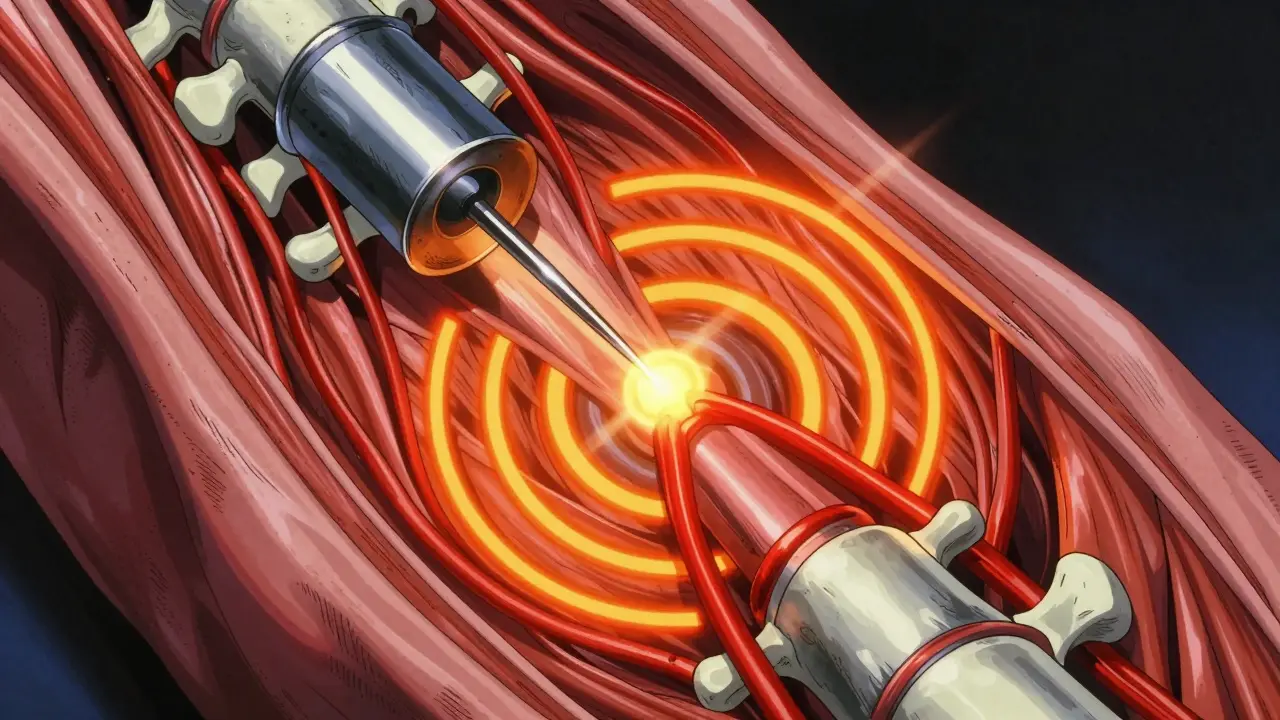
RFA works through carefully controlled thermal processes. Picture a specialized needle guided by fluoroscopy (real-time X-ray imaging) toward target nerves. Once positioned, radiofrequency energy creates microscopic burns specifically affecting A-delta and C-fibers responsible for sharp and dull pain sensations. Crucially, motor and normal touch fibers remain untouched.
| Parameter | Typical Value |
|---|---|
| Cannula Gauge | 22-gauge |
| Active Tip Length | 5mm |
| Impedance Range | 300-500 ohms |
| Sensory Stimulation | 0.3-0.5V |
These exact measurements prevent accidental damage to healthy tissue. As Dr. Ron Gardner explains: "We're essentially frying only the wires carrying bad news, leaving everything else functional." The result? Sustained pain relief without affecting movement or basic sensation.
When Do Doctors Recommend These Procedures?
Not every chronic pain case qualifies. Success depends heavily on accurate diagnosis first. Here's the typical decision pathway:
- Persistent localized pain: Back pain from spinal facet joints, neck pain, or sacroiliac joint dysfunction often respond well
- Positive diagnostic block response: Candidates typically experience 50-80% pain reduction after test injection
- Failed conservative therapies: Physical therapy, NSAIDs, or medication alone haven't provided lasting improvement
- Desire to avoid surgery: Patients seeking alternatives to spinal fusion or other major interventions
According to Mayo Clinic Health System, approximately 70-80% of carefully selected candidates achieve meaningful pain reduction lasting beyond 6 months. However, Dr. Steven Cohen warns against skipping the diagnostic phase: "RFA is only effective when you've properly confirmed which nerve carries the pain signal. Without that step, failure rates jump significantly."
Nerve Block vs. RFA: Key Differences Explained
| Factor | Nerve Block | Radiofrequency Ablation |
|---|---|---|
| Duration of Relief | Hours to weeks | 6-24 months |
| Invasiveness | Minimally invasive injection | Thermal lesion creation |
| Anesthesia Type | Local | Light sedation + local |
| Average Cost | $500-$1,500 | $3,000-$5,000 |
| Success Rate | 30-50% long-term | 70-80% for qualified candidates |
While nerve blocks serve primarily as diagnostic tools, RFA delivers sustained relief by physically altering nerve function. Cooled RFA technology enhances this further by creating larger, uniform lesions (8-10mm versus traditional 3-4mm), proving especially beneficial for complex cases like knee osteoarthritis. Research shows 65% of knee arthritis patients maintained significant improvement at 6 months post-cooled RFA compared to just 40% with standard techniques.
Recovery Timeline and Patient Experiences
Most patients leave the clinic within an hour. Initial soreness at the injection site usually resolves within 3-7 days, with full effects developing over 2-4 weeks. Here's what typical recoveries look like:
- Day 1: Mild fatigue; avoid heavy lifting or strenuous activity
- Week 1: Gradual return to light activities; some may notice subtle improvements
- Week 2-4: Peak therapeutic effect begins; many resume normal routines
- Ongoing: Follow-up appointments assess durability of relief
Gardner Orthopedics reports 85% of patients reduce opioid usage significantly after successful RFA. One patient shared her story: "After three years of daily painkillers, I walked my dog for half an hour without stopping within two weeks." However, Ark Surgical Hospital reminds us: "This manages symptoms-it doesn't cure underlying conditions like arthritis. Expect periodic maintenance sessions every 12-18 months as nerves regenerate."

Technological Advancements Shaping Treatment
Innovation continues expanding possibilities. Pulsed-field ablation received FDA approval in 2022, offering non-thermal nerve modulation for faster recovery times. Meanwhile, cooled RFA systems enable broader lesion patterns ideal for irregularly shaped pain generators like sacroiliac joints (showing 70% success at six months).
The global RFA market is projected to reach $8.5 billion by 2028 according to Grand View Research, reflecting growing adoption across specialties. Interestingly, CMS data reveals a 22% reduction in long-term opioid prescriptions among Medicare recipients receiving RFA compared to purely pharmaceutical management.
Critical Considerations Before Proceeding
Despite strong evidence supporting efficacy, certain factors influence outcomes:
- Proper patient selection remains paramount: Inadequate pre-procedure diagnostics account for up to 30% failures
- Physician expertise matters: The American Society of Regional Anesthesia recommends minimum 50 supervised procedures before independent practice
- Underlying pathology persists: Conditions causing degeneration require complementary treatments alongside symptom management
- Maintenance expectations differ per condition: Facet joint RFA typically lasts 12-18 months versus 6-9 months for peripheral applications
Dr. Gardner emphasizes: "It's incredibly fast, low-risk, and life-changing-but only when used appropriately. Always ensure your provider follows strict diagnostic protocols."
Frequently Asked Questions About Pain Interventions
How long does pain relief last after RFA?
Relief duration varies based on individual factors but typically ranges from 6-24 months. Newer technologies like cooled RFA often extend this window compared to traditional methods. Most patients require repeat procedures annually to maintain optimal results.
Are nerve blocks always done before RFA?
Yes, successful diagnostic blocks confirming >50% pain reduction are mandatory before proceeding. This step validates which nerve transmits your specific pain signals, dramatically improving procedural success rates.
What are potential side effects of these procedures?
Common temporary reactions include mild soreness at injection sites (resolving within one week) and transient nerve inflammation. Serious complications occur in less than 1% of cases when performed by experienced providers using image guidance.
Will insurance cover interventional pain procedures?
Coverage depends on diagnosis appropriateness and prior authorization requirements. Medicare and most private insurers approve RFA for documented chronic spinal conditions after failed conservative therapies. Consult your provider beforehand to confirm eligibility criteria.
Can I drive home after the procedure?
No, sedation and local anesthesia effects impair reaction time. Arrange transportation assistance-you'll need someone to accompany you for at least 24 hours post-procedure as advised by Weill Cornell Medicine guidelines.

Comments (9)
Tommy Nguyen March 27 2026
Honestly this sounds like a game changer for chronic pain folks.
Shawn Sauve March 29 2026
Great overview of the procedures and technical parameters involved here. It is really helpful to see the success rates laid out clearly in tables. I appreciate the emphasis on diagnostic blocks before moving to RFA. Many patients skip that step and regret it later on. Safety should always be the primary concern for any intervention. Thanks for putting this together for us all to read :)
Devon Riley March 31 2026
Reading about the recovery timeline gives me so much hope for my aunt. She has been suffering with knee arthritis for years now. Knowing there is non opioid management makes a huge difference in quality of life. Always remember to listen to your body during the healing process too. You have done amazing work explaining the complexities simply. Sending positive vibes to everyone navigating chronic pain journeys right now 🙌✨
walker texaxsranger April 1 2026
they claim safety but the thermal energy causes scar tissue formation inevitably. corporate interests drive adoption rates rather than patient outcomes primarily. impedance ranges listed are dangerously broad for surgical precision standards. fluoroscopy exposes patients to unnecessary radiation doses during navigation. insurance companies block access until conservative therapies fail completely. data suggests nerve regeneration triggers neuropathic hypersensitivity later on. cooling mechanisms do not eliminate risk factors inherent in tissue destruction. research funding comes from device manufacturers seeking market share growth. regulatory approvals often lag behind clinical evidence significantly. patients report numbness areas expanding beyond the target zone initially. long term durability claims lack independent longitudinal verification studies. maintenance sessions imply the treatment is temporary symptom masking mostly. medical debt increases with each procedural session required annually. underlying degeneration remains unaddressed by these interventional strategies entirely. alternative modalities get ignored in favor of high margin interventions. trust the data less and monitor personal symptoms closely instead.
tyler lamarre April 3 2026
Typically the armchair experts arrive with their half baked theories. You missed the nuance regarding the selection criteria mentioned clearly above. Most of your concerns stem from fear rather than factual medical evidence. It is amusing how internet forums replace actual doctor consultations these days. Your skepticism shows a distinct lack of understanding of modern ablation tech. Perhaps you should consult literature before typing nonsense online. We do not have time to explain basic physiology to theorists. The efficacy rates speak for themselves quite loudly actually. Try reading a paper before spreading misinformation casually here. Good luck convincing anyone with this wall of text.
Debra Brigman April 3 2026
There is a profound poetry in the way science interrupts suffering. We seek silence amidst the chaotic noise of nociceptive signals constantly firing. Each degree of heat applied represents a delicate dance with biology. To burn away pain is to carve out a path for peace again. The machine becomes an extension of our desire to endure without agony. Technology whispers promises of release to those weary from constant struggle. Yet the body remembers the fire through new pathways forming slowly. Hope blooms in the quiet weeks following the procedure gently. We must acknowledge that healing is not a straight linear journey upwards. Pain management is a conversation between medicine and human resilience daily. These tools offer bridges over the chasm of disability many face alone. Gratitude grows when movement returns even if temporary relief is granted. Art meets science in the sterile light of the operating room space. We are all searching for that moment where silence finally speaks. Life resumes with new purpose once the constant pressure fades away.
Tony Yorke April 4 2026
good info here keeps people off opioids. nice work. helps reduce dependency. solid breakdown of risks.
Rachael Hammond April 4 2026
I wasnt sure about the cost part but glad to see details. insurance can be tricky for sure tho. hope more places offer these options to patients soon. my sister tried meds and didnt get relief like she needed. thanks for sharing the recovery timeline stuff too. sounds manageable compared to major surgery procedures. definitely worth asking a doctor about next appointment.
Kameron Hacker April 5 2026
We must critically evaluate the long-term implications of thermal lesions on neural networks. While symptomatic relief is achieved, the fundamental pathology persists unchallenged beneath the surface. The industry focus shifts toward procedure frequency rather than curative intent explicitly. Regulatory bodies must enforce stricter oversight on outcome reporting metrics publicly. Patient advocacy groups should demand transparency regarding maintenance schedule requirements. Ethical considerations arise when symptom management masks progression of disease silently. Physicians bear responsibility to educate thoroughly on the temporary nature of interventions. Insurance policies should align coverage with holistic care models comprehensively. Innovation in non-thermal modulation offers promising alternatives for future practice. We cannot rely solely on ablative techniques to manage population health burden. Systemic reform is necessary to integrate these tools into broader care plans. Collaboration between specialists ensures optimal utilization of these advanced technologies. The discourse must move beyond individual case successes toward aggregate data analysis. Society benefits when medical interventions are deployed with strategic foresight consistently. Vigilance remains paramount as we integrate these powerful methods responsibly.