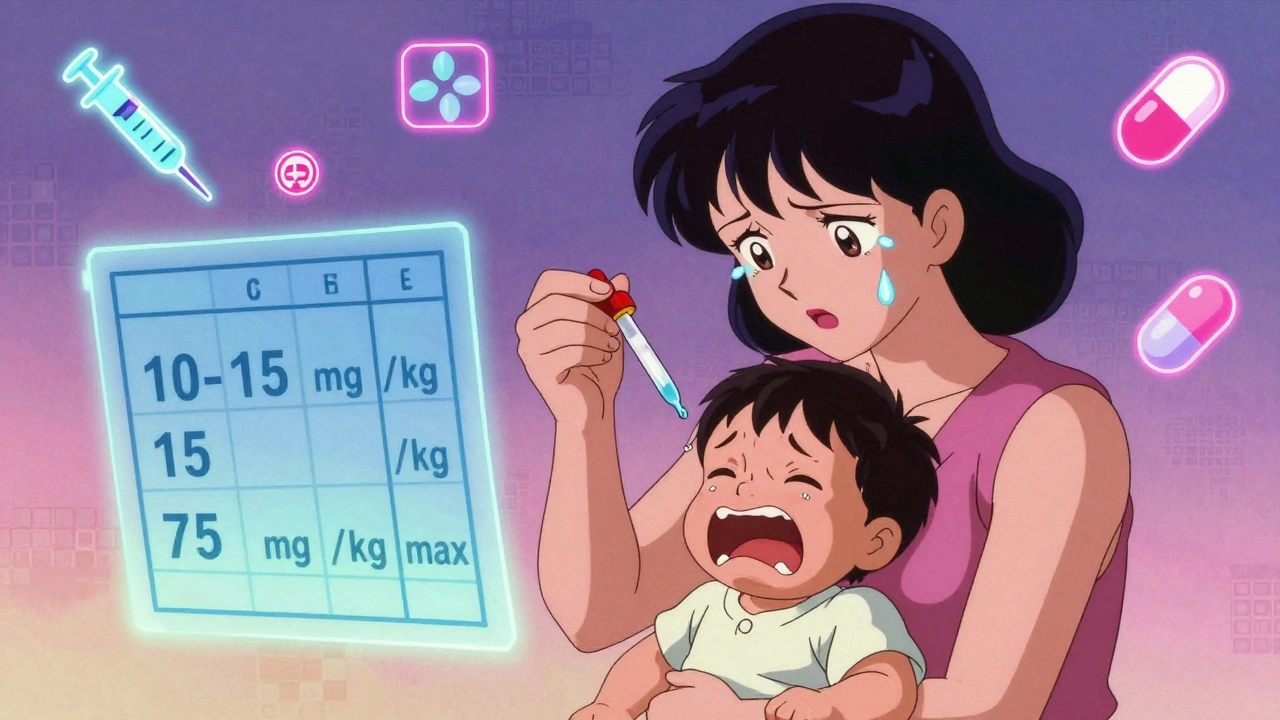
When a child gets sick, parents don’t just want relief-they need safe relief. Giving a child the same medicine as an adult, even in a smaller dose, can be dangerous. Children aren’t small adults. Their bodies process drugs differently. Their livers and kidneys are still developing. Their weight changes rapidly. And their ability to swallow pills? That changes too. That’s why age-appropriate medications matter-not as a nice-to-have, but as a necessity.
Why Pediatric Medications Can’t Be Just Adult Doses Cut in Half
It’s a common mistake. You see a bottle of ibuprofen. You read the label: 200 mg per tablet. Your 2-year-old weighs 28 pounds. You think, ‘Half a tablet should do it.’ But that’s not how it works. Pediatric dosing isn’t about age alone-it’s about weight, organ maturity, and how the body absorbs and clears the drug.
For example, acetaminophen (Tylenol) is safe for kids when given correctly: 10-15 mg per kilogram of body weight every 4-6 hours. But the maximum daily dose? 75 mg/kg or 3,750 mg-whichever comes first. Give too much, and you risk liver damage. Too little, and the fever doesn’t break. The difference between a safe dose and a toxic one can be as small as half a milliliter in a liquid suspension.
Infants under 3 months have immature liver enzymes. They clear drugs slower. That’s why some medications, like certain antibiotics or antivirals, need lower concentrations or longer dosing intervals. A 2-month-old might need 20 mg/kg of oseltamivir twice daily, while a 7-year-old weighing 25 kg gets the same dose-but the concentration of the liquid is different. The same drug, different formulation. That’s the key.
Age Groups and Formulations: What Works at Each Stage
The FDA and WHO divide children into six clear age groups for drug development:
- Preterm neonates (up to 37 weeks postmenstrual age)
- Term neonates (0-27 days)
- Infants (28 days-23 months)
- Children (2-11 years)
- Adolescents (12-16 years)
- Young adults (17-21 years)
Each group needs different formulations. Newborns can’t swallow pills. They need oral drops or IV solutions with precise concentrations-sometimes 10 to 100 times lower than adult strengths. For infants and toddlers, liquids are standard. But not just any liquid. It has to taste good. A bitter antibiotic can mean missed doses, failed treatment, and recurring infections.
That’s why fruit-flavored oseltamivir suspension saw a 58% increase in adherence during the 2022-2023 flu season. Kids actually took it. Without the flavor, many refused. Chewable tablets come in next, around age 2-3, if the child can safely chew and swallow. By age 6-7, most kids can handle regular tablets, but many still prefer chewables or dissolvable forms. Adolescents can usually take adult tablets-but even then, dosing must still be weight-based.
Common Conditions and Safe Medications by Age
Here’s what works-and what doesn’t-for the most common pediatric illnesses.
Pain and Fever: Acetaminophen and Ibuprofen
Acetaminophen is the go-to for fever and mild pain in kids of all ages. Dose: 10-15 mg/kg every 4-6 hours. Max: 75 mg/kg/day or 3,750 mg/day. Never exceed that. Ibuprofen (Advil, Motrin) is safe for kids over 6 months. Dose: 5-10 mg/kg every 6-8 hours. Max: 40 mg/kg/day. Don’t give ibuprofen to infants under 6 months unless directed by a doctor.
Aspirin? Never. It causes Reye’s syndrome-a rare but deadly condition that attacks the liver and brain. This risk is why aspirin has been removed from all pediatric formularies since the 1980s.
Ear Infections: Antibiotics
Amoxicillin is first-line for otitis media (ear infections) in children under 12. Dose: 25-35 mg/kg/day, split into two or three doses. Max single dose: 500 mg. For kids with penicillin allergies, azithromycin is an option-but resistance is high (25-40% in some areas), so it’s not ideal. Fluoroquinolones like ciprofloxacin? Avoid in kids under 18. They can damage growing cartilage.
Cough and Cold: No OTC Cough Syrups for Under 6
The FDA and AAP warn against over-the-counter cough and cold medicines for children under 6. They don’t work well, and they carry risks: sedation, rapid heart rate, even seizures. Honey? For kids over 1 year, 1-2 teaspoons before bed can soothe nighttime cough better than most syrups. For babies under 1? Skip it. Honey can carry botulism spores.
COVID-19 and Flu: Antivirals
Oseltamivir (Tamiflu) is approved for kids as young as 2 weeks. Dose: 20 mg/kg/day in two doses for 5 days. For children under 3 months, use only under specialist supervision. Molnupiravir is not recommended for anyone under 18 due to potential effects on growing cells. Paxlovid isn’t approved for kids under 12 yet.
Asthma and Allergies: Montelukast and Beyond
Montelukast (Singulair) is used for asthma and allergic rhinitis. But the 2025 KIDs List added a ‘use with caution’ flag for all patients under 18. Studies link it to sleep disturbances, nightmares, and mood changes. Use only if other treatments fail, and monitor closely.
Medications to Avoid Completely in Children
Some drugs have no safe pediatric dose. They’re banned outright.
- Codeine and tramadol: Both are metabolized into morphine in the liver. Kids metabolize them unpredictably. Some turn it into too much morphine-leading to fatal breathing problems. Avoid in all children.
- Angiotensin receptor blockers (ARBs): Avoid in infants under 1 month. They can cause severe kidney damage called renal tubular dysgenesis.
- Ivermectin: Removed from the 2025 KIDs List because evidence of benefit in pediatric infections is lacking, and overdose risk is high.
- Adult NSAIDs in high doses: Naproxen, diclofenac, and others aren’t approved for routine use in kids under 12. Stick to ibuprofen.
The Pediatric Pharmacy Association’s KIDs List (2025) identifies 27 medications with clear warnings. It’s not a suggestion-it’s a clinical safety standard. Hospitals and pharmacies use it to block unsafe prescriptions before they’re written.
The Real Problem: Formulation Gaps and Dosing Errors
Even when the right drug is chosen, the wrong form can ruin everything.
A 2022 survey of 1,247 pediatricians found 68% struggled with dosing because commercial formulations didn’t match their patients’ weights. A child weighing 15 kg might need 7.5 mL of a liquid antibiotic-but the bottle only has markings for 5 mL or 10 mL. Parents guess. They use kitchen spoons. They misread decimals. That’s how 32% of pediatric medication errors happen-decimal point mistakes.
One parent on Reddit said, ‘The 2.5 mL dose for my 18-month-old feels like a chemistry lab experiment.’ That’s not hyperbole. It’s reality. Non-standard measuring devices (like kitchen spoons) lead to 42% dosing errors, according to Children’s Hospital of Philadelphia.
And taste? It’s a silent killer of adherence. A bitter antibiotic means a crying child, a stressed parent, and a lingering infection. That’s why flavored suspensions, chewables, and orally disintegrating tablets are more than convenience-they’re medical necessities.
Tools That Help: Dosing Calculators and Electronic Alerts
Good systems prevent mistakes.
Lexicomp Pediatric Dosage Handbook (2024) has over 1,200 drug monographs with age-specific dosing. The FDA’s Pediatric Dosing Calculator app is used by 63% of pediatric pharmacists. Hospitals using Epic’s pediatric safety modules cut inappropriate dosing by 61%.
Standardized concentrations-like 100 mg/mL for amoxicillin instead of 125 mg/mL or 250 mg/mL-reduce errors by 47%. Electronic alerts that flag a 75 mg/kg acetaminophen dose as too high? That’s lifesaving.
But not every clinic has these tools. Community clinics have only a 38% adoption rate of pediatric pharmacists. That’s a gap. A dangerous one.
What’s Next? Personalized Medicine for Kids
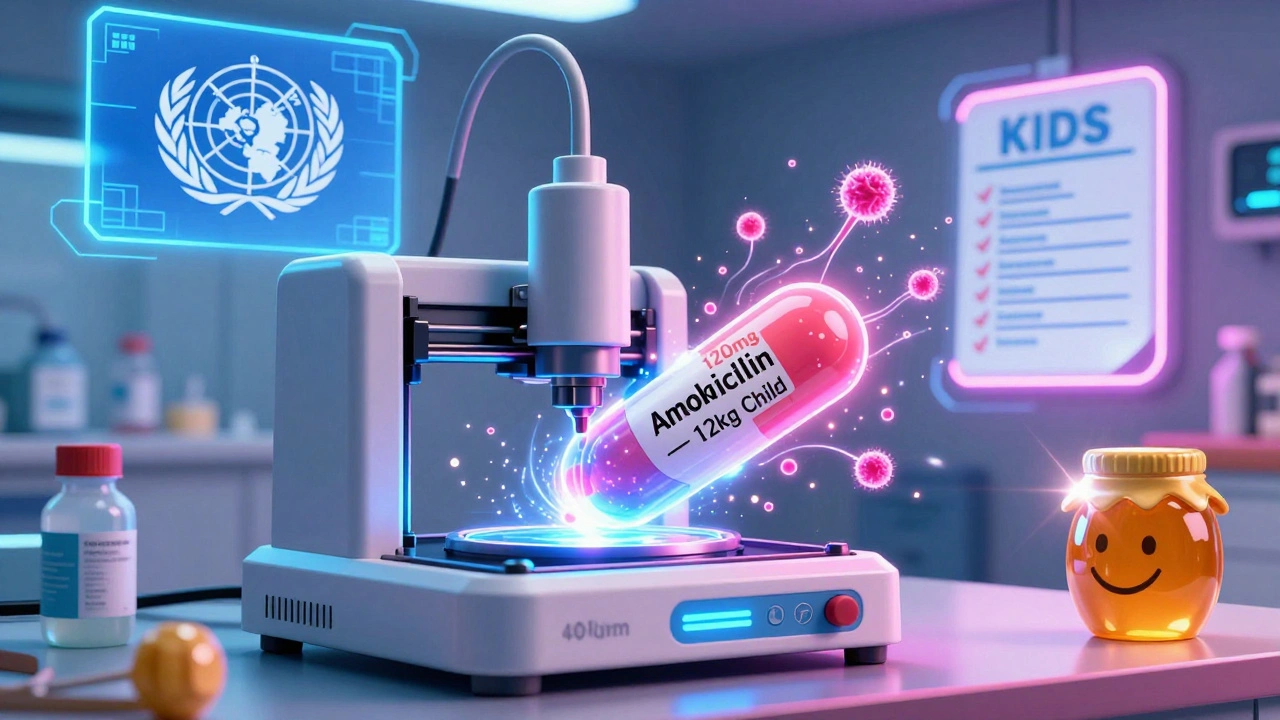
The future is already here. Cincinnati Children’s Hospital is testing 3D-printed pills tailored to a child’s exact weight. A 12 kg toddler gets a pill with exactly 120 mg of amoxicillin-no measuring, no guessing. Nanoparticle delivery systems are being tested to help neonates absorb drugs better through their immature guts.
The WHO’s 2025 Access to Medicines Framework wants 90% of essential pediatric drugs available in low-income countries by 2030. Right now, only 34% are available there. That’s not just a gap-it’s a crisis.
What’s driving change? The Pediatric Research Equity Act (PREA). Since 2003, it’s forced drug companies to study kids. Before PREA, only 12% of new drugs had pediatric data. Now, it’s 89%. That’s progress. But it’s not enough. Forty percent of pediatric drug development programs still fail-mostly because the formulation doesn’t work for kids.
Children deserve medicines made for them-not scaled-down versions of adult pills. The science knows it. The guidelines say it. The data proves it. Now, the system just needs to catch up.

Comments (9)
Ignacio Pacheco December 2 2025
So let me get this straight-we’re giving toddlers liquid medicine that tastes like regret, and we’re surprised they spit it out? The real tragedy isn’t the dosing errors-it’s that we still treat kids like tiny, screaming adults who just need a smaller pill.
Vincent Soldja December 3 2025
Formulations matter. Dosing matters. But most parents don’t care until their kid vomits the medicine or gets hospitalized. Then it’s the pharmacist’s fault. Always.
Chloe Madison December 4 2025
Every parent should have a calibrated syringe in their medicine cabinet-not a kitchen spoon. Every. Single. One. This isn’t optional. It’s basic safety. And yes, I’m yelling this from the rooftops because I’ve seen what happens when people wing it.
Gavin Boyne December 4 2025
Let’s be real-pharma companies don’t care about kids. They care about profit margins. That’s why there’s no flavored amoxicillin in 90% of the world. Why bother when you can sell adult pills and let parents play guess-the-dose? It’s not negligence-it’s capitalism. And we’re all complicit.
Meanwhile, in India, a mother gives her 18-month-old half a tablet because the bottle says ‘for children’ and she’s too tired to Google. She’s not stupid. She’s exhausted. And the system failed her before she even opened the bottle.
We need 3D-printed pills. We need universal concentrations. We need pediatric pharmacists in every rural clinic. Not in 2030. Now.
And no, honey doesn’t ‘just work.’ It works because it’s sweet, not because it’s magic. But we’d rather blame the child than fix the system.
sagar bhute December 6 2025
Why do Western countries even bother with this? In India, we’ve been giving kids crushed adult tablets for decades. No one dies. No one complains. Your over-medicalized fear culture is what’s making kids fragile. Stop treating children like lab rats.
shalini vaishnav December 6 2025
Oh please. Your ‘KIDs List’ is just another Western bureaucratic overreach. In my country, children are raised on natural remedies and parental intuition. Why does your society need a 200-page dosing manual for acetaminophen? It’s absurd. You’ve turned parenting into a PhD thesis.
And don’t get me started on ‘flavored suspensions.’ Sugar-coating medicine is not medicine-it’s corporate manipulation. Real children don’t need fruit punch to survive.
Gene Linetsky December 8 2025
Ever wonder why the FDA lets Big Pharma get away with this? They’re hiding something. Those ‘safe’ pediatric doses? They’re based on studies funded by the same companies that make the drugs. And guess what? The 3D-printed pills? That’s not innovation-it’s a tracker. They’re embedding microchips to monitor compliance. You think that’s a coincidence? Wake up.
Jim Schultz December 9 2025
Let’s not forget: 42% of dosing errors come from kitchen spoons. That’s not a statistic-it’s a national disgrace. And yet, pharmacies still sell those godforsaken ‘measuring cups’ that hold 5 mL when they’re supposed to be 2.5. Who approved this? Who signed off? Someone’s getting paid to keep kids sick.
And don’t even get me started on the fact that amoxicillin comes in THREE different concentrations-and no one tells you which one to use. It’s a minefield. A pharmacy nightmare. A parent’s worst nightmare.
Meanwhile, the WHO is talking about ‘access to medicine’ in low-income countries? Please. The real access problem is here, in the suburbs, where the mom with the 18-month-old is holding a syringe like it’s a bomb defusal kit.
Joykrishna Banerjee December 11 2025
While we're busy debating flavored suspensions and 3D-printed pills, the real issue is epistemological: the ontological reduction of pediatric pharmacology to mere pharmacokinetic variables. The child, as a phenomenological subject, is erased in favor of weight-based algorithms and FDA-sanctioned protocols. The real tragedy isn’t dosing-it’s the epistemic violence of quantifying human vulnerability into milligrams per kilogram.
And let’s not forget: the KIDs List is a neoliberal apparatus disguised as safety. It doesn’t save children-it commodifies parental anxiety. You want change? Dismantle the medical-industrial complex. Not the syrup.