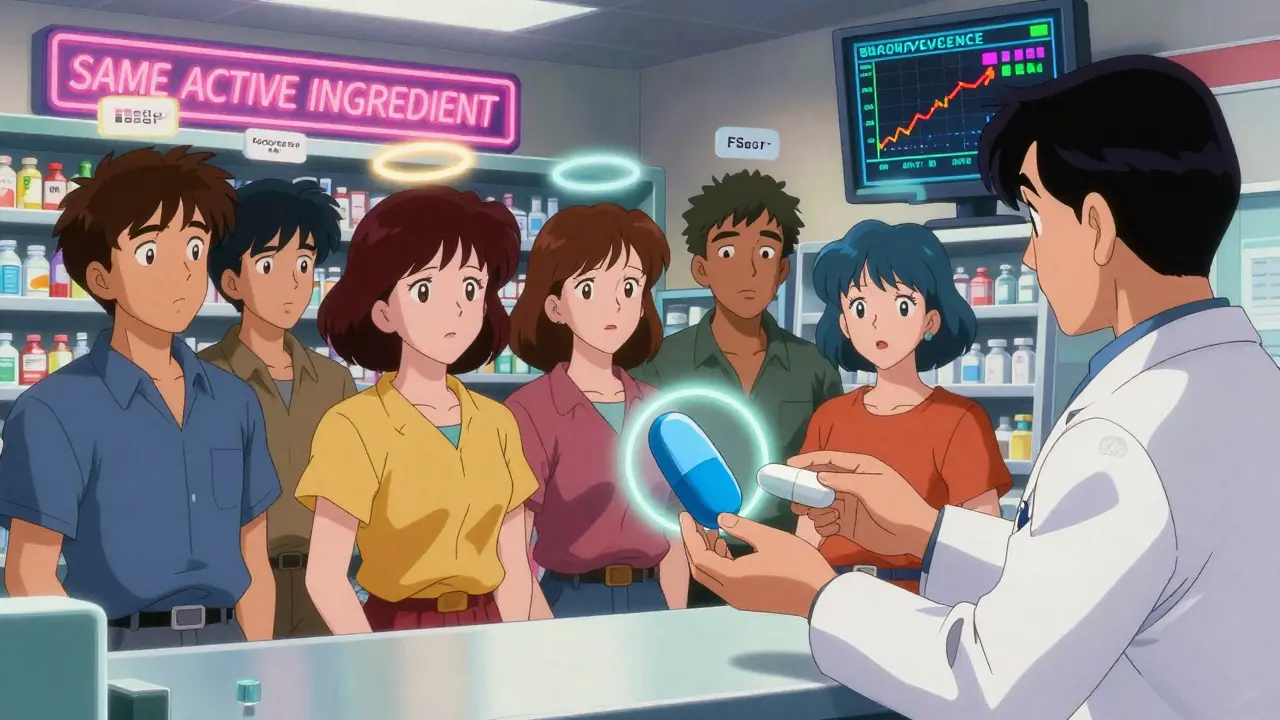
Every year, millions of people in the U.S. fill prescriptions for generic drugs - and most don’t even notice the difference. Yet, if you ask a patient why they’re taking a generic version of their blood pressure pill, you might hear, “I don’t trust it.” Or worse: “My doctor said it’s the same, but I still want the blue pill.” This isn’t just about price. It’s about psychology, trust, and the invisible weight of branding in medicine.
Generics Are Not Second-Class Drugs
The FDA requires generic drugs to meet the same standards as brand-name drugs. Same active ingredient. Same strength. Same way it’s taken - tablet, capsule, injection. The only differences? Color, shape, and price. And even those aren’t random. The FDA’s “Look Alike Sound Alike” program has cut patient confusion by 37% since 2018 by standardizing how generics look and are labeled.
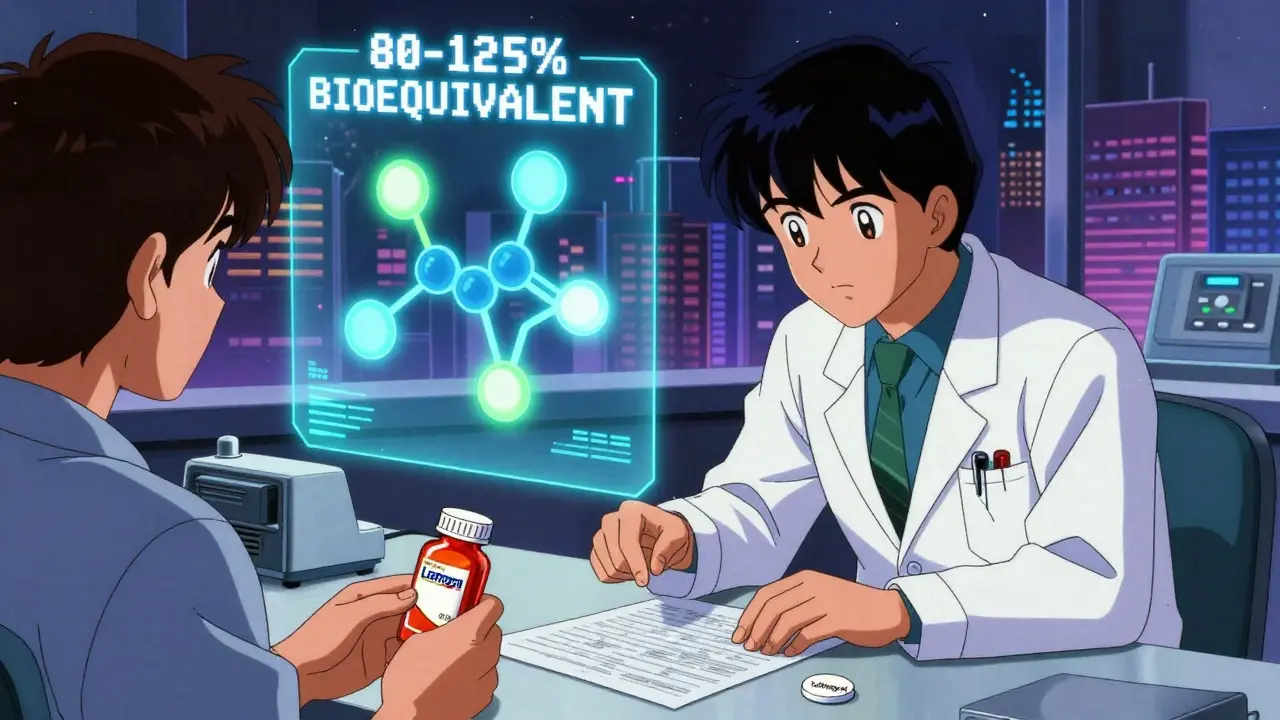
Before a generic drug hits the shelf, it must prove it delivers the exact same amount of medicine into your bloodstream as the brand-name version. That’s called bioequivalence. The standard? The generic’s absorption rate must fall within 80-125% of the brand’s. That’s not a guess. It’s science. And it’s tested on real people - not just in labs.
Manufacturing facilities for generics are inspected just as often as those for brand-name drugs. In 2022, the FDA conducted over 1,500 inspections worldwide - half of them at generic drug plants. No shortcuts. No exceptions. If a facility fails, it’s shut down. Same rules. Same consequences.
Doctors Know Generics Work - But They Don’t Always Prescribe Them
Here’s the paradox: The American College of Physicians says doctors should prescribe generics whenever possible. The evidence? Patients on generics are 6% more likely to stick with their medication. That means fewer hospital visits, fewer complications, and lower costs across the system.
Yet, only 72% of new prescriptions are written as generics, even though 89% of all filled prescriptions are. Why the gap? Because doctors don’t always start with the generic. They often default to the brand - especially in hospitals, private practices, or when they’re unsure how a patient will react.
One study of Saudi physicians found that 47% of primary care doctors prescribed generics regularly, but only 22% of private specialists did. In Greece, half of doctors said generics were “high or very high” quality - yet only 25% actually prescribed them. Knowledge doesn’t equal action.
Even when doctors believe in generics, they’re caught in the middle. Forty-one percent say patients sometimes pressure them to prescribe the brand-name version. Forty percent say patients demand the generic. That’s a lot of pressure. And when a patient walks in and says, “I’ve always taken the blue pill,” it’s easier to write the brand than to explain why the white one is just as good.
Why Patients Don’t Trust Generics - Even When They Should
Patients aren’t irrational. They’re responding to cues they’ve been given - often without realizing it.
Think about it: Brand-name drugs come with fancy packaging, TV ads, and names you’ve heard for decades. Lisinopril? Sounds like a chemical. Zestril? Sounds like something your doctor prescribed after a heart scare. The brand name sticks. The generic? It’s just a chemical name on a $4 bottle at Walmart.
Then there’s the physical change. A patient switches from a red, oval pill to a white, round one. Same dose. Same manufacturer. But now they’re worried. Did they get the wrong medicine? Is this weaker? Is this why my blood pressure spiked last week? These fears aren’t based on data. They’re based on appearance - and that’s powerful.
The FDA found in a 2015 study that patients often associate generic drugs with “lower quality” simply because they cost less. It’s a psychological shortcut: cheaper = worse. Even when they’re told otherwise. That’s brand psychology in action.
And it’s not just patients. Pharmacists report that 30-40% of people refuse a generic switch, even when it’s legally allowed and medically safe. One internist in Reddit’s r/medicine shared: “I had a patient insist on brand-name lisinopril costing $350/month when the generic was $4. He said, ‘I don’t care what the data says - I want the real one.’”
The Real Cost of Not Using Generics
It’s not just about what you pay at the pharmacy. It’s about what happens when you stop taking your medicine because it’s too expensive.
Studies show that patients on generics are more likely to take their medication consistently. That’s not a small thing. For people with high blood pressure, diabetes, or heart disease, skipping doses leads to ER visits, hospitalizations, and even death. A 2017 study in the American Journal of Managed Care found that better adherence from generics reduced hospitalization risk by 2.2% for chronic conditions. That’s tens of thousands of avoidable hospital stays every year.
And the savings? Massive. Generics cost 80-85% less than brand-name drugs. In 2021, the Congressional Budget Office estimated that if doctors prescribed generics for every new prescription - not just the ones filled - Medicare Part D could save $17.3 billion annually.
Canada saw something strange in 2015. After generic versions of three blood pressure drugs launched, ER visits and hospitalizations went up - by 8% to 14%. But researchers didn’t blame the generics. They suspected patients stopped taking their meds because they didn’t recognize the new pills. The problem wasn’t the drug. It was the switch.
When Generics Aren’t the Right Choice
There are exceptions. Not because generics are unsafe - but because some drugs are incredibly sensitive.
The FDA keeps a list of 15 drugs with a narrow therapeutic index - meaning tiny differences in blood levels can cause big problems. Think thyroid meds like levothyroxine, seizure drugs like phenytoin, or blood thinners like warfarin. For these, even a 5% change in absorption could mean your condition isn’t controlled.
In those cases, doctors may stick with one brand - or require patients to stay on the same generic manufacturer. It’s not about distrust. It’s about precision. And even then, multiple generic versions are approved and safe - they just need to be monitored closely.
Complex drugs like inhalers or topical creams also pose challenges. Patients may struggle with the new delivery device. The generic inhaler might feel different. The cream might not spread the same. That doesn’t mean it’s less effective. But it can make patients feel like something’s wrong.

What’s Changing - And What’s Not
Things are slowly shifting. Since 2015, 68% of internal medicine residency programs now teach generic prescribing. That’s up from 29%. More doctors are learning early that generics aren’t a compromise - they’re the standard.
Also, the FDA’s Generic Drug User Fee Amendments (GDUFA) cut approval times from 36 months to 10. More generics are entering the market faster. That drives prices down even more.
But the biggest barrier isn’t science. It’s perception. Patients still equate cost with quality. Doctors still default to brands out of habit or fear of pushback. And the system doesn’t always make switching easy.
One simple fix? Better communication. When a pharmacist switches your pill, they should explain why. When a doctor writes a prescription, they should say: “This is the same medicine, just cheaper. You’ll get the same results.” That’s not just helpful - it’s necessary.
The FDA’s Dr. Sarah Ibrahim put it best: “Patients are more likely to stop taking their generic medications when they experience a change.” That’s not about the drug. It’s about the message.
What You Can Do
- Ask your doctor: “Is there a generic version of this?” If they say no, ask why.
- If you’re switched to a generic, check the label. Is it the same active ingredient? If yes, it’s safe.
- Don’t assume a different-looking pill is weaker. Color and shape don’t affect how it works.
- If you feel worse after switching, talk to your doctor - but don’t assume it’s the generic. It might be something else.
- Use mail-order pharmacies or discount programs. Generics at Walmart, Costco, or CVS can cost under $4 - even for brand-name equivalents.
Medicine isn’t about logos. It’s about what’s inside the pill. And for over 90% of prescriptions, that’s exactly the same - whether it’s branded or generic.

Comments (12)
Radhika M December 16 2025
My mom switched to generic blood pressure meds last year and her numbers are better than ever. She used to freak out about the color change, but her pharmacist sat down with her and showed her the label. Same active ingredient. Same results. No magic pills, just science.
Philippa Skiadopoulou December 17 2025
The data is unequivocal. Generics meet identical bioequivalence standards. The psychological resistance stems from marketing-induced conditioning, not pharmacological disparity.
Pawan Chaudhary December 17 2025
Love this post. Seriously. I used to be the guy who only wanted the blue pill too. Then I found out my generic was made by the same company as the brand. Mind blown. Saved me $300 a month. Life’s better when you’re not broke.
Jonathan Morris December 17 2025
Let’s not pretend the FDA isn’t influenced by pharma lobbying. The 80-125% bioequivalence window is a joke. That’s a 45% swing in absorption. You think that’s safe for cardiac patients? They’re testing on healthy volunteers, not the elderly with comorbidities. This is corporate medicine in a white coat.
Linda Caldwell December 19 2025
Generics saved my life. I had diabetes and was skipping doses because I couldn’t afford the brand. Switched to generic metformin and now I’m running 5Ks. Stop letting branding scare you. Your body doesn’t care what color the pill is. It just wants the medicine.
Anna Giakoumakatou December 21 2025
How quaint. We’ve reduced medicine to a Walmart bargain bin, yet somehow expect the same biological precision as a Swiss watch. The placebo effect is the only thing keeping half of us alive. At least the blue pill makes you feel like you’re not living in a dystopian pharmaceutical hellscape.
CAROL MUTISO December 21 2025
It’s wild how we treat pills like they’re sacred relics instead of molecules. We’ll pay $300 for a blue oval because it has a logo, but the white circle with the same chemical structure? ‘Too cheap to work.’ We’ve turned healthcare into a luxury brand where the active ingredient is an afterthought. The real tragedy isn’t the cost-it’s that we’ve forgotten medicine is supposed to heal, not impress.
I had a patient cry last week because her insurance switched her from brand to generic. She said, ‘I feel like I’m taking a knockoff.’ I showed her the FDA bioequivalence report. She stared at it for ten minutes. Then she whispered, ‘So… it’s really the same?’ I said yes. She hugged me. We both cried.
Erik J December 23 2025
Interesting how the FDA inspections are evenly split between brand and generic plants. But do they inspect the same frequency per facility? Or just total numbers? The sample size for smaller generic manufacturers might be statistically insignificant.
Martin Spedding December 24 2025
Generics are fine unless you’re on warfarin. Then you’re playing russian roulette with your blood. My uncle died because he switched and his INR went nuts. Pharma’s lying. Always is.
Donna Packard December 26 2025
I switched my dad to generic lisinopril after his heart attack. He was scared. We talked about it for an hour. Now he says it’s the best decision he ever made. No side effects. Lower bill. Same results. Sometimes the simplest fix is the right one.
Patrick A. Ck. Trip December 26 2025
It is my humble opinion that the psychological burden associated with pharmaceutical branding is a manifestation of societal commodification of health. The pill’s color is not the issue. The loss of perceived trust is.
Sam Clark December 27 2025
For patients on narrow therapeutic index drugs, consistency matters. If you switch generics, track your labs. If you feel off, speak up. But don’t assume the generic is the problem. Most of the time, it’s not. The system just doesn’t prepare you for the change.