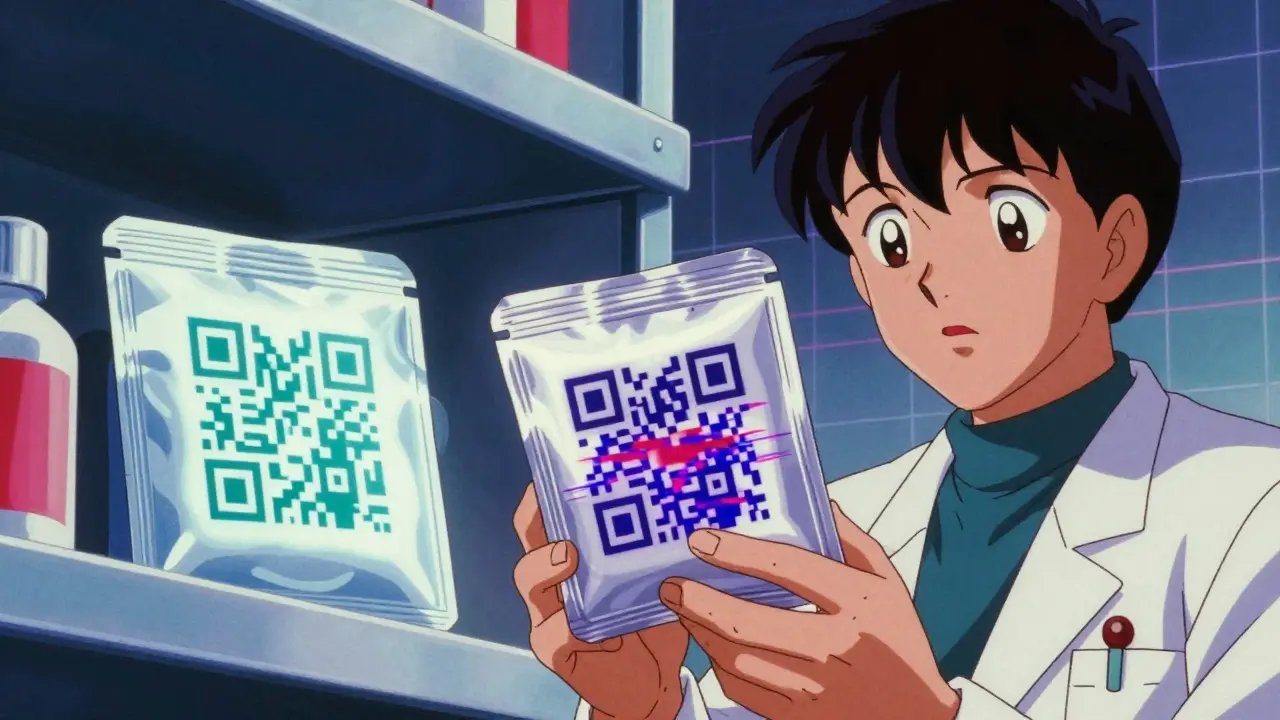
Every year, over 1 million people die from counterfeit medications. The World Health Organization estimates $200 billion in fake drugs flood the global market annually. Online pharmacies are especially vulnerable-without proper checks, patients might receive sugar pills instead of life-saving treatments.
Here's the scary part: counterfeit drugs often look identical to real ones. They might lack active ingredients, contain toxic substances, or have wrong dosages. For example, fake malaria drugs in Africa have caused thousands of preventable deaths. This isn't just a financial problem-it's a public health emergency.
How blockchain verifies drugs
Blockchain is a distributed ledger technology that creates an immutable record of transactions. In drug verification, each package gets a unique digital ID that's tracked through the supply chain.
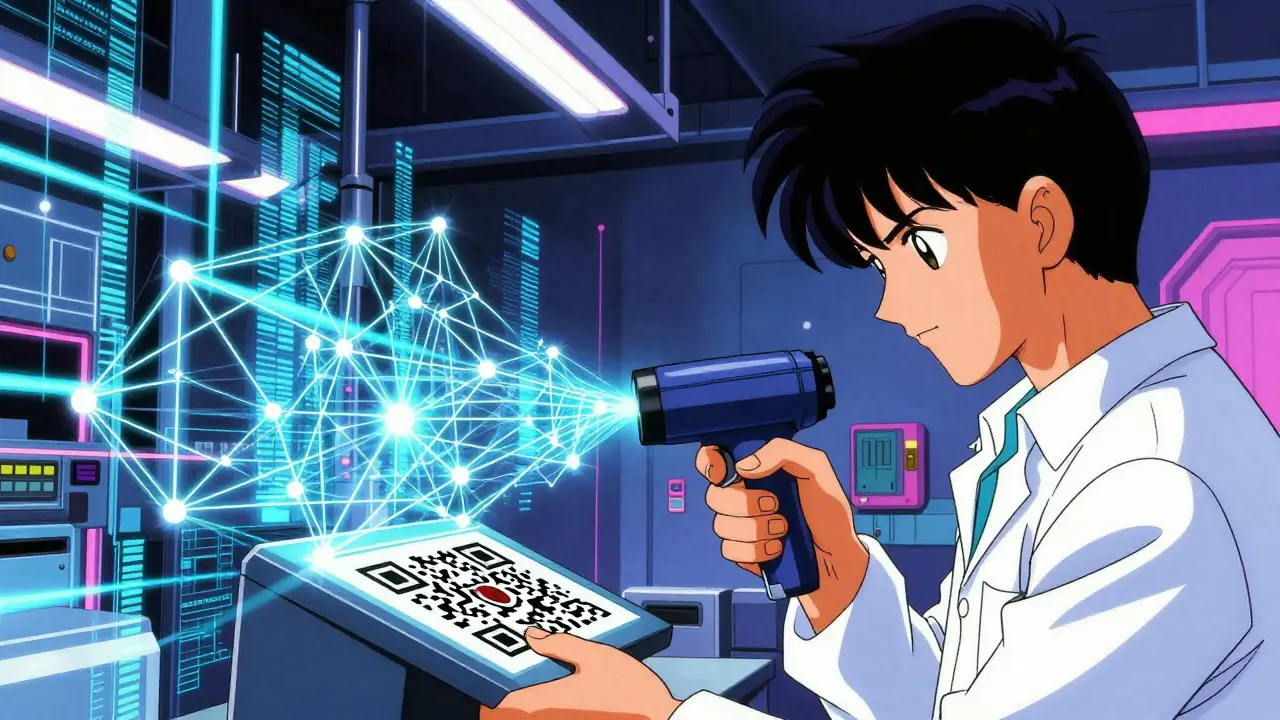
Here's how it works: when a drug is manufactured, it receives a unique serial number (following GS1 standards). This number is printed as a QR code on the packaging. At every step-shipping, distribution, pharmacy receipt-the barcode is scanned and recorded on a blockchain. Because blockchains are tamper-proof, any attempt to alter records would be immediately detected.
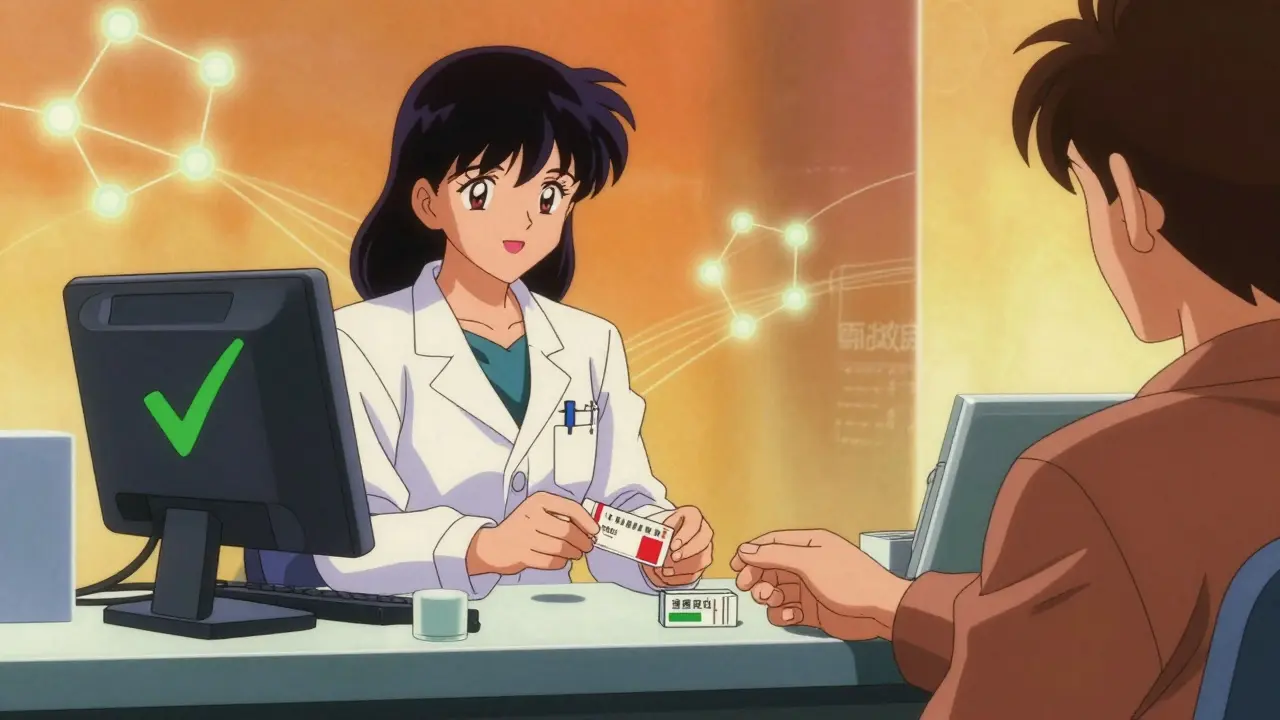
The Drug Supply Chain Security Act (DSCSA), passed in 2013, requires electronic tracking of prescription drugs in the U.S. by 2023. Drug Supply Chain Security Act (DSCSA) is a US law requiring electronic tracking of prescription drugs. Blockchain meets this requirement perfectly. Unlike traditional databases, which can be hacked or altered, blockchain creates a permanent, transparent history. When a pharmacist scans a drug at the point of sale, the system checks the blockchain in under 2.3 seconds to confirm authenticity.
Real-world success stories
The MediLedger Project, launched in 2017 by EY, is a leading example. MediLedger Project is a blockchain-based supply chain verification system used by pharmaceutical companies. It connects major pharmaceutical companies like Pfizer and Genentech on a shared blockchain network. In a 2022 FDA pilot, the system achieved 99.8% accuracy in verifying drugs. One pharmacy chain reported verification time dropped from 15 minutes to 45 seconds per batch.
India's Apollo Hospitals implemented blockchain across 5,000 pharmacies and cut counterfeit antimalarials by 94%. Meanwhile, Alibaba's Ali Health platform in China tracks drug authenticity for millions of consumers daily. These aren't theoretical experiments-they're saving lives right now.
Benefits for pharmacies and patients
Blockchain isn't just about stopping fakes-it saves money too. HIMSS found that blockchain systems generate $183 million in annual labor savings for U.S. pharmacies. They also free up $20 billion in safety stock inventory because pharmacies no longer need to overstock drugs to guard against counterfeits.
For patients, this means safer medications and faster access. When a pharmacist can instantly verify a drug, there's no delay in treatment. During emergencies, like natural disasters, blockchain ensures critical drugs reach those in need without fraud.
Challenges and limitations
Adopting blockchain isn't simple. The initial cost is high-about $2.1 million for a mid-sized pharma company. Smaller generic manufacturers often can't afford this. Integration with legacy systems takes 6-9 months and requires significant IT resources.
Connectivity issues also plague rural areas. Reddit users in r/Pharmacy reported 63% of respondents face "spotty internet" during verification, causing delays. Dr. Sarah Wynn-Williams of the London School of Economics warns: "Blockchain only tracks documentation, not physical product integrity. Without supplementary checks, it can create a false sense of security."
According to the Generic Pharmaceutical Association, 63% of generic drug manufacturers cite unclear ROI as their primary adoption barrier. Permissioned blockchains use 97% less energy than public ones, but the complexity of integrating with existing systems remains a hurdle.
The future of blockchain in drug safety
The FDA announced new Blockchain Verification Standardization Guidelines in May 2024, effective January 2026. These will standardize how blockchains interact across supply chains. Recent updates include MediLedger's Version 4.2, which uses AI to reduce false positives by 37%.
Market research predicts the global pharmaceutical blockchain market will grow from $427 million in 2023 to $3.8 billion by 2028. As costs decrease and technology matures, blockchain is expected to become the standard for 95% of prescription drugs in developed markets by 2030. For now, though, the focus remains on solving real-world problems one verification at a time.
Frequently Asked Questions
How does blockchain prevent counterfeit drugs?
Blockchain creates a tamper-proof digital record for each drug package. Every time a drug is handled-manufactured, shipped, or sold-the transaction is logged on the blockchain. Since the ledger is distributed across multiple parties, no single entity can alter the data. When a pharmacist scans a QR code, the system checks the blockchain instantly. If the drug's history doesn't match the expected path, it's flagged as counterfeit. In FDA pilots, this method reduced counterfeit detection to 0.2%, compared to 38% for traditional methods like holograms.
Is blockchain used in online pharmacies today?
Yes, but adoption varies. Major online pharmacies like Amazon Pharmacy and CVS use blockchain for high-value prescription drugs. However, smaller online pharmacies often lack the resources for full implementation. The FDA's 2022 pilot showed that blockchain verification works best in regulated environments with standardized serialization. While 89% of top pharmaceutical companies have blockchain initiatives, only 8% of individual online pharmacies have adopted it as of Q2 2024.
What's the role of DSCSA in blockchain verification?
The Drug Supply Chain Security Act (DSCSA) mandates electronic tracking of prescription drugs in the U.S. by 2023. Blockchain provides the perfect infrastructure for this requirement. Unlike paper-based systems or isolated databases, blockchain creates a unified, tamper-proof record that all supply chain partners can access. This interoperability is crucial-without it, the system would fail. The FDA's 2022 pilot confirmed that blockchain is the only method meeting DSCSA's stringent requirements for end-to-end traceability.
Can blockchain stop all counterfeit drugs?
Not entirely, but it drastically reduces the risk. Blockchain verifies the digital trail of a drug package, but it doesn't check the physical contents. For example, a fake drug could have the correct QR code but still be counterfeit if it's made with wrong ingredients. However, when combined with physical testing (like spectroscopy), blockchain becomes nearly foolproof. The FDA's pilot showed 99.8% accuracy in detecting counterfeit drugs when blockchain was used alongside lab tests. For most scenarios, this level of security is more than sufficient.
Why isn't blockchain used everywhere yet?
Cost and complexity are the main barriers. Implementing blockchain requires new hardware, software, and staff training. For a mid-sized pharmaceutical company, the initial investment is around $2.1 million-compared to $1.7 million for traditional serialization. Smaller generic manufacturers often can't justify this expense. Additionally, integrating blockchain with legacy pharmacy management systems can take 6-9 months. As costs decrease and standards improve, adoption will accelerate, but it's a gradual process.

Comments (12)
Pamela Power February 6 2026
Blockchain is the latest silver bullet being sold to gullible healthcare administrators. It's all smoke and mirrors-costly, complex, and utterly impractical for the majority of pharmacies. Remember the 63% of rural pharmacies struggling with internet connectivity? This 'solution' ignores basic infrastructure realities. The real issue is corrupt supply chains, not technology. Fix that first, then we can talk about blockchain. The FDA's pilot data shows mixed results, and the cost for mid-sized pharma is $2.1 million? That's a joke. This isn't saving lives; it's enriching consultants. Stop the hype.
anjar maike February 8 2026
Blockchain is cool 🌟 but internet in rural areas is bad 😕 Costs are high 💸 but safety is worth it ✅
Cole Streeper February 9 2026
Blockchain is a tool for Big Pharma to control the market. They're using it to push out smaller generic manufacturers. This is all about monopolizing drug supply chains. The DSCSA? It's just a front for corporate control. We need to stop this before it's too late.
Dina Santorelli February 10 2026
Blockchain sounds good on paper but in reality it's a disaster. The costs are insane and it doesn't even solve the real problem. They're just throwing tech at it without thinking. Classic case of solutionism.
divya shetty February 11 2026
Blockchain is the only viable solution to the counterfeit drug crisis. Without it, patients are at risk. The Indian government should mandate this immediately. It's not optional-it's a moral imperative.
Phoebe Norman February 13 2026
It works.
Albert Lua February 13 2026
Blockchain is a game-changer for global drug safety. In India, Apollo Hospitals cut counterfeit antimalarials by 94% across 5,000 pharmacies.
Alibaba's Ali Health in China tracks millions of drugs daily.
The MediLedger Project, used by Pfizer and Genentech, achieved 99.8% accuracy in FDA pilots.
These aren't just numbers-they're lives saved.
The cost is high upfront, but the long-term savings are massive.
HIMSS reports $183 million in annual labor savings for US pharmacies.
Plus, $20 billion in safety stock inventory freed up.
For patients, this means faster access during emergencies.
Yes, there are challenges: rural internet issues, integration costs.
But the tech is evolving fast.
FDAs new guidelines in 2024 will standardize this.
As costs drop, adoption will accelerate.
This is the future.
Forget the naysayers-real-world results speak for themselves.
It's not perfect, but it's the best tool we have right now.
Let's focus on improving it, not dismissing it.
The data is clear: blockchain works when implemented properly.
Stop the fearmongering and get behind this.
Katharine Meiler February 13 2026
Blockchain integration requires careful planning but the ROI is clear.
The DSCSA compliance is non-negotiable and blockchain is the only way to achieve it.
With proper implementation, the benefits far outweigh the costs.
HIMSS data shows $183 million in annual labor savings for US pharmacies alone.
Plus, $20 billion in safety stock inventory freed up.
The MediLedger Project's 99.8% accuracy in FDA pilots proves its effectiveness.
Yes, there are challenges like rural internet, but solutions are emerging.
The FDA's new guidelines in 2024 will standardize this further.
This isn't about tech for tech's sake-it's about patient safety.
We need to push for adoption, not fearmongering.
The data speaks for itself.
Rene Krikhaar February 15 2026
Blockchain isn't perfect but it's the best tool we have right now.
The MediLedger Project has shown 99.8% accuracy in FDA pilots.
For pharmacies, verification time dropped from 15 minutes to 45 seconds.
That's huge.
Yes, there are challenges like rural internet but solutions are being developed.
The FDA's new guidelines will help standardize this.
It's not just about tech-it's about saving lives.
Every time a pharmacist scans a drug and it's verified instantly, that's a life saved.
Let's keep pushing for better implementation.
In India, Apollo Hospitals cut counterfeit antimalarials by 94% across 5000 pharmacies.
Alibaba's platform in China handles millions daily.
These are real-world examples.
The cost is high upfront but the savings in labor and inventory are massive.
$183 million annually for US pharmacies alone.
We need to focus on scaling this tech.
It's not about hype-it's about making drugs safer for everyone.
Let's work together to make it happen.
Dr. Sara Harowitz February 15 2026
Blockchain is a critical tool for drug safety, but it's being oversold.
The reality is that it's not a silver bullet-physical verification is still needed.
The FDA's pilot shows 99.8% accuracy when combined with lab tests, but alone it's not enough.
We need to stop pretending it's perfect.
Jennifer Aronson February 16 2026
While blockchain has limitations, it's still the most effective tool we have for tracking drugs.
The real issue is implementation-not the technology itself.
With proper standards and investment, it can work.
Let's focus on making it better instead of tearing it down.
Kate Gile February 16 2026
I agree. Blockchain isn't perfect but it's a huge step forward.
The key is to keep improving it while addressing real-world challenges like rural internet access.
Patient safety is worth the effort.