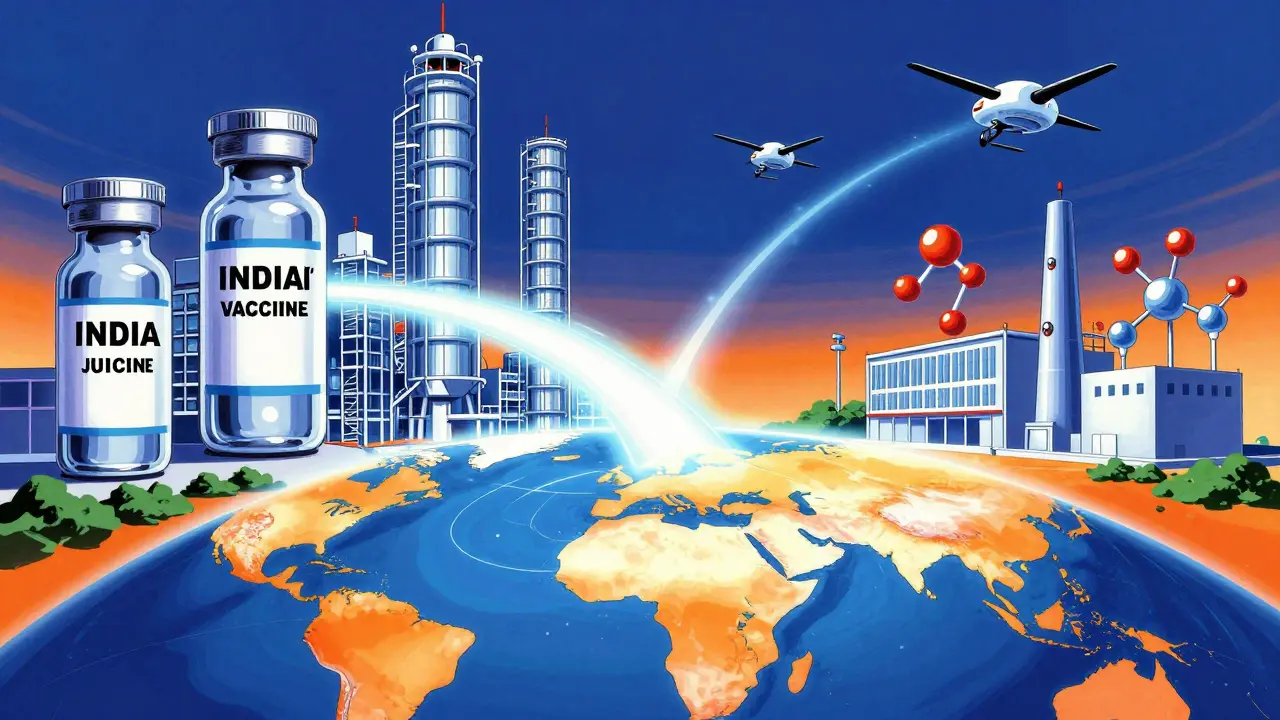
The global generic pharmaceuticals market relies heavily on India and China. India supplies over 60% of the world's vaccines and 40% of generic drugs used in the United States. China controls nearly 70% of the global supply of Active Pharmaceutical Ingredients (APIs)-the essential building blocks of medicines. These numbers reveal a stark reality: the health of billions depends on two nations and their complex pharmaceutical ecosystems. But behind the statistics lies a story of competition, collaboration, and constant change. How do India and China shape the global generic drug market? And what role do emerging economies play in this critical supply chain? Let's explore the facts.
India's role in the global generic supply chain
India earned the nickname 'pharmacy of the world' after changing its patent laws in the 1970s. Today, its India pharmaceutical market is worth $61.36 billion (Drug Patent Watch, 2024). About 75% of this comes from conventional generics, with 15% over-the-counter drugs and 10% specialty medicines. Manufacturing hubs in Gujarat (35% of production) and Maharashtra (25%) host over 3,000 FDA-approved facilities. Yet India depends heavily on China for Active Pharmaceutical Ingredients (APIs). Despite initiatives like 'Pharma Vision 2020', India imports 68% of its API needs from China, creating supply chain vulnerabilities as global regulators tighten quality controls.
China's dominance in pharmaceutical manufacturing
China leads the global pharmaceutical market with $80.4 billion in 2024 (Drug Patent Watch, 2024). Its output includes 60% conventional drugs, 25% Traditional Chinese Medicine (TCM), and 10% biologics. TCM exports alone reached $12.7 billion in 2024, a 9.2% increase from 2023 (China Pharmaceutical Industry Association, 2024). China produces 70% of the world's APIs, making it a critical player in the global supply chain. However, quality issues persist. The U.S. FDA issued 142 warning letters to Chinese manufacturers in 2024 compared to 87 for Indian facilities (U.S. FDA, 2024), forcing many global buyers to adopt dual-sourcing strategies.
India vs China: Volume versus value
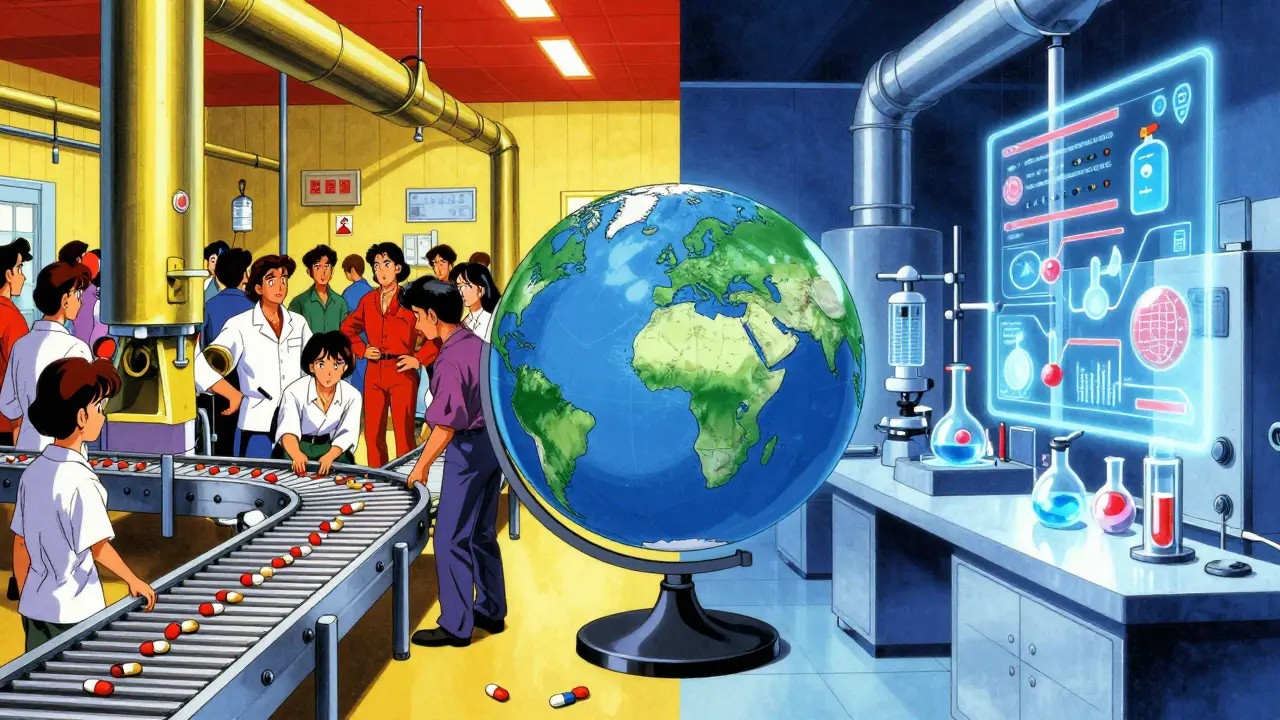
Comparing these two giants reveals a clear divide. India ranks third globally by production volume but only 14th by market value. China holds first or second place in volume while ranking second in market value (Drug Patent Watch, 2024). This gap shows India's focus on low-margin generics versus China's shift toward higher-value products. For example, India exported $24.2 billion in pharmaceuticals in 2024 with 87% generics. China exported $48.7 billion, but only 63% were generics-the rest includes biologics and TCM. Innovation metrics highlight the divide: India exports just 1.2% novel drugs versus China's 8.5% (World Health Organization, 2024). Yet India maintains advantages in responsiveness. A U.S. pharmacy chain executive noted on LinkedIn in April 2025 that 'India's 24/7 customer support model for generic drug inquiries has reduced our operational issues by 60% compared to Chinese suppliers.'
| Metric | India | China |
|---|---|---|
| Market Size | $61.36 billion | $80.4 billion |
| Pharmaceutical Exports | $24.2 billion | $48.7 billion |
| Generics in Exports | 87% | 63% |
| API Production Share | - | 70% |
| Novel Drug Exports | 1.2% | 8.5% |
Emerging economies filling the gaps
While India and China dominate, smaller Asian nations are carving out niches. Vietnam's pharmaceutical exports grew 24.7% in 2024 to $2.8 billion, primarily in antibiotic intermediates (East West Basics, 2025). Cambodia's medical device assembly sector hit $1.2 billion (32% growth) through ASEAN trade preferences. These countries benefit from lower costs and specialized production. For instance, Vietnamese manufacturers now supply 15% of global antibiotic intermediates, while Cambodian factories assemble low-cost medical devices for regional markets. This diversification helps global supply chains become more resilient.
Current trends shaping the future
Both India and China are making strategic shifts. India's 'Pharma 2047' initiative allocates $13.4 billion to reduce API imports from 68% to 30% by 2030, with 12 new API parks under construction (Indian Ministry of Chemicals and Fertilizers, 2025). China's 'Healthy China 2030' amendment redirects $22.8 billion toward biologics innovation, targeting 25% of exports as high-value biologics by 2030 (China State Council, 2025). Meanwhile, the U.S. FDA's 'Project BioSecure' requires API traceability, which could increase compliance costs by 18-22% for Asian manufacturers (FDA Guidance Document, December 2024). Major U.S. pharmacy chains now source 40-60% of generics from India and 25-35% from China to mitigate risks (Drug Store News Survey, March 2025).
Challenges and the path forward
The path forward isn't smooth. S&P Global Ratings warns that 'overcapacity in API production could trigger 15-20% price corrections in 2026-2027 as both nations pursue self-sufficiency' (S&P Global Ratings, April 2025). Quality control remains a critical challenge. The WHO reported a 27% increase in inspection failures at Asian facilities in 2024 compared to 2023 (WHO Global Benchmarking Tool Report, January 2025). However, the growing demand for affordable medicines-especially in developing regions-ensures these markets will remain central to global healthcare. As Dr. Rajesh Gupta of the Indian Pharmaceutical Alliance notes, 'India's demographic dividend-65% of population under 35-combined with digital health infrastructure investments will accelerate India's transition to biosimilars production' (India Avenue, 2024).
What is the main difference between India and China in the generic drug market?
India excels in volume production of low-cost generics, while China focuses on higher-value products like biologics and Traditional Chinese Medicine. India ranks third globally by production volume but only 14th by market value, whereas China ranks first or second in volume and second in market value. India exports 87% generics, while China's exports are 63% generics with the rest being higher-value items.
Why does India rely on China for Active Pharmaceutical Ingredients (APIs)?
Despite initiatives like 'Pharma Vision 2020', India's domestic API production meets only 18% of its total needs. China supplies 68% of India's API requirements due to lower production costs and established manufacturing infrastructure. This dependency creates supply chain risks, especially as global regulators tighten quality controls on APIs.
How are emerging economies like Vietnam and Cambodia contributing to the generic drug market?
Vietnam's pharmaceutical exports grew 24.7% in 2024 to $2.8 billion, focusing on antibiotic intermediates. Cambodia's medical device assembly sector reached $1.2 billion with 32% growth, leveraging ASEAN trade preferences. These countries fill niche roles-Vietnam supplies 15% of global antibiotic intermediates, while Cambodia assembles low-cost medical devices-making global supply chains more resilient by diversifying sources.
What are the biggest challenges facing India and China's pharmaceutical industries?
India struggles with regulatory inconsistencies across 17 federal and state bodies, infrastructure gaps adding 12-15% to logistics costs, and heavy API import dependence. China faces quality control issues-142 FDA warning letters in 2024-and must balance rapid biologics investment with maintaining API production standards. Both nations also face potential price volatility from overcapacity in API production by 2027.
How are U.S. companies adapting to supply chain risks from Asia?
Major U.S. pharmacy chains now source 40-60% of generics from India and 25-35% from China to mitigate risks. They also implement dual-sourcing strategies for critical APIs, increase batch testing, and invest in traceability systems to comply with FDA's 'Project BioSecure'. These adjustments have increased supply chain costs by 18% for some companies but improved resilience against disruptions.

Comments (12)
Heather Burrows February 8 2026
It's interesting how the world depends on two countries for medicine.
Some might call it a vulnerability, others say it's just the way things are.
But really, shouldn't we be doing more to diversify? Or maybe not.
Who knows. Just saying.
Ritu Singh February 8 2026
India's contribution to global healthcare is undeniable.
With over 60% of vaccines and 40% of US generics, our pharmaceutical sector plays a pivotal role.
However, reliance on China for APIs is a critical vulnerability that needs strategic attention.
Collaborative efforts between nations can ensure sustainable supply chains.
Mark Harris February 9 2026
Hey everyone, India and China are doing amazing work for global health!
But we need to keep pushing for innovation and diversification.
Let's support these efforts!
Savannah Edwards February 10 2026
It's fascinating to see how India and China have become central to the global pharmaceutical supply chain.
India's 'pharmacy of the world' status comes from its ability to produce affordable generics, but the dependency on Chinese APIs is a double-edged sword.
On one hand, it's cost-effective, but on the other, it creates risks like the recent shortages we've seen.
Meanwhile, China's shift towards higher-value products like biologics shows their ambition, but quality issues persist.
It's a complex interplay of economics, politics, and healthcare needs.
We need to think about how to build resilience without sacrificing accessibility.
Maybe diversifying sources among emerging economies like Vietnam and Cambodia could help.
They're stepping up with their own niches.
It's all about balance.
Mayank Dobhal February 12 2026
India's API dependency on China is a ticking time bomb.
Marcus Jackson February 13 2026
Actually, the data shows India's 87% generics vs China's 63%-but the real issue is China's biologics growth.
They're moving up the value chain.
India's stuck in generics.
It's basic economics.
Natasha Bhala February 15 2026
so glad india and china are helping the world with medicines
even with the challenges they're doing great
we should support them more
keep it up! <3
Gouris Patnaik February 16 2026
India is the real pharmacy of the world.
China's just a supplier of raw materials.
Their quality control is a joke.
FDA warnings 142 vs 87.
India's better.
We need to reduce dependence on China.
Jesse Lord February 16 2026
its important to recognize both india and china's roles
they have strengths and weaknesses
we need to work together to build a more resilient supply chain
supporting emerging economies like vietnam and cambodia is key
lets keep the conversation going
AMIT JINDAL February 16 2026
Hey everyone, let me tell you something.
India's pharmaceutical industry is top-notch.
China's doing great too, but honestly, they're not as good as India.
We need to focus on our own strengths.
Also, the API dependency is a problem but we're fixing it.
Pharma Vision 2020 is going to save us! 😎
Catherine Wybourne February 18 2026
Oh, it's lovely how India and China are handling everything.
Just two countries for all our medicine.
Perfectly safe.
No issues there.
🙄 Maybe we should all just move to Asia and hope for the best.
Ashley Hutchins February 19 2026
India and china are the main suppliers but they have so many problems
Quality control is a mess
FDA warnings are proof
We need to stop relying on them
Its a national security issue