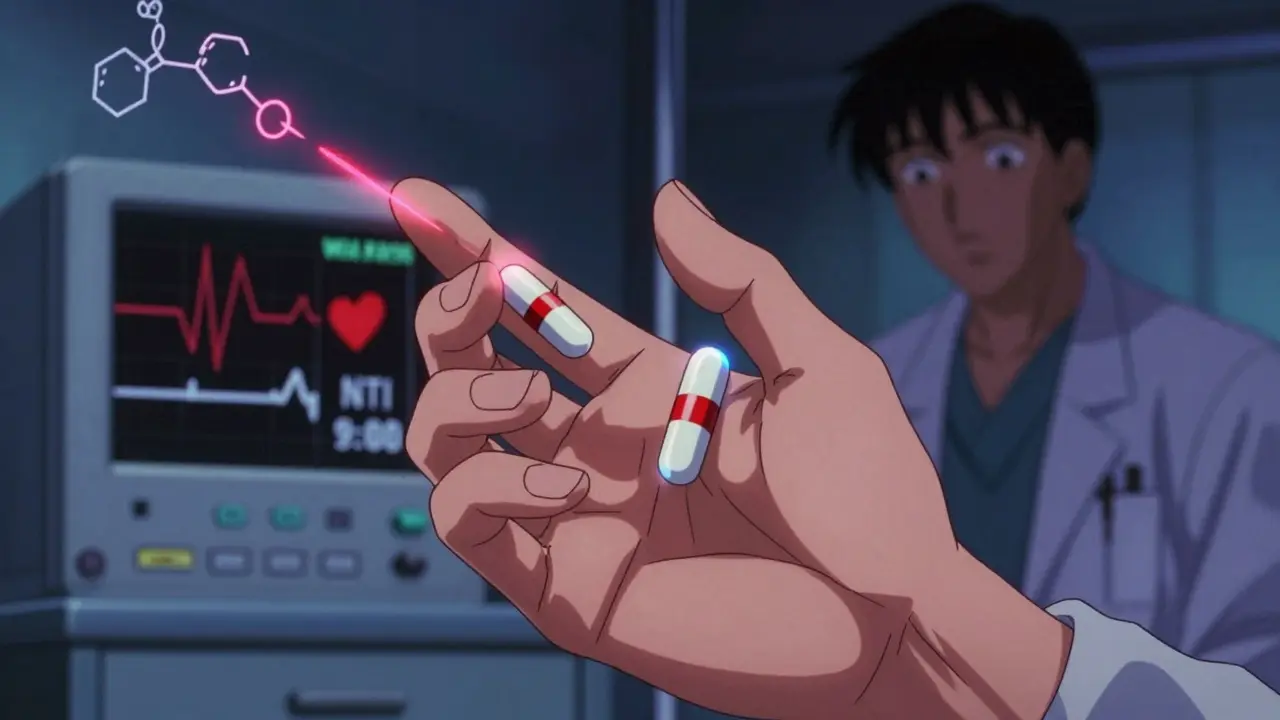
When a drug has a narrow therapeutic index (NTI), even tiny changes in how much of it gets into your bloodstream can mean the difference between healing and harm. These aren’t just any medications - they’re the ones where a little too much can cause toxicity, and a little too little can let your condition flare up. Think warfarin, digoxin, levothyroxine, or phenytoin. For patients taking these drugs, switching from a brand-name version to a generic isn’t like switching brands of laundry detergent. It’s a high-stakes decision. That’s why regulators have put in place some of the strictest bioequivalence rules in the entire pharmaceutical world.
What Makes a Drug a Narrow Therapeutic Index Drug?
A drug is classified as having a narrow therapeutic index when the difference between an effective dose and a toxic dose is very small. The FDA uses a cutoff of a therapeutic index ≤ 3 to define these drugs - meaning the dose that causes harm is no more than three times higher than the dose that works. That might sound abstract, but here’s what it looks like in real life: if you’re on levothyroxine for hypothyroidism, a 10% change in blood levels could push you from feeling fine to experiencing heart palpitations or anxiety. For someone on warfarin, that same shift could mean a dangerous blood clot or a life-threatening bleed.
These aren’t new concerns. Doctors have been monitoring blood levels of drugs like phenytoin and digoxin since the 1970s. But it wasn’t until generic versions started appearing in large numbers that regulators realized the standard bioequivalence rules weren’t enough. The old standard - allowing generics to fall between 80% and 125% of the brand-name drug’s exposure - was fine for most medications. But for NTI drugs? That range is too wide. A generic that’s 120% as potent as the brand might be safe for a painkiller. For a drug like tacrolimus, used after organ transplants, it could mean rejection of the new organ.
How Do Regulators Handle NTI Drugs Differently?
Regulatory agencies around the world have responded in different ways, but the FDA’s approach is the most detailed - and the most demanding.
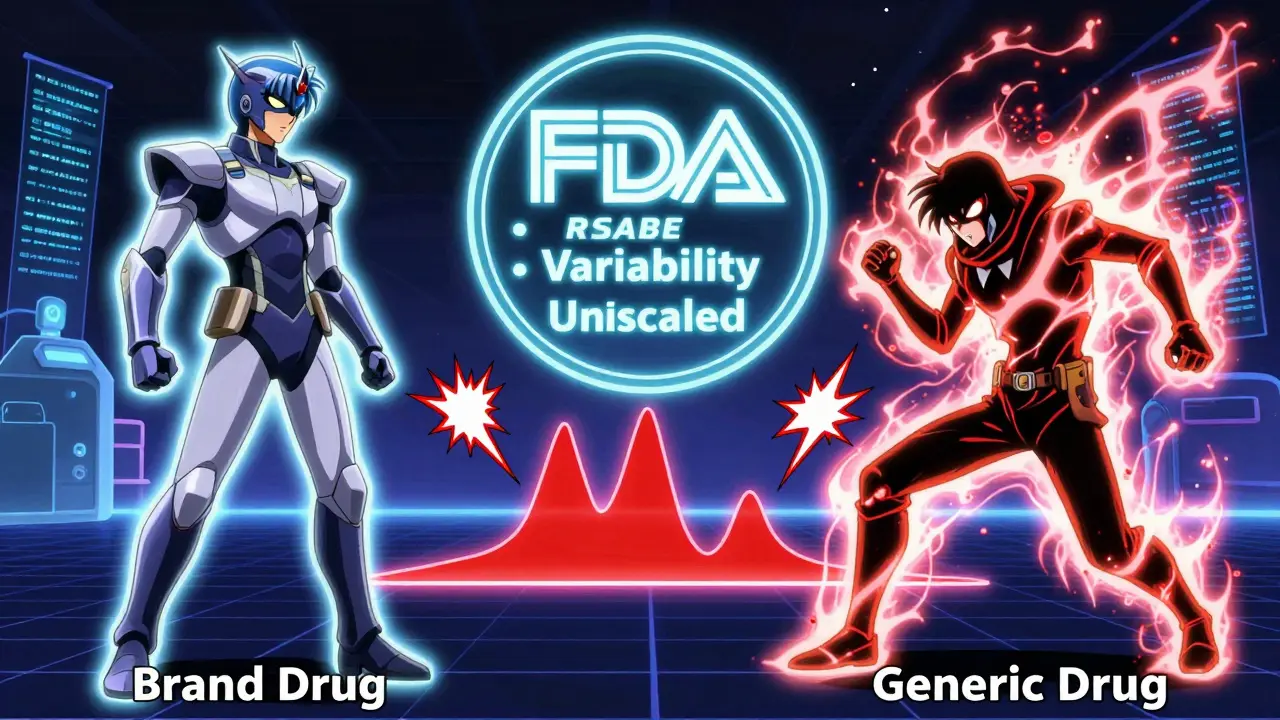
The FDA now requires generic NTI drugs to pass three tests:
- Reference-Scaled Average Bioequivalence (RSABE): This adjusts the acceptable range based on how much the brand-name drug varies from person to person. If the brand has high variability, the generic can vary a bit more too - but only up to a point. This is smarter than a fixed number because it accounts for real-world biology.
- Variability Comparison: The generic can’t be more variable than the brand. If the brand’s levels jump around a lot between doses, the generic can too. But if the brand is stable, the generic must be even more consistent. This is measured using a one-tailed F-test, and the upper limit of the confidence interval for the ratio of within-subject variability must be ≤ 2.5.
- Unscaled Average Bioequivalence: Even after passing the first two, the generic still must fall within the traditional 80-125% range for both AUC (total exposure) and Cmax (peak concentration). This acts as a final safety net.
Compare that to the European Medicines Agency (EMA), which uses a fixed 90-111% range for NTI drugs - no scaling, no variability tests. Health Canada uses 90.0-112.0% for AUC. These are simpler, but less flexible. The FDA’s method is harder to meet, but it’s also more scientifically tailored. It doesn’t treat all NTI drugs the same. A drug with low variability gets stricter limits. One with high variability gets slightly more room - as long as it’s not more variable than the original.
Why This Matters for Patients and Prescribers
Patients don’t always know if their prescription is brand or generic. Pharmacists often substitute without asking. But for NTI drugs, that substitution can carry real risk - even if the generic is technically approved. That’s why many doctors still prescribe by brand name, especially for transplant patients, people with epilepsy, or those on anticoagulants.
But here’s the twist: real-world data shows that when generics pass the FDA’s strict tests, they perform just as well. A 2017 study in the American Journal of Transplantation followed over 1,000 kidney transplant patients switching from brand to generic tacrolimus. No increase in rejection rates. No rise in side effects. A 2019 study in Circulation: Cardiovascular Quality and Outcomes found no difference in bleeding or clotting events between brand and generic warfarin.
So why the hesitation? Part of it is history. For years, there were scattered reports of problems - sometimes real, sometimes coincidental. That built distrust. And part of it is cost. NTI drug studies cost between $500,000 and $1 million - nearly double the price of a standard bioequivalence study. That’s because they require more participants (36-54 instead of 24-36) and more complex study designs, like a fully replicated four-period crossover. Many small manufacturers can’t afford it.
The Market for NTI Drugs: Big, But Slow to Go Generic
NTI drugs represent about $45 billion in annual U.S. sales. Yet, generic market share for these drugs hovers around 68%, compared to 90% for non-NTI drugs. That gap isn’t because patients don’t want generics - it’s because manufacturers have been hesitant to enter the market. The regulatory hurdles are high, and the legal risks are higher. If a generic fails to perform, lawsuits can be devastating.
The FDA has identified 15 NTI drugs with specific bioequivalence guidance, including:
- Warfarin
- Levothyroxine
- Digoxin
- Phenytoin
- Tacrolimus
- Carbamazepine
- Lithium carbonate
- Valproic acid
- Sirolimus
- Everolimus
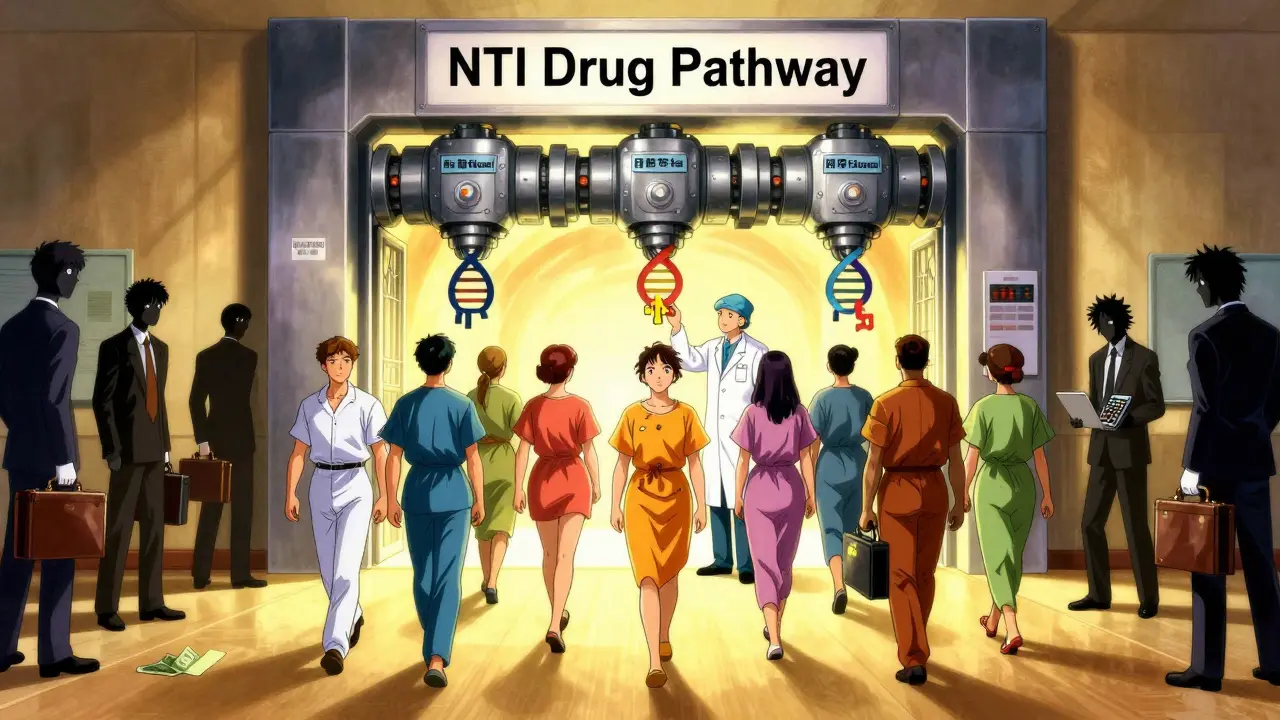
But here’s the problem: the FDA doesn’t have a public, official list of all NTI drugs. Manufacturers have to figure it out case by case. That creates uncertainty. If you’re a company trying to develop a generic version of a drug that might be NTI, you don’t know if you’ll need to jump through the FDA’s three-part hoops - or if you can get away with simpler testing. That uncertainty slows innovation.
What’s Changing in 2025-2026?
The FDA is moving toward a more systematic way to classify NTI drugs. Right now, they’re evaluated individually - often after a generic has already been approved. Starting in 2024, they plan to use quantitative therapeutic index calculations to classify drugs upfront. This means manufacturers will know early on whether their drug falls into the NTI category.
Also, the FDA is working with the EMA and Health Canada to harmonize standards. Right now, a company developing a generic for global markets must run multiple studies - one for the U.S., one for Europe, one for Canada. If regulators align on a single approach by 2026, development costs could drop by 15-20%. That could finally make it financially viable for more companies to enter the NTI generic market.
Some experts worry the rules are too strict. Dr. Lawrence Lesko argues that not every NTI drug needs this level of scrutiny. For drugs with very low variability - like levothyroxine - the current limits may be overkill. Others, like Dr. Leslie Benet, support the FDA’s approach as scientifically sound. The truth? It’s not one-size-fits-all. The FDA’s system is designed to protect patients without blocking access. And so far, the data shows it’s working.
What This Means for You
If you’re a patient on an NTI drug, your best move is to stick with the same manufacturer unless your doctor advises otherwise. Even if two generics are both FDA-approved, they might come from different manufacturers with slightly different formulations. If you notice new symptoms after a switch - fatigue, dizziness, irregular heartbeat - tell your doctor. Blood tests can catch changes before they become dangerous.
If you’re a prescriber, consider whether the patient’s condition is stable. If they’ve been on a brand for years with no issues, switching isn’t urgent. If they’re on a generic and doing fine, don’t switch back unless there’s a clear reason. Real-world evidence supports generic NTI drugs - when they meet the right standards.
If you’re in pharma, the message is clear: the bar is high, but the market is huge. The FDA’s system isn’t a barrier - it’s a filter. It keeps unsafe products out and rewards manufacturers who can meet the science. The next wave of NTI generics won’t come from cheap shortcuts. They’ll come from rigorous science - and that’s exactly what patients need.
What drugs are considered narrow therapeutic index (NTI) drugs?
Common NTI drugs include warfarin, levothyroxine, digoxin, phenytoin, tacrolimus, lithium carbonate, carbamazepine, valproic acid, sirolimus, everolimus, and phenobarbital. These drugs have very small differences between effective and toxic doses. The FDA has issued specific bioequivalence guidance for 15 such drugs as of 2023, but does not maintain a public comprehensive list. Regulatory agencies like the EMA and Health Canada recognize similar drugs based on clinical evidence.
Why are bioequivalence requirements stricter for NTI drugs?
Because small changes in blood concentration can lead to serious harm - like organ rejection, seizures, or dangerous bleeding. The standard 80-125% bioequivalence range used for most generics is too wide for these drugs. A generic that’s 120% as potent as the brand might be safe for a painkiller, but could cause toxicity in a patient on tacrolimus or warfarin. Stricter limits reduce the risk of therapeutic failure or overdose.
How does the FDA’s approach differ from the EMA’s?
The FDA uses a three-part test: Reference-Scaled Average Bioequivalence (RSABE), a variability comparison (limiting the generic’s variability to no more than 2.5 times the brand’s), and unscaled bioequivalence (80-125%). The EMA uses a fixed 90-111% range for both AUC and Cmax with no scaling or variability testing. The FDA’s method is more complex and costly but more scientifically precise. The EMA’s approach is simpler but less flexible.
Are generic NTI drugs safe?
Yes - when they meet the stricter regulatory standards. Real-world studies show no increase in adverse events when patients switch from brand to generic versions of drugs like warfarin and tacrolimus, as long as the generic passed the FDA’s RSABE requirements. A 2019 study in Circulation found no difference in bleeding or clotting between brand and generic warfarin. The concern isn’t that generics are unsafe - it’s that some might not meet the high bar needed to be safe.
Why are NTI generic drugs more expensive to develop?
NTI bioequivalence studies require larger sample sizes (36-54 subjects vs. 24-36), more complex designs (like fully replicated crossover studies), and more rigorous statistical analysis. Costs range from $500,000 to $1 million per study, compared to $300,000-$700,000 for standard generics. This high cost deters smaller manufacturers, slowing generic competition and keeping prices higher than they could be.

Comments (11)
Milad Jawabra March 6 2026
Man, I’ve seen so many patients freak out after switching generics for warfarin. One guy went from stable INR of 2.3 to 5.1 in a week - no changes in diet, no new meds, just a different generic. We had to hospitalize him. The FDA’s rules aren’t overkill - they’re a lifeline. If your pharmacist swaps your tacrolimus without telling you, you’re playing Russian roulette with your transplant. Don’t let ‘generic’ fool you. This isn’t toilet paper.
Chris Beckman March 7 2026
soo the fda says 80-125% is too wide for ntis but ema uses 90-111?? like bro why are we even comparing?? the usa is just being extra again. also i think they should just make all ntis brand only and stop the whole generic thing. too risky. why risk lives for $5 savings??
Levi Viloria March 9 2026
It’s wild how much this stuff matters. I work in a clinic in rural Texas - we’ve got patients on levothyroxine who can’t afford brand, so they get generic. Most do fine. But I’ve had a few come in with palpitations or fatigue after a switch. No one’s telling them to monitor symptoms. The system’s broken if we’re letting pharmacists swap these without warning. Maybe the FDA’s rules are tough, but at least they’re trying to protect people who can’t advocate for themselves.
Zacharia Reda March 9 2026
So let me get this straight - the FDA makes you do a $1M study with 54 people just to make a generic version of a drug that’s been around since the 80s? And you’re telling me this is ‘scientifically sound’? Meanwhile, we’re paying $500 for a 30-day supply of levothyroxine while Canada gets it for $12. The system’s not protecting patients - it’s protecting Big Pharma’s monopoly. If a generic passes the 80-125% range for 90% of drugs, why is this one so special? Maybe it’s not the drug - it’s the profit margin.
Matt Alexander March 10 2026
NTI drugs = tiny window between helping and hurting. Think of it like driving a car with no gas gauge. If you’re off by 10%, you stall or crash. Generic versions need to be exact. The FDA’s 3-step test isn’t overkill - it’s basic safety. If your heart’s on digoxin, you don’t want to guess if your pill is 110% strong. It’s not about cost. It’s about not dying.
Gretchen Rivas March 11 2026
My mom’s on levothyroxine. She switched generics last year and got dizzy. We didn’t connect it until her TSH spiked. Now she’s back on brand. I didn’t know this was a thing. Everyone should be told: if you’re on one of these drugs, stick with the same maker. Even if it’s more expensive.
Stephen Vassilev March 13 2026
Are you serious? The FDA doesn't have a public list? This is a classic government cover-up. I've been tracking this since 2018. There's a secret database - it's not that they don't know which drugs are NTI, it's that they don't want you to know how many are being illegally swapped. The pharmaceutical lobby owns the FDA. Look at the timing - right after the 2020 election, they delayed the public list. And now they're 'harmonizing' with EMA? That's just a front for multinational profit. I've got documents. I'm filing a FOIA request. This is a public health crisis.
Mike Dubes March 13 2026
My cousin’s a transplant patient on tacrolimus. Switched to generic after insurance forced it. Zero problems. No rejection, no side effects. He’s been stable for 3 years now. I think the fear around generics is mostly old stories and anxiety. The science says they’re fine when they pass the strict tests. Maybe the real issue is doctors not explaining it to patients? People panic because they don’t understand. We need better education, not more red tape.
Helen Brown March 15 2026
They say the studies prove generics are safe. But what about the ones that don’t get caught? What if the FDA’s tests are flawed? What if the labs are biased? I’ve read about patients who had seizures after switching phenytoin generics - but the FDA says it’s ‘coincidental.’ That’s not science - that’s denial. They’re covering up deaths because they don’t want to admit they messed up. How many people have died because we trusted a cheap pill?
John Cyrus March 16 2026
Stop acting like NTI drugs are some special snowflake. Every drug has risks. Why are we treating levothyroxine like it’s magic? People take aspirin and bleed out. People take insulin and overdose. We don’t make special rules for those. This is just fearmongering dressed up as science. The FDA is just trying to protect brand-name profits. Let generics compete. Lower prices. Let patients decide. If you can’t afford your med, that’s your problem - not the system’s.
John Smith March 18 2026
Y’all act like this is some revolutionary breakthrough. Nah. This is just Big Pharma playing hardball. They spent millions lobbying to keep generics out of NTI drugs so they can keep charging $400 for a 30-day supply. The FDA’s ‘strict’ rules? That’s a tax on anyone trying to make a cheaper pill. Meanwhile, in Europe, people get safe generics for half the price. We’re not protecting patients - we’re protecting corporate greed. And don’t even get me started on how they cherry-pick which drugs are NTI. This whole thing’s a scam.