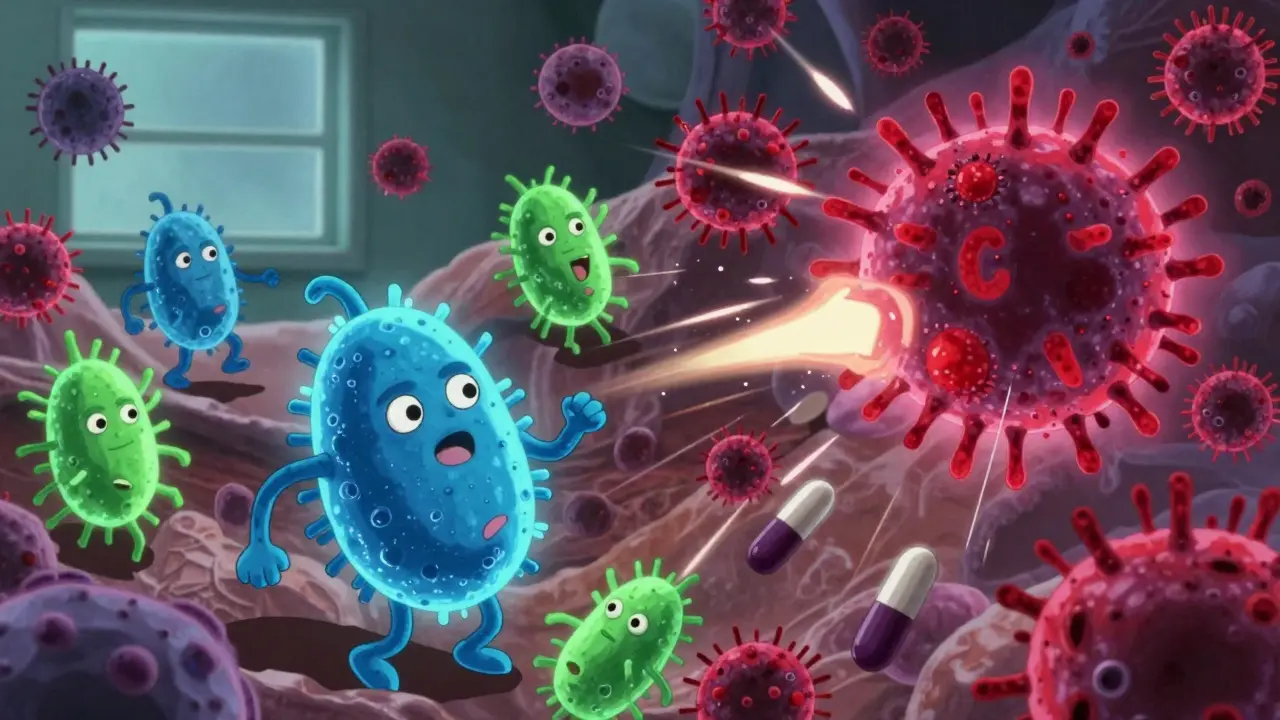
When antibiotics go wrong, they don’t just kill bad bacteria-they can wipe out the good ones too. And when that happens in your gut, it can open the door to something far worse: C. difficile colitis. It’s not just a bad stomach bug. It’s a serious, sometimes deadly infection that strikes after antibiotics disrupt the natural balance of your intestines. Thousands of people in the U.S. get it every year. Many end up back in the hospital. And for some, standard treatments fail-over and over again.
What Exactly Is C. difficile Colitis?
Clostridioides difficile (or C. diff) is a bacterium that lives quietly in some people’s guts without causing harm. But when antibiotics like clindamycin, cephalosporins, or piperacillin-tazobactam wipe out the healthy microbes that normally keep it in check, C. diff explodes in number. It starts producing toxins that attack the colon lining, causing severe diarrhea, abdominal cramps, fever, and sometimes life-threatening inflammation called pseudomembranous colitis.
The CDC classifies C. diff as an “urgent threat.” In 2015 alone, it caused half a million infections and nearly 30,000 deaths in the U.S. The infection isn’t just a hospital problem anymore. About half of cases now happen in people who haven’t been hospitalized-a sign that community exposure and overuse of antibiotics outside clinics are fueling the spread.
Which Antibiotics Carry the Highest Risk?
Not all antibiotics are created equal when it comes to triggering C. diff. Some are far more dangerous than others. A large 2023 study analyzing over 33,000 hospital stays found that piperacillin-tazobactam, a type of beta-lactam/beta-lactamase inhibitor, carried the highest risk-more than double the chance of C. diff compared to other antibiotics. Carbapenems and later-generation cephalosporins like ceftriaxone were nearly as bad.
Clindamycin, once a common go-to for skin infections, is still one of the worst offenders. It’s so strongly linked to C. diff that doctors now avoid it unless absolutely necessary. On the flip side, tetracyclines like doxycycline show much lower risk. That’s not a free pass to use them freely, but it does mean they’re safer options when alternatives are needed.
Here’s the scary part: every extra day on antibiotics raises your risk by 8%. The danger doesn’t just spike right away-it builds slowly, then surges again after 14 days. That’s why guidelines now say: review your antibiotics within 48 to 72 hours. If they’re not working, switch or stop. If they are, get off them as soon as possible.
Why Stopping Antibiotics Can Be the First Step to Recovery
If you’re diagnosed with C. diff and you’re still on the antibiotic that likely caused it, you’re making things worse. The Infectious Diseases Society of America says continuing the offending drug prolongs diarrhea and increases the chance of treatment failure. In many cases, simply stopping the antibiotic allows the gut to begin healing on its own.
A small but telling study found that some patients recovered fully after just discontinuing their antibiotics and taking probiotic kefir-a fermented milk drink rich in live cultures. Their recovery rates matched those seen with fecal transplants. That doesn’t mean kefir is a cure-all, but it does show the body can sometimes heal itself if you remove the trigger.
Still, don’t try this on your own. If you have severe symptoms-high fever, bloody stool, swelling in the abdomen-you need medical care immediately. C. diff can turn deadly in hours if it leads to toxic megacolon or a ruptured colon.
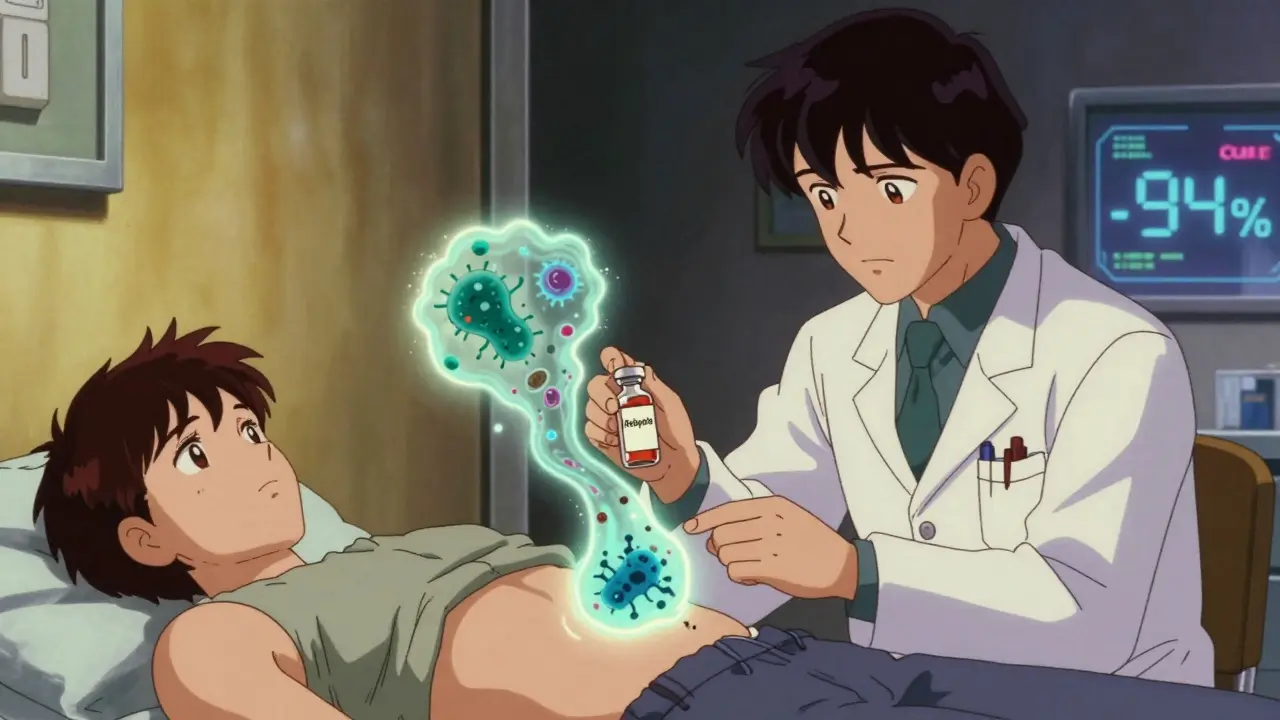
Fecal Transplant: The Game-Changer for Recurrent Infections
For people who keep getting C. diff after multiple rounds of antibiotics, the standard treatments often fail. Vancomycin and fidaxomicin can clear the infection-but up to 30% of patients relapse. And each relapse makes the next one harder to treat.
Enter fecal microbiota transplantation (FMT). It sounds extreme, but it’s one of the most effective treatments in modern gastroenterology. The idea is simple: take healthy stool from a screened donor, process it, and deliver it into the patient’s colon. The goal? Rebuild the gut’s microbial ecosystem so it can fight off C. diff naturally.
A landmark 2013 study in the New England Journal of Medicine showed FMT cured 94% of patients with recurrent C. diff after just one or two treatments. Compare that to vancomycin, which worked in only 31%. Since then, multiple reviews have confirmed cure rates between 85% and 90%.
Today, FMT isn’t just a last-resort experiment. The FDA has approved two standardized, freeze-dried FMT products-Rebyota and Vonjo-both delivered as enemas. These aren’t “poop smoothies” anymore. They’re regulated, tested, and available by prescription. The delivery method varies: colonoscopy (most common), enema, or oral capsules. Most patients feel better within days.
Who Gets FMT? And When?
FMT isn’t for everyone. Current guidelines from the American Gastroenterological Association recommend it only for patients who’ve had three or more recurrences of C. diff. That’s because the procedure carries risks-though rare. There’s a small chance of transferring harmful bacteria, viruses, or even long-term microbiome changes. That’s why donor screening is intense: stool is tested for over 50 pathogens, including HIV, hepatitis, and antibiotic-resistant superbugs.
Costs vary, but in the U.S., FMT runs between $1,500 and $3,000 per treatment. That’s far cheaper than repeated hospital stays, which average $11,000 per episode. Many insurance plans now cover it, especially when standard treatments have failed.
There’s also a new class of drugs on the horizon. Bezlotoxumab, a monoclonal antibody that neutralizes C. diff toxin B, reduces recurrence by 10% when given alongside antibiotics. And oral microbiome therapies like SER-109 (still in trials) show 88% efficacy without the “yuck factor” of stool transplants. These are the future-but for now, FMT remains the gold standard for stubborn cases.

What Can You Do to Prevent It?
The best treatment for C. diff is avoiding it in the first place. Antibiotic stewardship isn’t just a hospital policy-it’s a personal health strategy.
- Don’t ask for antibiotics for colds or flu-they’re viral, and antibiotics won’t help.
- If you’re prescribed an antibiotic, ask: “Is this necessary? Can we use something with lower C. diff risk?”
- Never skip doses or stop early unless your doctor says so-but also don’t keep taking it longer than prescribed.
- Ask about probiotics during antibiotic treatment. While evidence is mixed, some strains like Saccharomyces boulardii may help reduce risk without the dangers seen in immunocompromised patients.
And if you’ve had C. diff before, be extra cautious. Your gut may never fully return to its original state. Avoid unnecessary antibiotics. Tell every new doctor about your history. And if you get diarrhea again after antibiotics-don’t wait. Get tested early.
Why This Matters Beyond the Hospital
C. diff isn’t just a personal health issue. It’s a public health crisis. The CDC estimates the infection costs the U.S. healthcare system $6.3 billion a year. Hospitals have cut hospital-acquired cases by 24% since 2009-but community cases have risen by 14% annually since 2011. That means the problem is moving out of hospitals and into homes, nursing homes, and pharmacies.
Doctors are starting to treat it differently. More hospitals now have formal FMT programs-up from 5% in 2015 to 35% today. And the FDA’s approval of standardized microbiome therapies signals a major shift: we’re no longer just killing bacteria. We’re learning how to restore balance.
The next frontier? Targeting people who carry C. diff without symptoms. These silent carriers can spread it to others, and antibiotics don’t help them-they make things worse. Researchers are now testing vaccines, targeted antimicrobials, and microbiome boosters to stop transmission before it starts.
Can you get C. diff without taking antibiotics?
Yes. While antibiotics are the biggest trigger, you can get C. diff from touching contaminated surfaces or coming into contact with an infected person’s stool. About half of all cases now happen in people who haven’t taken antibiotics recently. This is why handwashing with soap and water (not just hand sanitizer) is critical in hospitals and homes.
Is fecal transplant safe?
When done through approved programs with screened donors, FMT is very safe. The FDA requires donors to be tested for over 50 pathogens, including drug-resistant bacteria and viruses. Serious side effects are rare. The biggest risk is transmitting unknown microbes, which is why standardized products like Rebyota and Vonjo are becoming preferred over donor stool from friends or family.
Do probiotics prevent C. diff?
The evidence is mixed. Some studies show Saccharomyces boulardii may reduce risk in healthy adults taking antibiotics. But for people with weakened immune systems, probiotics can cause dangerous infections. The IDSA does not recommend probiotics as a standard preventive measure due to potential harm. Always talk to your doctor before taking them.
Can C. diff come back after FMT?
Yes, but it’s uncommon. About 10-15% of patients have a recurrence after FMT, usually because their gut microbiome hasn’t fully stabilized or they took another antibiotic too soon. Most who relapse respond well to a second FMT. Long-term, most patients remain symptom-free if they avoid unnecessary antibiotics.
Are there alternatives to FMT for recurrent C. diff?
Yes. For first-time recurrence, doctors often switch from vancomycin to fidaxomicin, which has a higher sustained cure rate. Adding bezlotoxumab, a monoclonal antibody, reduces recurrence by 10%. For those who can’t access FMT, these are the next best options. New oral microbiome therapies like SER-109 are expected to become widely available by 2026.
What Comes Next?
The future of C. diff treatment is moving away from brute-force antibiotics and toward precision microbiome repair. We’re no longer just trying to kill a bug-we’re learning how to rebuild the ecosystem it thrives in. That’s why FMT, though strange-sounding, isn’t a fringe treatment anymore. It’s science.
If you’ve battled recurrent C. diff, know you’re not alone. And you’re not out of options. FMT has changed the game. Antibiotic stewardship is saving lives. And the next generation of treatments-targeted, safe, and easy to take-is already on the way.
Don’t wait for the third recurrence to act. Talk to your doctor early. Ask about alternatives. And never underestimate the power of a healthy gut-not just for digestion, but for survival.

Comments (9)
Jacob Milano January 4 2026
Man, I never realized how much my last round of amoxicillin nearly killed my gut. I thought diarrhea was just a side effect, not a red flag. Now I ask my doc every time: 'Is this really necessary?' and they look at me like I'm asking to perform surgery myself. But hey, at least I'm alive to complain about it.
Enrique González January 5 2026
My grandma had C. diff after a hip surgery. They gave her vancomycin three times. She was in and out of the hospital for months. When they finally did the poop transplant - yeah, I said it - she bounced back like nothing happened. No more meds, no more fear. Just normal bowel movements. Wild how science got weird and saved her.
Shanna Sung January 6 2026
They’re hiding the truth about FMT. Big Pharma doesn’t want you to know you can cure this with a stranger’s poop because they make billions off antibiotics. And probiotics? They’re banned for immunocompromised people because they’re trying to kill off the natural healers. Wake up. The gut is the immune system. They’ve been poisoning it for decades.
John Ross January 7 2026
From a clinical microbiology standpoint, the 2023 cohort study on piperacillin-tazobactam’s relative risk (HR 2.17, 95% CI 1.89–2.49) is a paradigm-shifting data point. The beta-lactamase inhibitor component doesn’t just broaden spectrum - it creates a permissive niche for C. diff spore germination by depleting obligate anaerobes like Faecalibacterium prausnitzii. This isn’t just stewardship - it’s microbial warfare. FMT isn’t quackery; it’s ecological restoration at the phylum level. The FDA’s approval of Rebyota is the first regulatory acknowledgment that the microbiome is a therapeutic organ. We’re entering the post-antibiotic era - and it’s not what you think.
Ashley Viñas January 8 2026
Oh honey, you just can’t trust doctors anymore. I mean, I read the NEJM study - 94% cure rate? That’s more than my last relationship. And yet people still take antibiotics like candy. You think your ‘natural remedies’ are helping? Please. You’re just feeding the C. diff buffet. If you want to be healthy, stop being lazy. Wash your hands. Stop asking for pills. And for god’s sake, don’t drink kombucha unless you’ve got a PhD in gut flora.
Brendan F. Cochran January 8 2026
US is getting soft. Back in my day we just toughed out the runs. Now we’re doing poop transplants like its some kind of spa treatment? I got a cousin who took one round of clindamycin and now he’s on kefir like it’s holy water. What’s next? Eating dirt for probiotics? We need less science and more common sense. Stop overtreating everything. Antibiotics are for infections - not for when you feel like crap after a bad taco.
jigisha Patel January 10 2026
The data presented is statistically significant but lacks longitudinal follow-up beyond 12 months. Additionally, the exclusion of patients with IBD or recent chemotherapy in most FMT trials introduces selection bias. The cost-benefit analysis ignores regional disparities in healthcare access. In India, where antibiotic overuse is rampant and sanitation infrastructure is inadequate, community transmission rates exceed 30% - yet FMT remains inaccessible due to regulatory and cultural barriers. This is not a global solution; it is a Western privilege masked as innovation.
Justin Lowans January 12 2026
Reading this made me think about my uncle who got C. diff after a dental procedure. He was on amoxicillin for a week - just a routine thing, right? Turns out, it wasn’t. He ended up in ICU. Now he’s a walking PSA for antibiotic caution. I’ve started keeping a little log of every antibiotic I take - duration, reason, how I felt after. Small habits matter. And yeah, I’ve started eating sauerkraut. Not because it’s trendy, but because my gut deserves better than a chemical warzone.
Michael Rudge January 13 2026
Oh wow, a 94% cure rate? That’s almost as impressive as your Instagram bio. FMT? Really? You’re seriously recommending that people ingest someone else’s poop like it’s a new protein shake? And you call this science? Next you’ll tell me to drink my own pee for gut health. At least antibiotics are clean. At least they’re *manufactured*. This is just a fancy way of saying ‘here, eat a bag of poop and pray.’