When a brand-name drug company spends billions developing a new medicine, they get a patent to protect their investment. That patent usually lasts 20 years. But here’s the twist: Paragraph IV certification lets generic drug makers challenge that patent before the drug even hits the market. It’s not sabotage. It’s the law.
This isn’t science fiction. It’s the Hatch-Waxman Act of 1984 - a deal struck between big pharma and generics to balance innovation and access. The law lets generic companies file an Abbreviated New Drug Application (ANDA) with the FDA, claiming that a patent listed in the FDA’s Orange Book is either invalid, unenforceable, or won’t be infringed. That’s a Paragraph IV certification. And it triggers a legal domino effect that can bring down drug prices years ahead of schedule.
How the Paragraph IV Process Actually Works
It starts with the ANDA. A generic company doesn’t just say, “We’ll make this drug cheaper.” They must prove their version is bioequivalent to the brand drug - same active ingredient, same dose, same effect. But if the brand drug has patents listed in the Orange Book, the generic must pick one or more and challenge them. That’s the Paragraph IV.
Once the FDA accepts the ANDA, the generic has exactly 20 days to notify the patent holder. This isn’t a polite letter. It’s a legal notice saying, “We’re coming for your patent.” The brand company then has 45 days to sue for infringement. If they do, the FDA can’t approve the generic for 30 months - unless the court rules sooner.
That 30-month clock is the hinge of the whole system. It gives the brand time to defend its patent, but it also forces a decision. If the generic wins, they get in early. If they lose, they wait. And if no one sues? The generic can launch immediately.
Why the 180-Day Exclusivity Is a Game-Changer
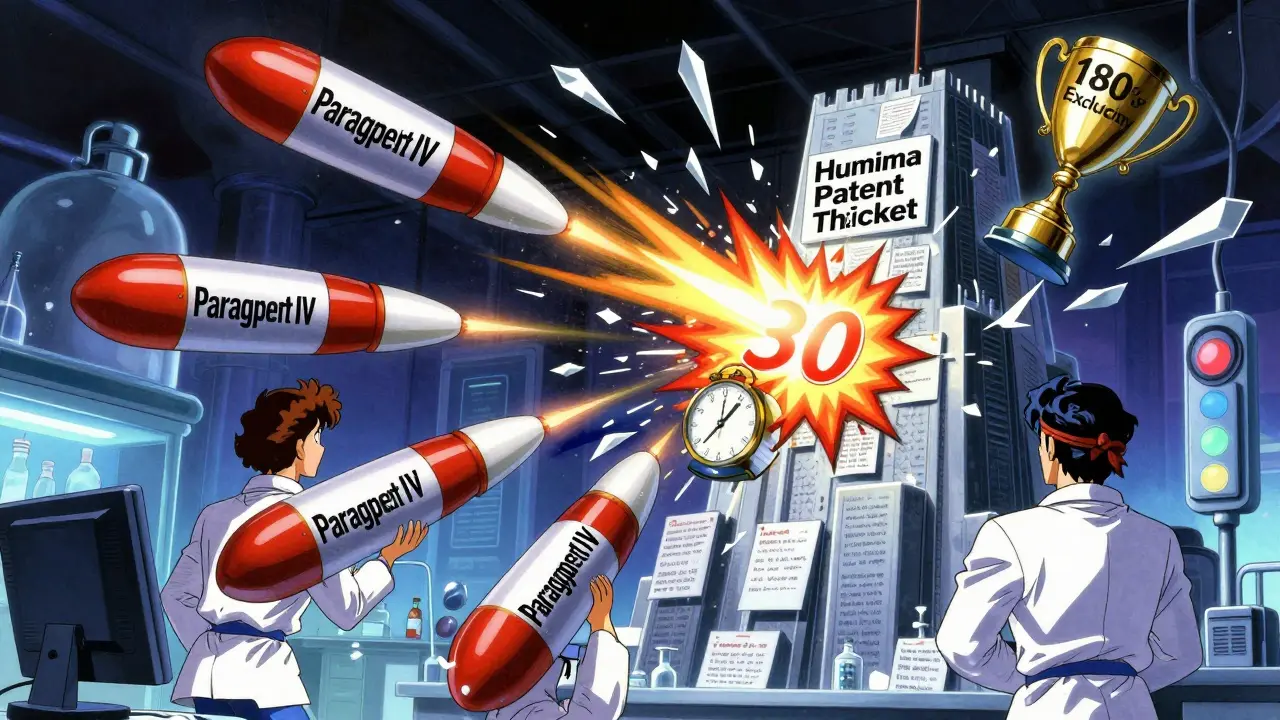
The real incentive? The first generic to file a successful Paragraph IV challenge gets 180 days of exclusive market access. No other generic can enter during that time. For a blockbuster drug like Humira, which brings in $20 billion a year, 180 days of exclusivity means over $10 billion in revenue.
That’s why companies like Teva, Mylan, and Sandoz spend millions on legal teams just to be first. In 2024 alone, the first filer on a single drug could make up to $500 million in pure profit if they launched right away. But here’s the catch: many of these companies end up settling with the brand. In 78% of cases, they agree to delay their launch in exchange for cash or other perks - a practice the FTC calls “pay-for-delay.” In 2023 and 2024, the FTC sued 17 of these deals, arguing they keep prices high.
Patent Thickets and the Arms Race in Pharma
Branded drug companies didn’t sit still. They responded by filing more patents. In 2005, the average drug had 7.2 patents listed in the Orange Book. By 2024, that number jumped to 17.3. Some drugs have over 30. This is called “patent thicketing.” The goal? Make it so expensive and time-consuming for generics to challenge every patent that they give up.
But generics fought back. Now, 68% of major brand drugs face three or more Paragraph IV challenges at once. It’s like a legal barrage. One company files on the formulation patent, another on the method-of-use patent, another on the crystalline structure. Each challenge eats into the brand’s protection.
And it’s working. From 2003 to 2019, generics won about 41% of Paragraph IV cases. From 2020 to 2025, that number rose to 58%. Why? Courts have become more skeptical of overly broad patents - especially those covering minor changes like a new pill shape or a slightly different dosage schedule.
Carve-Outs and Skinny Labels: The Sneaky Shortcut
Not every patent blocks the whole drug. Sometimes, a patent only covers one use - say, treating rheumatoid arthritis - but the drug is also approved for psoriasis and Crohn’s disease. A generic can file a “Section viii carve-out,” meaning they’ll only market the drug for the non-patented uses. The label says, “Not for rheumatoid arthritis,” even though the pill is identical.
This tactic, called a “skinny label,” is used in about 37% of Paragraph IV filings. It lets generics enter the market without touching the patent at all. No lawsuit. No 30-month stay. Just a different label. It’s legal. It’s smart. And it’s cutting into brand profits without a fight.
The Real Cost of Fighting for Market Access
Winning a Paragraph IV challenge isn’t cheap. Generic companies spend an average of $12.3 million per case in legal fees. Cases take nearly 29 months to resolve. And if they lose? They lose everything - including the chance to get the 180-day exclusivity. That’s why many choose to settle.
But the risk is worth it. A successful challenge can generate 3.2 times more revenue than a generic that doesn’t challenge a patent. For a drug with $1 billion in annual sales, that’s $3.2 billion in potential revenue over the next few years. That’s why 78% of generic executives say Paragraph IV filings are critical to their business strategy.
Still, delays hurt. In 2023, 63% of generic companies faced a 30-month stay that stretched beyond 36 months due to court backlogs or procedural delays. Each month of delay costs an average of $8.7 million in lost revenue. Some companies take the risk and launch “at-risk” - selling the drug before the court rules. In 2024, 22% did this. If they win, they make $83 million on average. If they lose? They owe up to $217 million in damages.
Who’s Winning and Who’s Losing
The top generic players in 2024 were Teva (147 filings), Mylan (112), Sandoz (98), and Hikma (87). The brands under the most pressure? AbbVie’s Humira (28 challenges), Eli Lilly’s Trulicity (24), and Pfizer’s Eliquis (21). These aren’t obscure drugs - they’re among the most profitable in the world.
The savings for patients are massive. Since 1984, Paragraph IV challenges have saved U.S. consumers $2.2 trillion. In 2024 alone, they saved $192 billion. That’s money that went back into people’s pockets, insurance plans, and government programs.
But the system isn’t perfect. Brand companies keep inventing new ways to delay generics - like “product hopping,” where they tweak a drug’s formula just before a patent expires and get a new patent on the new version. In 2024, 31% of Paragraph IV targets were affected by this tactic.
What’s Next for Paragraph IV?
The FDA is tightening the rules. In 2022, they updated how generics can amend their Paragraph IV certifications after a court ruling. Now, they can’t just tweak their application to sneak in a new drug - they have to prove it’s the same product.
In 2026, the FDA plans to require brand companies to justify every patent they list in the Orange Book. That could cut patent thickets by 30-40%. The FTC is also ramping up its fight against pay-for-delay deals. If they succeed, generics could enter the market 4-6 months earlier on average.
One thing’s clear: Paragraph IV certifications aren’t going away. They’re the backbone of the generic drug market. And as more drugs lose patent protection, this system will keep driving down prices - even if the battles get harder.
What is a Paragraph IV certification?
A Paragraph IV certification is a legal statement made by a generic drug company when filing an Abbreviated New Drug Application (ANDA). It claims that one or more patents listed in the FDA’s Orange Book for a brand-name drug are invalid, unenforceable, or won’t be infringed by the generic version. This triggers a patent lawsuit before the generic drug enters the market.
Why does the FDA allow generics to challenge patents before launch?
The Hatch-Waxman Act of 1984 created this system to balance innovation and access. Without it, brand companies would have to wait until a generic drug hit the market to sue for infringement. That delay could cost them billions. The Paragraph IV system lets lawsuits happen upfront, so both sides know the rules before spending millions on production and marketing.
What is the 180-day exclusivity period?
The first generic company to successfully file a Paragraph IV certification gets 180 days of exclusive rights to sell its version of the drug. No other generic can enter during that time. This incentive encourages companies to take the legal risk of challenging patents, even when it costs millions.
Can a generic drug be approved without challenging a patent?
Yes. If a brand drug has no listed patents, or if all patents have expired, the generic can file an ANDA without a Paragraph IV certification. They can also use a Section viii carve-out to exclude patented uses from their label and launch without challenging the patent directly.
What are pay-for-delay settlements?
Pay-for-delay settlements occur when a brand-name drug company pays a generic manufacturer to delay launching its cheaper version. In exchange for cash or other benefits, the generic agrees to wait months or years before entering the market. The FTC considers these deals anti-competitive and has sued 17 of them since 2023.
How do generic companies decide which patents to challenge?
They use patent analytics software to map out all patents listed in the Orange Book. They look for weak patents - those with vague claims, expired claims, or ones that cover minor changes. They also target drugs with fewer patents (27% higher success rate) and combine multiple challenges or use skinny labels to maximize their chances of winning.
What’s the success rate of Paragraph IV challenges?
From 2003 to 2019, generics won about 41% of cases. Since 2020, that rate has risen to 58%. Courts have become more skeptical of broad patents, especially those covering trivial changes. Supreme Court rulings limiting patent eligibility have also helped generics win more often.
Final Thoughts: A System That Works - Mostly
Paragraph IV certifications are not perfect. They’re expensive, slow, and sometimes manipulated. But they work. They’ve brought down the cost of medicines for millions. They’ve forced big pharma to be more honest about its patents. And they’ve turned generic drug makers into powerful players in the health system.
Without Paragraph IV, we’d still be paying $10,000 a year for drugs that now cost $50. That’s the real impact. It’s not flashy. It’s not glamorous. But it’s one of the most effective tools we have to make medicine affordable.
Comments (13)
Stephen Tulloch January 17 2026
So let me get this straight - we’re letting generic companies legally gun down patents like it’s a Wild West showdown? 🤠💊 I love it. Big Pharma thinks they own the damn formula, but nah - the law says ‘prove it or lose it.’ 180-day exclusivity? That’s not a reward, it’s a goddamn lottery ticket for billionaires. 🎰💸Joie Cregin January 18 2026
This is actually kind of beautiful when you think about it. Like, people are fighting so hard to make life-saving meds affordable, and it’s not through protests or petitions - it’s through legal filings and bioequivalence studies. 🌱💙 It’s quiet, it’s messy, but it’s working. Someone’s getting their insulin for $20 instead of $300. That’s the real win.Melodie Lesesne January 19 2026
I didn’t know about skinny labels - that’s genius. Like, if the pill’s the same but you just don’t say it works for rheumatoid arthritis? Smart. No lawsuit, no drama. Just a little label tweak and boom - cheaper meds for everyone. 🤫💊Corey Sawchuk January 19 2026
The 30-month stay is such a loophole. Courts drag their feet, companies get rich, patients wait. It’s not about justice, it’s about cash flow. I’ve seen people skip doses because they can’t afford the brand version while this legal ping-pong goes on for yearsAllen Davidson January 19 2026
This system is one of the few places where capitalism actually serves the public. Generics aren’t stealing - they’re forcing innovation to be real. If your patent is just a slightly different color pill, you don’t deserve 20 years of monopoly. Kudos to the lawyers who fight this battle for us.john Mccoskey January 21 2026
Let’s be brutally honest here - this entire Paragraph IV framework is a legalized form of corporate warfare disguised as consumer advocacy. The ‘winners’ are not patients, they’re hedge funds that back generic manufacturers. The 180-day exclusivity isn’t an incentive - it’s a cartel mechanism. And the FTC’s crusade against pay-for-delay? Pathetic. They’re still letting $10 billion deals slide under the radar. This isn’t reform - it’s rearranging deck chairs on the Titanic. The real problem? Patent law was never meant to govern pharmaceuticals. It was meant for inventions, not molecules.vivek kumar January 23 2026
The 58% success rate since 2020 is the most telling stat here. Courts are finally waking up to patent trolling. When a company patents a pill shape or a 10% dosage change, they’re not innovating - they’re gaming the system. And the fact that 37% of generics use skinny labels? That’s not a loophole - it’s common sense. If the patent only covers one use, why should the whole drug be blocked?Riya Katyal January 23 2026
Oh wow, so generics are now legally allowed to outsmart Big Pharma? How cute. 🤭 I bet the CEOs of Pfizer are crying into their $10,000 bottles of Eliquis right now. Can we make this a reality show? ‘The Patent Wars: Generic Edition’? I’d binge it.waneta rozwan January 24 2026
I don’t care how many billions they save - if a company is willing to risk $217 million in damages just to launch early, that’s not courage, that’s gambling. And when they lose? Who pays? The patients who took the drug? The hospitals? The system is broken when the only people who can afford to play are the ones with lawyers on retainer. This isn’t access - it’s a high-stakes poker game with lives on the table.Nicholas Gabriel January 26 2026
I just want to say - thank you to every generic company lawyer, every paralegal, every researcher who’s spent 29 months in court fighting for a $50 pill instead of a $1,000 one. This isn’t glamorous. Nobody gets a parade. But you’ve saved trillions. And you’ve made it possible for someone’s grandparent to breathe again. That’s the quietest kind of heroism. Please don’t stop.Cheryl Griffith January 27 2026
I had a friend on Humira. Paid $12,000 a year before the generics came in. Now it’s $200. She cried when she found out. Not because she was happy - because she realized she’d been overpaying for years. This system? It’s not perfect. But it’s the only thing keeping people alive.swarnima singh January 27 2026
so like... big pharma is just like... lazy? they make one drug and then keep patenting tiny changes? like... why not just make a better one? and why are we letting them? i mean... people are dying because they cant afford meds and we're arguing over pill shapes?? this is so messed upKasey Summerer January 27 2026
I’m from the US, but I’ve seen this play out in India - where generics are the backbone of healthcare. We call it ‘pharma democracy.’ The fact that a kid in Mumbai can get the same drug as a kid in Boston for 1/100th the price? That’s not capitalism. That’s justice. And it only works because of Paragraph IV. So yeah - keep filing. Keep winning.