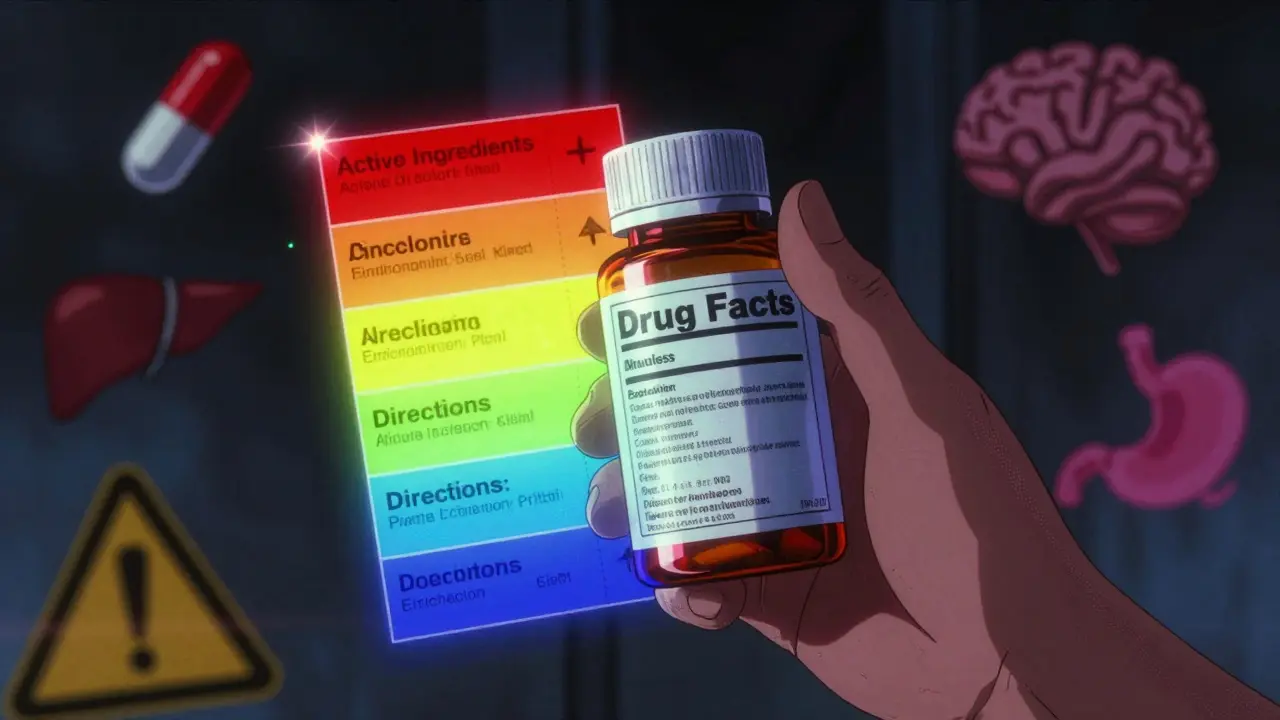
Why OTC Drug Labels Matter More Than You Think
You grab a bottle of pain reliever off the shelf because your head is pounding. You take two pills. Later, you take another because it’s not working fast enough. By bedtime, you’re nauseous, dizzy, and wondering why you feel worse. This isn’t rare. It happens every day. And it’s usually because people don’t read the label - not really. They see the brand name, remember what it’s for, and guess the rest. But OTC medicines aren’t harmless snacks. They’re powerful chemicals. And the Drug Facts Label is your only guide to using them safely.
The U.S. Food and Drug Administration (FDA) made this label mandatory in 2017 after years of research showed people were getting hurt from mixing medicines, taking too much, or ignoring warnings. Before this standard, labels looked like cereal boxes - cluttered, confusing, and full of marketing fluff. Now, every single OTC medicine sold in the U.S. must follow the same format. Seven sections. No exceptions. If you learn how to read them, you cut your risk of overdose, bad reactions, and hospital visits in half.
The Seven Sections of the Drug Facts Label - And What They Really Mean
Don’t skip ahead. This isn’t just about finding the dose. It’s about understanding what each part tells you - and what it hides.
Active Ingredients
This is the most important part. It lists the actual medicine inside the pill, liquid, or gel. Not the brand name. Not the slogan. The chemical. For example: Acetaminophen 325 mg. That’s the drug. Tylenol is just the brand. Advil is ibuprofen. Sudafed is pseudoephedrine. If you don’t know what’s in it, you can’t avoid doubling up.
Multi-symptom cold medicines often have three or four active ingredients. DayQuil? It has acetaminophen (for pain/fever), dextromethorphan (for cough), and phenylephrine (for congestion). If you take this and a separate Tylenol, you’re taking double the acetaminophen. And that’s dangerous. The maximum safe daily dose for adults is 4,000 mg. One bottle of Extra Strength Tylenol has 1,000 mg per dose. Take four, and you’re at the limit. Add DayQuil, and you’re over it. Liver damage doesn’t wait. It sneaks up quietly.
Purpose
This tells you what the active ingredient does. It’s not fluff. It’s a direct link between the chemical and its effect. “Pain reliever/fever reducer” means it blocks signals in your brain that tell you you’re in pain or running a fever. “Cough suppressant” means it quiets the cough reflex. “Nasal decongestant” shrinks swollen blood vessels in your nose. If you don’t know the purpose, you might think two different pills do the same thing - and accidentally take both.
Uses
This section says exactly what symptoms the medicine is approved to treat. It’s not a suggestion. It’s a legal limit. If the label says “relieves headache, sore throat, and fever,” then it’s not meant for muscle pain or allergies. Taking it for something outside the uses doesn’t make it work better - it just increases your risk. And if you’re treating something the label doesn’t mention, you might be masking a bigger problem. A persistent cough isn’t just a cold. It could be bronchitis. A fever that won’t break could be an infection. Don’t use OTC drugs to self-diagnose.
Warnings
This is where lives are saved - or lost. The FDA requires this section to be clear, direct, and impossible to ignore. It tells you:
- When NOT to use the medicine (e.g., “Do not use if you have liver disease”)
- When to ask a doctor first (e.g., “Ask a doctor before use if you are taking blood thinners”)
- What side effects to watch for (e.g., “May cause drowsiness”)
- Drug interactions (e.g., “Avoid alcohol while taking this product”)
- Special warnings for children, pregnant people, or seniors
One of the most common mistakes? Ignoring the liver warning on acetaminophen. Over 50 million Americans have some form of liver condition - many don’t even know it. Taking more than 4,000 mg of acetaminophen in 24 hours can cause sudden, irreversible liver failure. And it doesn’t always hurt. You might just feel tired, nauseous, or lose your appetite. By the time you realize something’s wrong, it’s too late.
Directions
This is where most people go wrong. Not because they’re careless - but because the instructions are easy to misread.
“Take 1 tablet every 4 to 6 hours.” Does that mean you can take one every 4 hours? Yes - but only if you’re under 65 and healthy. “Do not take more than 6 tablets in 24 hours.” That’s the cap. But what if the bottle says “Each tablet contains 500 mg”? Then 6 tablets = 3,000 mg. Still safe. But if you’re also taking a cold medicine with 325 mg of acetaminophen per dose, and you take three of those, you’re at 4,000 mg - the max. Now you’ve hit the limit without realizing it.
Also watch for “per 5 mL.” That’s one teaspoon. A 4-ounce bottle of Children’s Motrin has 118 mL. That’s nearly 24 doses. If you think “I have a 4-ounce bottle, so I can give my child 5 mL six times a day,” you’re wrong. You might think you’re being safe - but you’re not measuring correctly. Use the dosing cup that comes with it. Never use a kitchen spoon. A teaspoon isn’t 5 mL. A tablespoon isn’t 15 mL. They vary by brand.
Inactive Ingredients
This is the hidden trap. These aren’t medicine. They’re fillers, dyes, preservatives, or flavorings. But for some people, they’re deadly. If you’re allergic to dyes like FD&C Red No. 40, or if you’re gluten-sensitive and the label says “wheat starch,” you need to know. Same with lactose - it’s in nearly 20% of pills. If you’re lactose intolerant, you might get bloating, cramps, or diarrhea - not because the medicine isn’t working, but because the filler is upsetting your gut.
And if you’re on a low-sodium diet? Check this section. Some antacids and cold medicines contain up to 200 mg of sodium per dose. That’s 10% of your daily limit in one pill.
Other Information
This small section tells you how to store the medicine. “Store between 68°F and 77°F.” That’s room temperature. Don’t keep it in the bathroom - heat and moisture ruin pills. Don’t leave it in the car. Don’t store it near the stove. And if it says “Protect from light,” keep it in the original bottle - not a pill organizer.
The 5-Point Check: A Simple System That Works
Pharmacists at CVS and Walgreens have tested a simple method called the 5-Point Check. It takes 50 seconds. It saves lives.
- Identify the active ingredient. What’s the chemical? Is it in anything else you’re taking?
- Verify the uses. Does this match your symptom? Don’t use it for something it’s not meant for.
- Read every warning. Especially the liver, stomach, and allergy ones. If you have a condition - diabetes, high blood pressure, kidney disease - check if it’s listed.
- Check directions for your age and weight. Kids, seniors, and people under 120 lbs need different doses. Don’t guess.
- Scan inactive ingredients. Look for allergens, sugar, gluten, or sodium if you’re sensitive.
People who use this method reduce medication errors by 68%, according to a 2024 study by the BeMedWise Program. That’s not a small number. That’s the difference between a headache and a hospital.

What You’re Probably Getting Wrong
Here are the top three mistakes people make - and how to fix them.
Mistake 1: “I know what Tylenol is. I don’t need to read the label.”
Acetaminophen is in over 600 products. Cold medicines, sleep aids, prescription painkillers like Vicodin, even some combination birth control pills. If you’re taking more than one, you’re likely overdosing. Always check the active ingredient - not the brand.
Mistake 2: “Extra strength means it works faster.”
Extra strength usually means 50-100% more active ingredient. Regular Tylenol is 325 mg. Extra Strength is 500 mg. That’s not a “stronger” version - it’s a different dose. Taking two regular pills is the same as one extra strength. But if you take one extra strength and then a cold medicine with 325 mg, you’re at 825 mg in one go. That’s risky.
Mistake 3: “PM” means it’s safer at night.
“PM” almost always means it contains diphenhydramine - an antihistamine that causes drowsiness. It’s not a sleep aid. It’s a sedative. And it’s not safe for seniors. It increases the risk of falls, confusion, and urinary retention. If you’re over 65, avoid anything labeled “PM” unless your doctor says it’s okay.
What’s Changing in 2025
The FDA is making changes - and they’re coming fast. By the end of 2025, new labels will have:
- Color-coded sections (red for warnings, green for directions)
- Bigger font for active ingredients and max daily doses
- Simple icons: a liver for acetaminophen, a stomach for NSAIDs, a brain for drowsiness
- QR codes linking to video instructions
These aren’t just upgrades. They’re responses to real failures. In 2023, 41% of people still couldn’t find the max daily dose on the label. That’s unacceptable. The new system is designed for people who don’t read - or can’t read well.

When to Call a Pharmacist
You don’t have to figure this out alone. Pharmacists are trained to decode these labels. If you’re confused - even a little - ask. Walgreens saw a 40% increase in OTC consultations after launching their “Label Literacy” campaign. That’s because people realized: It’s not stupid to ask.
Bring your bottle. Point to the section you don’t understand. Ask: “Is this safe with my blood pressure medicine?” or “Can I take this if I’m pregnant?” or “I’m on a low-sodium diet - does this have salt in it?”
They’ve seen it all. They’ve helped people avoid overdoses, allergic reactions, and dangerous interactions. And they won’t judge you. They’re there to keep you safe.
Final Thought: Labels Are Your Shield
OTC medicines are convenient. They’re cheap. They’re everywhere. But they’re not toys. They’re tools - and like any tool, they can hurt you if you don’t use them right. The Drug Facts Label isn’t bureaucracy. It’s your last line of defense. Read it. Understand it. Use it. Your body will thank you.
What should I do if I accidentally take too much of an OTC medicine?
Call Poison Control immediately at 1-800-222-1222. Do not wait for symptoms. Even if you feel fine, some overdoses - especially with acetaminophen - don’t show signs for hours. Have the medicine bottle with you when you call. Tell them the name of the drug, how much you took, and when. They’ll tell you whether to go to the ER or wait it out. Don’t try to induce vomiting unless they say so.
Can I trust generic brands over name brands?
Yes - if the active ingredients are the same. A generic ibuprofen and Advil both contain 200 mg of ibuprofen per tablet. The FDA requires generics to work the same way as brand names. The only differences are in inactive ingredients - fillers, dyes, or coatings. If you’re not allergic to anything on the label, generics are just as safe and often cheaper. Always compare the active ingredients, not the brand names.
Why do some OTC labels say “do not use” for children under 12?
Children’s bodies process medicines differently. Their livers and kidneys aren’t fully developed. A dose that’s safe for an adult can be toxic for a child. That’s why labels specify exact doses by age and weight. If a label says “do not use under 12,” it’s not a suggestion - it’s a safety rule based on clinical studies. Never guess a child’s dose. Use products made specifically for kids, and always use the dosing device that comes with it.
Is it okay to take OTC medicine with alcohol?
Never assume it’s safe. Alcohol can increase the risk of liver damage with acetaminophen, cause dangerous drowsiness with antihistamines, and raise the chance of stomach bleeding with NSAIDs like ibuprofen or naproxen. The label will warn you if it’s risky. If it doesn’t say “avoid alcohol,” assume it’s still dangerous. The safest choice? Don’t mix them.
Do OTC labels change over time?
Yes. The FDA updates labels when new safety data comes in. For example, in 2021, labels for NSAIDs were required to add stronger warnings about stomach bleeding. In 2024, acetaminophen labels were updated to make the liver warning bigger. Always check the label each time you buy a product - even if you’ve used it before. Ingredients and warnings can change without you noticing.
Next Steps: What to Do Today
Don’t wait for a mistake to happen. Right now, find one OTC medicine in your cabinet. Open it. Read the Drug Facts Label. Use the 5-Point Check. Ask yourself: Do I know what’s in this? Am I taking anything else with the same ingredient? Is this safe for me? If you can’t answer those questions - call your pharmacist. It’s not a waste of time. It’s the smartest thing you can do for your health.

Comments (15)
Melissa Melville February 1 2026
I used to think labels were boring until I mixed DayQuil and Tylenol and spent a night in the ER. Now I read every word. Your body doesn't care what brand it is.franklin hillary February 2 2026
This is the kind of post that makes me believe people can still learn. The Drug Facts label isn't government red tape-it's your last line of defense against a silent killer. Most folks treat medicine like candy. We need to stop pretending OTC means harmless. Read the damn label. Your liver will thank you.Lilliana Lowe February 2 2026
The FDA’s standardization of OTC labels in 2017 was a monumental achievement in public health literacy. Prior to this, the lack of uniformity led to statistically significant increases in iatrogenic hepatotoxicity. The inclusion of color-coding and QR codes in the 2025 update is not merely aesthetic-it’s a necessary evolution in cognitive accessibility. One must acknowledge the agency’s commitment to evidence-based design.vivian papadatu February 4 2026
I love how this breaks it down without being condescending. Seriously, if you’ve ever Googled ‘why do I feel weird after taking cold medicine’-this is your answer. Take five minutes. Open your cabinet. Read one label. You might just save your own life. 🙏Jamie Allan Brown February 5 2026
I’ve worked in community health for 18 years. The most common question I get? ‘Is this safe with my other meds?’ Not from seniors. From millennials. They’re scared of doctors but trust random Reddit advice. This post? It’s the bridge. Share it with someone who needs it.Nicki Aries February 5 2026
I just checked my medicine cabinet-and I had three different bottles with acetaminophen. I didn’t even realize. I’m so embarrassed. I’m throwing them all out and starting fresh. Thank you for this. I didn’t know I was playing Russian roulette with my liver.Ed Di Cristofaro February 6 2026
People are idiots. You don’t need a PhD to read a label. If you can’t figure out that two pills with the same active ingredient = bad news, then maybe you shouldn’t be allowed to own a bottle of ibuprofen. Just read the damn thing.Deep Rank February 7 2026
I read this and felt like crying. My mom took 4 extra strength Tylenol for her back pain and ended up in the ICU because she didn’t know the cold medicine she was taking had the same thing. She’s fine now but she’ll never be the same. This isn’t just advice. It’s a warning. Please. Please read the labels. For your mom. For your dad. For yourself.Naomi Walsh February 7 2026
I find it amusing that the FDA felt the need to standardize labels because the average American cannot distinguish between a brand name and a chemical compound. This is not a failure of education-it is a failure of intellectual curiosity. If you cannot read a label, you should not be allowed to purchase medication.Bryan Coleman February 8 2026
I used to skip the inactive ingredients until I had a bad reaction to FD&C Red No. 40. Turns out I’m allergic to the dye, not the medicine. Now I check every bottle. It’s a habit. Takes 10 seconds. Could save your life.Naresh L February 9 2026
There’s a quiet dignity in reading the label. It’s not just about safety-it’s about respect. Respect for the science behind the medicine, respect for your own body, and respect for the people who designed this system to protect you. Most don’t see it that way. But those who do? They live longer.Sami Sahil February 10 2026
I teach this to my grandma every time she buys something new. She says I’m overthinking it. I say I’m saving her life. She’s 78. She’s alive because she listens. You should too.Bob Cohen February 11 2026
I read the label. I still took the extra pill because ‘it’s just one more.’ I’m not proud of it. But now I know. And now I’m telling you: don’t be like me.Ishmael brown February 12 2026
I think the FDA is just trying to make people feel guilty for being human. You take a pill. You feel better. Who cares what’s in it? The real problem is that we’ve been conditioned to distrust our own instincts. Maybe we should just trust our gut instead of reading a 10-page pamphlet on a bottle.Aditya Gupta February 12 2026
Just checked my painkillers. Same active ingrediant as my cold med. Yikes. Thanks for the wake up call. Sharing this with my whole family.