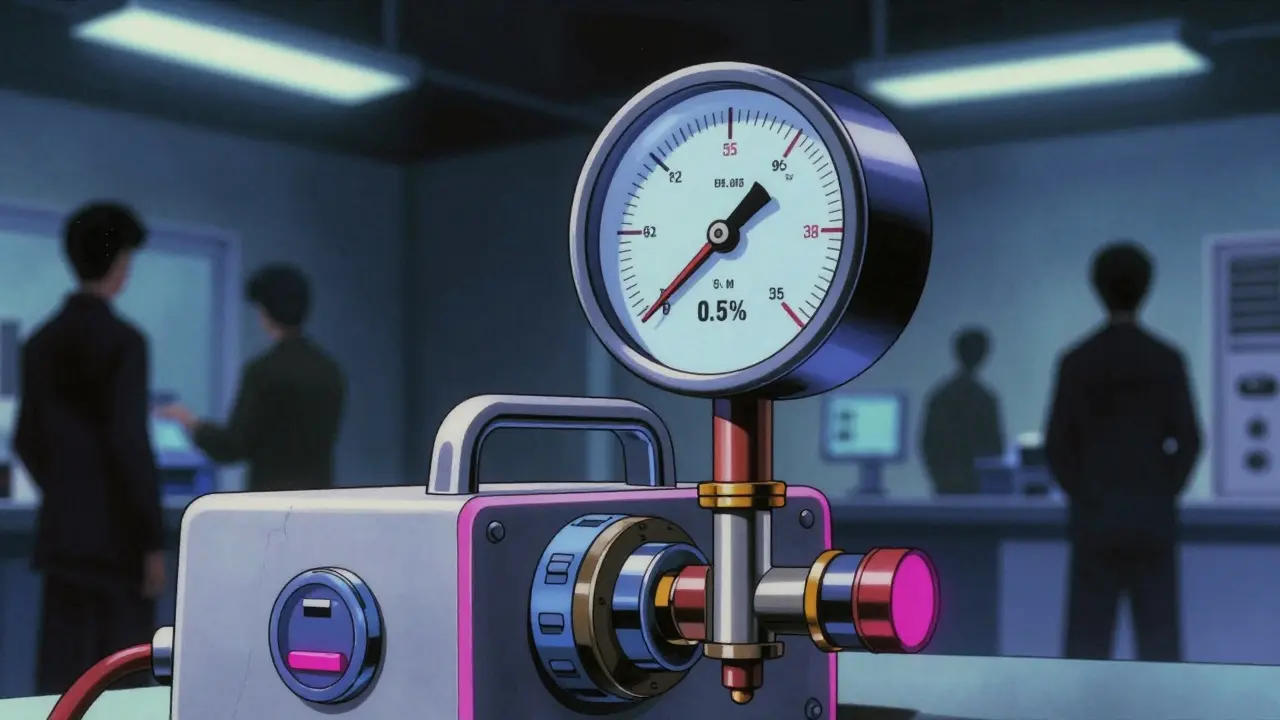
Imagine a medical device manufacturer in Sheffield producing life-saving pumps. The pressure gauge reads perfect numbers. The software logs green status. But what if that gauge is drifting by just 0.5%? In the real world, that tiny error could mean the difference between a patient getting the right dose or an overdose. This isn't a hypothetical nightmare; it's why calibration and validation are not just bureaucratic checkboxes but critical safety nets.
We often treat maintenance as a nuisance-a cost center that slows down production. Yet, when you look at the data, this mindset is dangerous. A 2023 analysis of FDA warning letters revealed that over 37% cited inadequate calibration procedures. That means more than one in three regulatory failures traces back to poor measurement practices. If you are managing manufacturing quality, understanding the distinct roles of calibration versus validation is your first step toward compliance and, more importantly, product integrity.
The Core Difference: Calibration vs. Validation
It is easy to mix these terms up, but they solve different problems. Think of calibration as checking your watch against atomic time. It answers the question: "Is my instrument measuring correctly?" Validation, on the other hand, asks: "Does this entire process produce the result we need?"
Calibration is defined by ISO/IEC 17000 as the operation that establishes a relationship between quantity values provided by measurement standards and corresponding indications from the instrument under test. It is purely about accuracy and traceability. You take a micrometer, compare it to a master standard, and document any deviation.
Validation, however, is broader. According to GAMP 5 guidelines, it confirms that equipment performs as intended for its specific use case. This involves Installation Qualification (IQ), Operational Qualification (OQ), and Performance Qualification (PQ). While calibration ensures the ruler is straight, validation ensures the carpenter builds a square table.
| Feature | Calibration | Validation |
|---|---|---|
| Purpose | Verify measurement accuracy | Confirm system performance for intended use |
| Frequency | Periodic (e.g., monthly, annually) | Once per change/new installation, then re-validated after changes |
| Traceability | To SI units (National Standards) | To user requirements and specifications |
| Output | Certificate with uncertainty values | Protocol reports (IQ/OQ/PQ) |
| Cost Range | $50 - $500 per device/year | $25,000 - $500,000 per complex system |
Regulatory Landscapes: What the Standards Demand
You cannot pick and choose which rules apply based on convenience. The regulatory framework depends heavily on your industry vertical. For medical devices, the bar is exceptionally high.
ISO 13485:2016 Clause 7.6 mandates calibration at specified intervals against standards traceable to the International System of Units (SI). Crucially, it requires documented uncertainty calculations. The golden rule here is that measurement uncertainty must be less than 25% of the tolerance being measured, per ISO 10012 requirements. If your tolerance is ±1mm, your calibration uncertainty should ideally be ≤0.25mm. Anything larger introduces unacceptable risk of false acceptance.
In contrast, ISO 9001:2015 Section 7.1.5.2 allows organizations more flexibility. You can determine calibration intervals based on risk assessment. An aerospace manufacturer might calibrate high-precision micrometers every three months, while a food processor might stick to a 24-month cycle for basic thermometers. The key is justification. You need historical data proving the equipment stays within tolerance during those extended periods.
For clinical labs, CLIA regulations (42 CFR §493.1255) create a tiered system. Waived tests require no calibration. Moderate complexity tests demand calibration every six months minimum. High complexity tests, like automated chemistry analyzers used by 98.7% of clinical labs, require verification every six months or per manufacturer instructions, whichever is stricter. The Centers for Medicare & Medicaid Services (CMS) guidance from April 2006 still holds weight here, requiring daily testing with NIST-traceable controls.

Setting Intervals: Beyond the Manufacturer’s Suggestion
Here is where most companies bleed money. Manufacturers recommend conservative intervals to protect their liability, not necessarily your efficiency. A common pitfall is blindly following a "calibrate every 6 months" sticker without looking at actual performance data.
Dr. James Westad, an ASQ Fellow, points out in the Journal of Quality Technology (2023) that organizations wasting resources on monthly calibrations of stable equipment violate the risk-based philosophy of modern standards. He cites a Class III medical device manufacturer that avoided FDA 483 observations by implementing condition-based calibration using IoT sensors. They reduced calibration frequency by 40% without compromising quality.
To do this legally and safely, you need a strategy:
- Gather Historical Data: Look at the last 3-5 years of calibration certificates. Did the drift trend show stability?
- Apply Method 5: Use the approach from SAE AS9100D:2016, which combines manufacturer recommendations, historical performance, and risk assessment.
- Monitor Environment: Remember that 57.8% of out-of-tolerance incidents occur in settings with temperature fluctuations greater than ±5°C from calibration conditions (NIST Technical Note 1900, 2022). If your shop floor swings from 15°C to 30°C, your interval needs to be shorter regardless of the tool's history.
Sarah Chen, a biomedical engineer, shared her experience on Reddit’s r/QualityAssurance forum in April 2024. Her lab extended electronic scale calibration from quarterly to biannually after analyzing 18 months of stability data. The result? She saved $18,500 annually. However, she noted that pH meters in high-humidity environments still required monthly checks despite the manufacturer’s 6-month recommendation. Context matters.
The Validation Process: IQ, OQ, and PQ
If calibration is routine, validation is a project. For complex production equipment, medical device manufacturers typically spend 18 to 24 months validating systems, with costs ranging from $25,000 to $500,000 per system according to 2024 Cognidox benchmarks.
The process breaks down into three phases:
- Installation Qualification (IQ): Did we install it correctly? Are the utilities connected? Is the software version correct? This is a snapshot in time.
- Operational Qualification (OQ): Does it operate within limits? We test the equipment at extreme ends of its range. If a heater is rated for 20-80°C, we verify it hits 20°C exactly and doesn’t overshoot 80°C.
- Performance Qualification (PQ): Does it work under real-world conditions? We run actual products through the system for multiple batches to prove consistency.
Software adds another layer. Under 21 CFR Part 11, you must validate algorithms extensively. However, ISO 13485:2016 Annex B permits simplified validation for off-the-shelf software if you have manufacturer validation certificates. Don't reinvent the wheel if you don't have to.

Digital Transformation and Future Trends
The industry is shifting from paper trails to digital ecosystems. The FDA’s 2024 Calibration Modernization Initiative mandates electronic records for all Class II and III device manufacturers by December 31, 2026. This move aims to eliminate 14.2 million paper records annually.
Cloud-based systems like GageList and Trescal are gaining traction. A 2024 benchmark study found that companies using calibration management software reduced audit preparation time by 63.2%, dropping from 84 hours weekly to just 31 hours. These tools automate certificate generation and flag upcoming due dates, reducing human error.
However, there are risks. NIST’s 2024 cautionary report warns that 44.2% of automated calibration systems fail to properly document chain-of-custody for reference standards. Just because it’s digital doesn’t mean it’s compliant. You must ensure your software maintains the unbroken traceability chain to SI units.
Looking ahead, AI-driven scheduling is emerging. Pfizer piloted AI-driven calibration scheduling that reduced costs by 31.7%. By predicting drift patterns rather than relying on fixed calendars, companies can optimize resource allocation. Meanwhile, NIST’s roadmap for quantum-based calibration standards promises 100x accuracy improvements for electrical measurements by 2030, which will fundamentally change how we view "uncertainty" in high-precision fields.
Practical Steps for Implementation
If you are starting from scratch or overhauling your program, follow this path:
- Inventory Everything: Identify every piece of measurement equipment. Assign unique IDs. This phase averages 112 hours for companies with 500+ devices.
- Risk Categorize: Not all tools are equal. Group them by criticality. Critical tools (those affecting product safety) get tighter intervals and stricter environmental controls.
- Select Providers: Choose calibration labs accredited to ISO/IEC 17025. Verify their scope covers your specific instruments.
- Define Uncertainty Limits: Establish your Test Uncertainty Ratio (TUR). Aim for TUR ≥ 4:1. If your tolerance is 10 units, your measurement uncertainty should be 2.5 units or less.
- Train Staff: Ensure technicians hold credentials like the ASQ Certified Calibration Technician (CCT). As of Q2 2024, CCT holders command 22.5% higher salaries, reflecting the value of expertise.
Remember, the goal isn't just to pass an audit. It's to ensure that when a patient uses your device, or a car brakes on a highway, the underlying measurements are trustworthy. That trust is built on rigorous, well-documented calibration and validation.
What is the difference between calibration and validation?
Calibration verifies that a measurement instrument provides accurate readings by comparing it to a known standard. Validation confirms that the entire equipment or process performs as intended for its specific application, ensuring it meets user requirements and produces consistent results.
How often should equipment be calibrated?
There is no single answer. It depends on regulatory requirements (e.g., CLIA mandates 6 months for moderate complexity tests), manufacturer recommendations, historical performance data, and environmental factors. Risk-based approaches allow extending intervals if stability data proves the equipment remains within tolerance.
What does ISO 13485 require for calibration?
ISO 13485:2016 Clause 7.6 requires calibration at specified intervals against standards traceable to SI units. It mandates documented uncertainty calculations, identification of equipment, and retention of records for the product lifecycle plus two years. Measurement uncertainty should generally be less than 25% of the tolerance being measured.
Can I extend calibration intervals beyond manufacturer recommendations?
Yes, but only with justification. ISO 9001 allows risk-based determination of intervals. You must analyze historical calibration data to demonstrate that the equipment remains within tolerance for the extended period. Environmental monitoring is also crucial, as temperature and humidity fluctuations can cause premature drift.
What is the Test Uncertainty Ratio (TUR)?
The Test Uncertainty Ratio compares the tolerance of the device under test to the uncertainty of the calibration standard. A TUR of 4:1 or greater is recommended to minimize the risk of false acceptance. For example, if a part has a tolerance of ±1mm, the calibration uncertainty should be ≤0.25mm.
How much does equipment validation cost?
Costs vary significantly. Simple equipment may cost a few thousand dollars, while complex production systems in medical device manufacturing can range from $25,000 to $500,000 per system. The timeline typically spans 18-24 months for comprehensive IQ/OQ/PQ protocols.
What are the consequences of poor calibration?
Poor calibration leads to inaccurate measurements, which can result in defective products, safety hazards, and regulatory non-compliance. Over 37% of FDA warning letters cite inadequate calibration. It can also lead to costly recalls, increased waste, and loss of customer trust.
Do I need to validate off-the-shelf software?
Under ISO 13485:2016 Annex B, you can use simplified validation for off-the-shelf software if the manufacturer provides validation certificates. However, you still need to verify that the software operates correctly in your specific environment and meets your operational requirements.

Comments (13)
Gareth Tyler May 22 2026
really interesting read about the drift issues
never thought about how a tiny error in pressure gauges could be so dangerous for patients
the part about calibration vs validation is super clear now
Sharon O’Mahonh May 24 2026
hey everyone love this breakdown of the regulatory landscape
it really highlights why we cant just pick and choose rules based on convenience
the distinction between iso 13485 and iso 9001 flexibility is crucial for quality managers
we need to embrace that risk-based approach to save resources while keeping safety high
its all about trust in the end right
Jonhnnie john13 May 25 2026
the author clearly misunderstands the fundamental nature of measurement uncertainty
claiming that a 0.5% drift is the primary concern ignores systemic process failures
most companies fail because they lack basic discipline not because their micrometers are slightly off
this article is just fluff for people who dont know better
Naresh Chandra May 25 2026
I completely agree with the sentiment here! It is truly important to understand these differences.
The section on setting intervals was very helpful, especially the point about gathering historical data.
It makes sense to look at the last 3-5 years of certificates to see if there is any stability trend.
This approach seems much more logical than blindly following manufacturer suggestions every single time.
Cyburg Adeoye May 27 2026
Welcome to the discussion everyone! I find the integration of IoT sensors for condition-based calibration fascinating.
As mentioned by Dr James Westad, reducing frequency by 40% without compromising quality is a significant achievement.
We must ensure that our environmental monitoring is robust, as temperature fluctuations can severely impact instrument stability.
Let us continue to share best practices for optimizing our calibration management systems!
Joseph Teichman May 27 2026
good info but i think peple forget how hard it is to get good techs
training staff is key and those CCT certs are worth the money
you cant just buy software and expect it to fix bad habits
Grace Gayle McMullen May 28 2026
i always mix up iq oq and pq until now
the carpenter analogy is perfect though
calibration is the ruler validation is the table
thanks for clarifying that mess
Angela Niculescu May 29 2026
everyone thinks digital transformation is the answer but its usually just a way to hide incompetence
paper trails are annoying yes but they force you to actually look at the data
now we have automated systems failing to document chain-of-custody which is worse
why do we keep falling for these shiny new tools
Victoria Mangiapane May 31 2026
oh great another boring post about regulations
who cares about iso standards really
just let us build stuff already
this is such a waste of time reading all this jargon
boringggg
Nivetha Narayanan June 1 2026
love the positive vibes here!
its cool to see how much money can be saved by extending calibration intervals
sarah chens story is inspiring
we should all try to analyze our own data like she did
keep sharing your wins guys!
Frank Arlyss June 3 2026
i wonder if the author has ever actually touched a gauge
probably just sitting in an office writing words
must be nice to talk about safety nets when you dont deal with the real world
typical corporate speak
Tim Reynolds June 4 2026
the fda is watching you.
every digital record is a trap.
they want to control everything.
trust no one.
especially not the cloud.
Groman Neta June 5 2026
this article is fundamentally flawed in its assumption that cost savings justify reduced rigor
any competent engineer knows that cutting corners on calibration is negligence
the author is essentially encouraging non-compliance under the guise of efficiency
do not follow this advice if you value your license