
When it comes to your pills, who really decides?
You walk into the doctor’s office with a prescription in hand. It’s the same one they’ve given you for three years. You don’t like how it makes you feel-drowsy, dry-mouthed, emotionally flat-but you’ve never said anything. Why? Because you assume they know best. What if you didn’t have to assume? What if you had the right, the power, even the expectation, to choose?
This isn’t about rebellion. It’s about autonomy-your right to say yes or no to what goes into your body. In medicine, we talk about this a lot in theory. But in practice? Too often, patients are handed a script like a menu item with no options, no explanations, and no real say.
Why medication choice is different from other medical decisions
Surgery? You decide once. A biopsy? You agree to a one-time test. But medication? That’s a daily, monthly, yearly commitment. You take it while you sleep, while you work, while you’re with your kids. It changes your mood, your energy, your sex drive, your weight. And it doesn’t just stop when you stop taking it-some effects linger for weeks.
That’s why medication autonomy isn’t just another checkbox on a consent form. It’s an ongoing conversation. A 2023 study found that 50% of people with chronic conditions stop taking their meds within the first year-not because they’re noncompliant, but because they never truly agreed with the choice in the first place.
And here’s the kicker: patients feel more risk with pills than with scans or needles. A JAMA survey showed 73% of people worry more about side effects from medication than from diagnostic tests. Why? Because you’re inviting a chemical into your system. That’s personal. That’s intimate. That’s yours to control.
What true medication autonomy looks like
True autonomy doesn’t mean the doctor says, ‘Here’s your option.’ It means they say, ‘Here are your options-and here’s what each one actually does to your life.’
Take depression. SSRIs are commonly prescribed. They work for about half the people who try them. But for 25-30% of users, they cause sexual dysfunction. That’s not a side note. That’s a dealbreaker for many. Yet, how often do doctors mention it upfront? Not often enough.
Autonomy means knowing the numbers: the 50-60% response rate, the cost difference between brand-name drugs ($5,000-$7,000 a month) and biosimilars ($3,000-$4,500), and the fact that there are non-drug options-therapy, exercise, light therapy-that might work just as well for you.
It means asking: ‘What happens if I don’t take this?’ ‘What if I try a different one first?’ ‘Can we start low and go slow?’
That’s what the Shared Decision Making Index-9 measures. It’s not about how much information is given-it’s about whether the patient feels heard, understood, and in charge.

The hidden barriers: cost, time, and bias
Autonomy sounds great until you hit the real world.
Cost is the biggest silent killer of choice. In 2023, 32% of Medicare Part D users changed or skipped doses because they couldn’t afford their meds. Doctors know this. But many still prescribe the most expensive option-either because they’re unaware of alternatives, or because they assume the patient won’t push back.
Time is another wall. The average doctor visit lasts 15 minutes. Trying to explain three different antidepressants, their side effects, costs, and how they fit into someone’s life? Impossible. That’s why many skip the discussion entirely.
And then there’s bias. A 2023 survey found that Black and Hispanic patients were significantly less likely to report being involved in medication decisions than white patients. Some doctors assume low-income patients won’t adhere to complex regimens-and so they don’t offer them the best options. That’s not autonomy. That’s paternalism dressed up as concern.
Real stories: when choice changed everything
One patient on Reddit shared how she refused opioids for cancer pain because of her religious beliefs. Her doctor didn’t argue. They worked together on a non-opioid plan-more frequent doses, different combinations. She stayed in control. She stayed comfortable.
Another, a diabetic, was prescribed Ozempic without any discussion. She mentioned nausea as a concern. Her doctor shrugged and said, ‘It works.’ She switched providers. The new one spent 45 minutes reviewing alternatives: other GLP-1 drugs, insulin, lifestyle changes. She chose a different drug. Her nausea vanished.
These aren’t rare cases. A 2023 study in the Annals of Internal Medicine found that patients who helped choose their meds were 82% more likely to stick with them. That’s not just satisfaction. That’s better health.
What’s changing-and what’s not
There’s progress. In 2024, the American Society of Health-System Pharmacists launched a formal Medication Autonomy Framework with 12 evidence-based standards. The FDA is now asking drugmakers to collect patient preference data before launching new meds. And pharmacogenomic testing-where your genes tell you which drugs you’ll respond to-is now under $250, down from $1,200 in 2020.
But the systems aren’t keeping up. Only 38% of hospitals using Epic EHR systems have fields to document patient medication preferences. Meanwhile, 78% of U.S. hospitals use Epic. That’s a gap. A huge one.
And while 87% of U.S. healthcare institutions claim to use shared decision-making, only 42% of rural clinics actually do. Autonomy is still a privilege, not a right-for many, it’s still a luxury.
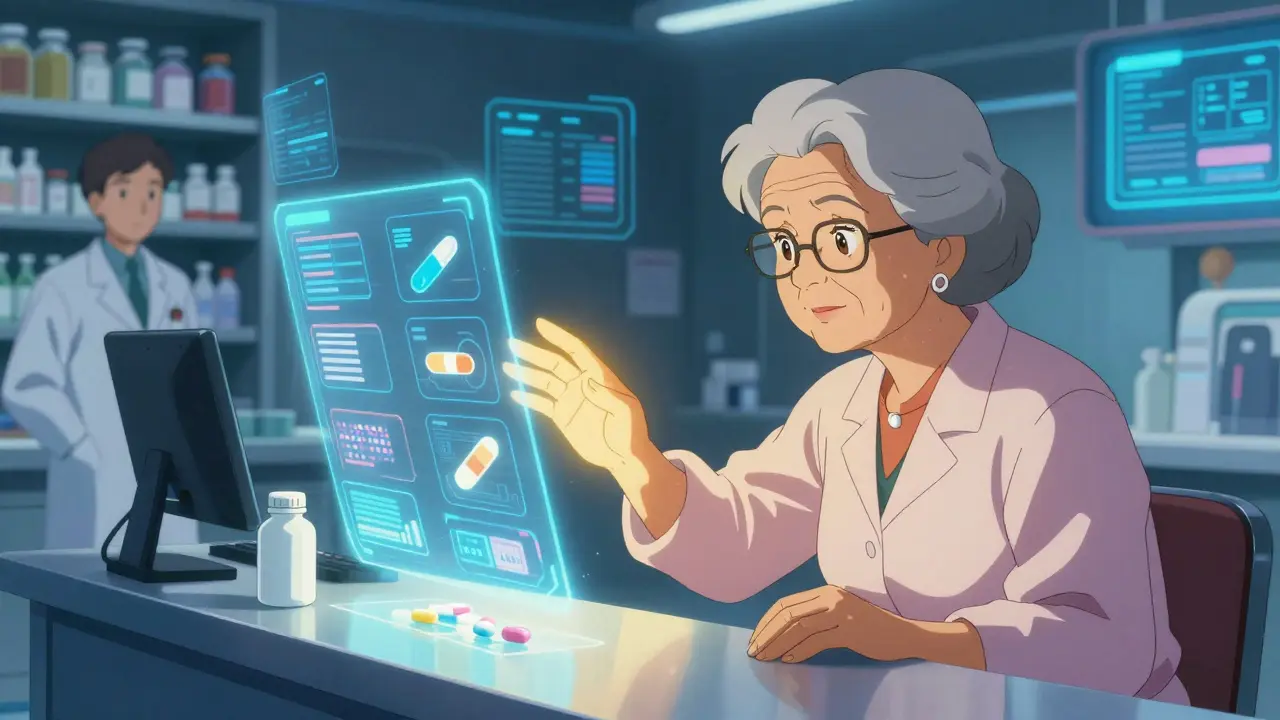
How to take back control
You don’t need a degree to ask for autonomy. You just need to speak up.
- Before your appointment, write down: What matters most to me about this medication? Is it avoiding drowsiness? Keeping costs low? Not taking pills at work?
- Ask: ‘What are my options besides this one?’
- Ask: ‘What happens if I wait or try something else first?’
- Ask: ‘Can we start with the cheapest generic?’
- Ask: ‘Is there a non-drug option I could try?’
Bring a list. Bring a friend. Bring your values. You’re not being difficult. You’re being human.
If your doctor brushes you off? Find someone who listens. Your health isn’t a one-size-fits-all prescription. It’s your life.
The future: personalization, not prescription
Soon, your medication won’t just be chosen based on your diagnosis. It’ll be chosen based on your DNA, your lifestyle, your job, your sleep habits, even your grocery list.
Pharmacogenomics will tell your doctor if you’re a fast or slow metabolizer of certain drugs. Digital apps will track how you feel day-to-day and adjust recommendations. Pharmacies will offer pre-visit tools to help you clarify what you want before you even see the doctor.
But here’s the catch: if these tools only work for people with smartphones and tech skills, we’ll make autonomy worse for older adults and low-income patients. Right now, 37% of people over 65 say they can’t use medication apps. That’s not progress. That’s exclusion.
True autonomy means everyone gets a seat at the table-not just those who can navigate digital interfaces.
It’s not about being difficult. It’s about being whole.
Medication isn’t just chemistry. It’s identity. It’s dignity. It’s control over your own body.
Autonomy doesn’t mean rejecting medicine. It means demanding better medicine-one that sees you as a person, not a case number.
Next time you’re handed a script, don’t just take it. Ask. Compare. Choose. You’re not just a patient. You’re the one living with the consequences. And you deserve to decide how they unfold.

Comments (11)
Solomon Ahonsi February 1 2026
Doctors act like they’re gods with a clipboard. You’re not a patient, you’re a vending machine. I’ve been on the same SSRI for 4 years because my doc said ‘it works’ and never asked how I felt. Then I read this and realized I’ve been gaslit by the medical industrial complex. Fuck that. I switched meds last month. No more emotional zombie mode.
George Firican February 2 2026
The core tension here isn’t between patient and physician-it’s between institutional inertia and the radical notion that a human being has the right to govern their own physiology. Medicine has become a transactional scaffold built on assumptions: that compliance equals care, that silence equals consent, that efficiency trumps embodiment. We treat the body like a machine with faulty parts, when in truth, it’s a living narrative shaped by trauma, culture, sleep, hunger, and hope. Autonomy isn’t a checkbox-it’s the daily practice of saying, ‘This is my flesh, and I will not outsource my dignity to a 12-minute consult.’
Matt W February 3 2026
I used to just take what they handed me. Then my anxiety got worse and I realized I hadn’t told my doctor I was having panic attacks at work. When I finally spoke up, they switched me to a different med and we started talking about therapy too. It wasn’t magic-but it felt like I was finally being treated like a person. You don’t need to be loud to deserve a seat at the table. Just honest.
Anthony Massirman February 5 2026
My doctor gave me a script for a $7k/month drug. I asked for the generic. He said ‘it’s not the same.’ I Googled it. Same active ingredient. Same results. I paid $40. He didn’t mention that. Ever.
Eli Kiseop February 5 2026
why do doctors never talk about cost like its a real thing like its always just ‘here’s your pill’ and then you’re stuck with a bill that makes you cry in the parking lot
larry keenan February 6 2026
While the conceptual framework of patient autonomy is laudable and aligned with bioethical principles articulated in Beauchamp and Childress, the operationalization of shared decision-making remains constrained by structural limitations inherent in fee-for-service models, time compression, and insufficient provider training in motivational interviewing techniques. The data cited are compelling, yet the systemic barriers to implementation are nontrivial and require policy-level intervention rather than individual patient advocacy alone.
Akhona Myeki February 6 2026
In South Africa, we don’t have the luxury of choosing between brand-name and generic. We fight just to get the basic meds. You people complain about side effects? We fight for access. Autonomy is a first-world privilege. Stop acting like your SSRI is a human right.
Chinmoy Kumar February 7 2026
i think this is so important but i also think doctors are overworked and underpaid like they dont have time to explain everything but maybe we need better systems not just more yelling from patients
Sandeep Kumar February 9 2026
Stop pretending this is about choice. Most people don’t even know what a pharmacokinetic profile is. Autonomy is a buzzword for people who think they’re smarter than their doctors. The system works fine. You want control? Study medicine.
Gary Mitts February 9 2026
So you’re telling me I need to become a pharmacist to get a pill that doesn’t make me feel like a zombie? Cool. I’ll just add that to my 8-hour workday.
Murarikar Satishwar February 11 2026
This is exactly why I started bringing a list to every appointment. Three bullet points: what I want, what I fear, what I can afford. My doctor actually smiled last time. Said, ‘I wish more patients did this.’ Turns out, when you show up prepared, they show up as humans too. It’s not about being difficult. It’s about being clear. And honestly? We all deserve that.