Getting a CT scan is usually routine, but for some patients, the injection of iodinated contrast media, commonly known as contrast dye, carries a real risk. These substances are essential for highlighting blood vessels and organs in X-ray imaging, yet they can trigger adverse responses ranging from mild hives to life-threatening anaphylaxis. If you have ever reacted badly to contrast in the past, you know the anxiety that comes with needing another scan. The good news is that medical professionals have developed robust strategies to manage this risk.
The core solution lies in premedication protocols, which involve administering specific drugs before the procedure to dampen your immune system's reaction. But these aren't just random pills; they follow strict timelines and dosages based on decades of clinical data. Understanding how these protocols work, who actually needs them, and what safety nets are in place can make the difference between a smooth diagnostic process and a dangerous emergency.
Understanding the Risk: Who Needs Protection?
Not everyone requires premedication. In fact, most people tolerate contrast dye without any issues. The primary group at risk consists of patients who have had a previous allergic-type reaction to contrast. According to foundational research by Greenberger et al. (1986), published in the Journal of Allergy and Clinical Immunology, patients with a prior reaction face a recurrence risk of approximately 35%. This is a significant jump from the baseline reaction rate of 0.04% to 0.22% seen in the general population using modern low-osmolar agents.
However, not all "allergies" are created equal. A common misconception is that shellfish or iodine allergies increase your risk. Major institutions like the University of Wisconsin and UCLA Health clarify that unrelated allergies-including those to shellfish, iodine, or povidone-iodine (Betadine)-do not constitute a high risk for contrast reactions. Patients with these allergies are only 2- to 3-fold more likely to react compared to the general public, which is insufficient to warrant routine premedication. The true red flag is a documented history of a reaction to the contrast medium itself.
Reactions are categorized by severity to determine the necessary level of intervention:
- Mild reactions: Symptoms like mild nausea, itching, or a few hives. Current evidence, including a 2021 study by McDonald et al. in Radiology, suggests that mild prior reactions carry minimal recurrence risk. Many experts now argue that premedication may not even be necessary for this group.
- Moderate reactions: More extensive hives, vomiting, or mild respiratory symptoms. Premedication is generally recommended here.
- Severe reactions: Anaphylaxis, bronchospasm, or hypotension. These cases require careful planning, often involving switching to a different contrast agent within the same class rather than just adding medication.
The Gold Standard: Traditional Premedication Regimens
When premedication is deemed necessary, the goal is to reduce that 35% recurrence risk down to roughly 2%. The American College of Radiology (ACR) Manual on Contrast Media, specifically Version 10.3 (2018), serves as the foundational reference for these protocols across major academic centers like Dartmouth-Hitchcock, UCSF, and Yale.
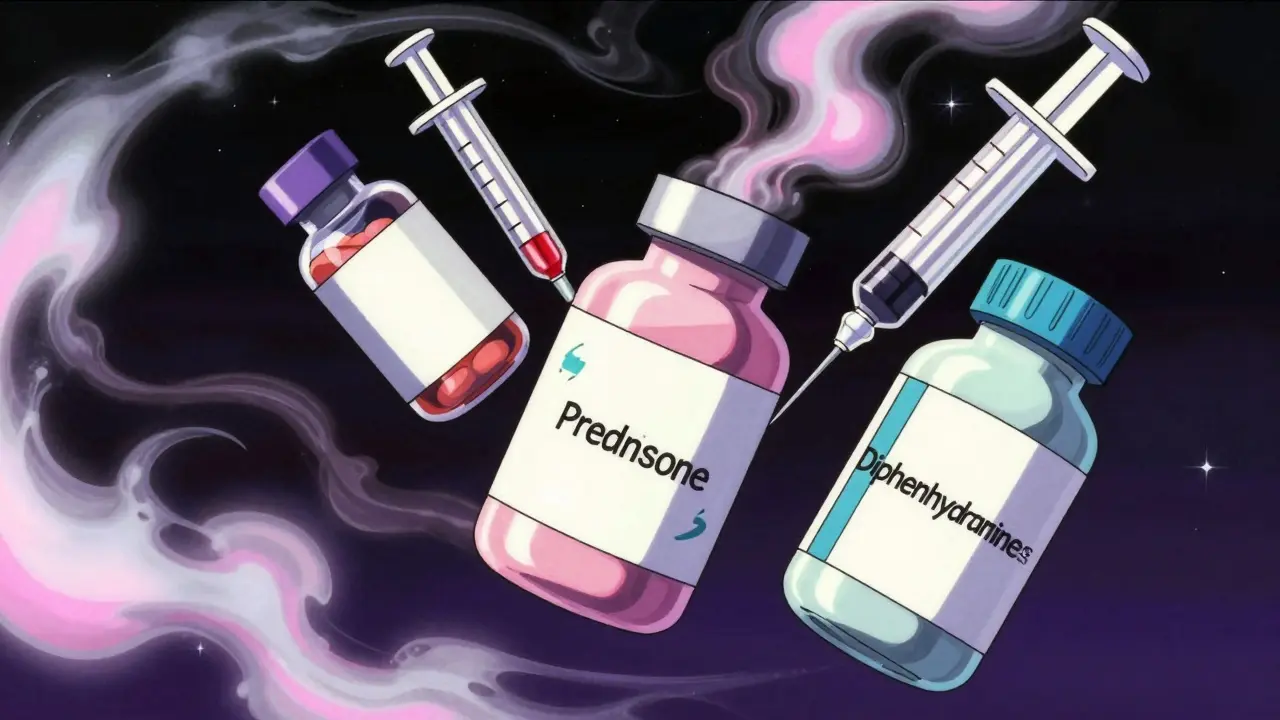
The traditional oral regimen is designed for outpatient settings and requires a lead time of 13 hours. This timeline is crucial because steroids need time to alter gene expression and suppress the inflammatory response. Rushing this process significantly reduces its effectiveness.
| Time Before Scan | Medication | Dosage | Purpose |
|---|---|---|---|
| 13 Hours Prior | Prednisone | 50 mg orally | Initial anti-inflammatory suppression |
| 7 Hours Prior | Prednisone | 50 mg orally | Maintain therapeutic levels |
| 1 Hour Prior | Prednisone | 50 mg orally | Peak effect during administration |
| 1 Hour Prior | Diphenhydramine (Benadryl) | 50 mg orally | Block histamine release |
A critical practical detail here is the sedating effect of diphenhydramine. Because it causes drowsiness, patients taking this regimen must have a driver. As UCLA Health explicitly states, if a patient has no ride home, the study may need to be rescheduled. This logistical hurdle is often overlooked but is vital for patient safety.
Inpatient and Emergency Protocols
For patients admitted to the hospital or those requiring urgent imaging, waiting 13 hours isn't always feasible. In these scenarios, intravenous (IV) regimens are preferred. These protocols use faster-acting steroids to achieve similar protective effects in a shorter window, though they still require a minimum of 4 to 5 hours to be effective.
Two primary IV options are widely used:
- Methylprednisolone Sodium Succinate (Solu-Medrol): 40 mg IV immediately, followed by 40 mg IV every 4 hours until contrast administration. Diphenhydramine 50 mg IV is given 1 hour before the scan.
- Hydrocortisone Sodium Succinate (Solu-Cortef): 200 mg IV immediately, followed by 200 mg IV every 4 hours until contrast administration. Diphenhydramine 50 mg IV is given 1 hour before the scan.
It is important to note that premedication regimens completed in less than 4-5 hours have not demonstrated consistent effectiveness. While it might seem logical to give everything right before the scan, the biological mechanism of steroid action simply doesn't support such rapid onset for allergy prevention.
Accelerated Regimens for Urgent Cases
What if you need a scan sooner than 13 hours but don't have IV access? Research has paved the way for accelerated oral protocols. A pivotal 2017 study by Mervak et al., published in Radiology, compared a traditional 13-hour regimen with a 5-hour accelerated protocol. The 5-hour regimen involved taking methylprednisolone 32 mg orally at 5 hours and again at 1 hour before contrast.
The study found comparable efficacy between the two methods, offering a lifeline for urgent cases where IV access is difficult or unnecessary. However, this regimen is less studied than the traditional approach and should be used under direct medical supervision. For pediatric patients, protocols differ significantly. UCSF Radiology specifies cetirizine 10 mg by mouth 1 hour prior for children aged 6 and above when antihistamine-only premedication is indicated, avoiding the complexity of steroid dosing in younger populations.
Safety Planning Beyond Medication
Premedication is not a magic shield. Even with proper preparation, there is a documented "breakthrough" reaction rate of about 2%. This means that despite following every step perfectly, a small percentage of patients will still experience a reaction. Therefore, safety planning extends far beyond the pill bottle.
First, location matters. Institutions like Mount Sinai Health System and UCSF mandate that patients requiring premedication must be scheduled at sites with primary response teams immediately available. If you have a history of severe reactions, your imaging should take place at a facility with rapid access to higher levels of care, such as a hospital with an intensive care unit nearby.
Second, documentation is key. Referring physicians must consult with radiologists before scheduling. At UCLA Health, specific buildings are designated for imaging patients with prior allergy histories to ensure that trained personnel and emergency equipment are on hand. In emergency situations, the clinical provider should accompany the patient to the radiology suite to aid in immediate management if a repeat reaction occurs.
Finally, consider contrast substitution. Yale Radiology emphasizes that for any severity of prior reaction, switching to a different contrast agent within the same class is best practice if the inciting agent is known. Sometimes, changing the brand or formulation of the dye is as effective as adding medication, potentially reducing the side effects associated with steroids.
Cost and Accessibility
One reassuring aspect of premedication is its cost-effectiveness. The medications involved-prednisone and diphenhydramine-are inexpensive generics. At 2023 Medicare reimbursement rates, prednisone 50 mg tablets cost approximately $0.25 each, and diphenhydramine costs about $0.15 per dose. This represents less than 0.1% of the typical CT scan cost, which ranges from $500 to $1,500. Despite the low cost, adherence to standardized protocols varies. A 2020 ACR survey indicated that while adoption approaches 100% in academic centers, only 78% of community hospitals strictly adhere to these guidelines. This variability highlights the importance of patients advocating for themselves and confirming their safety plan with their healthcare provider.
Frequently Asked Questions
Do I need premedication if I am allergic to shellfish?
No. Shellfish allergy is not a risk factor for contrast dye reactions. Major guidelines from the ACR and institutions like UCLA Health state that unrelated allergies do not warrant routine premedication. Only a prior reaction to contrast media itself is considered a significant risk factor.
How long does the premedication process take?
The traditional oral regimen requires 13 hours. Intravenous regimens require at least 4 to 5 hours. Accelerated oral protocols can be completed in 5 hours. Any regimen completed in less than 4 hours is generally considered ineffective for preventing reactions.
Can I drive myself home after taking premedication?
No. Diphenhydramine (Benadryl), a key component of most premedication protocols, causes sedation and drowsiness. You must arrange for a driver to take you home. Many facilities will reschedule your appointment if you cannot provide proof of transportation.
Is premedication 100% effective?
No. While premedication reduces the risk of reaction from 35% to approximately 2%, there is still a "breakthrough" rate. This is why safety planning, including imaging at equipped facilities and having emergency staff ready, remains critical.
What happens if I miss a dose of my premedication?
If you miss a dose, contact your radiology department immediately. They may advise you to take the missed dose if enough time remains, or they may reschedule your appointment to ensure the full protective benefit is achieved. Do not double up doses without medical advice.
Are there alternatives to premedication?
Yes. Switching to a different contrast agent within the same class is often recommended and may be equally effective. Additionally, for mild prior reactions, some experts suggest that premedication may not be necessary at all, relying instead on close monitoring during the procedure.

Comments (10)
swetha r May 13 2026
They want you to believe it's just a 'reaction' but have you ever stopped to think about what they are actually injecting into your bloodstream? It is not just dye, it is a chemical cocktail designed to keep you docile and compliant while they scan every inch of your body for data they sell to insurance companies. The shellfish myth is the perfect distraction because it makes you feel like you understand the risk when really you are walking blindfolded into a laboratory experiment. I had my cousin take those steroids and she said her skin felt like it was burning from the inside out for three days after. They tell you it reduces the risk by 35% but who calculated that number and why should we trust their math? The fact that they need to sedate you with Benadryl proves they know the substance is toxic enough to cause immediate physical distress. We are all guinea pigs in this medical industrial complex and they are smiling as they inject us.
Derick Garcia May 13 2026
It is truly pathetic that society has reached a point where individuals require a pharmacological intervention merely to endure a diagnostic procedure that is fundamentally harmless to the vast majority of the population. The reliance on prednisone and diphenhydramine is not a triumph of modern medicine but rather a testament to our collective fragility and inability to withstand minor physiological inconveniences without resorting to chemical suppression. One must ask why the baseline reaction rate is so low yet the protocols are so aggressive, suggesting a liability-driven culture rather than one focused on genuine patient welfare. The assertion that shellfish allergies are irrelevant is correct, yet the public continues to cling to these superstitions, demonstrating a profound lack of critical thinking skills. To demand a driver home due to drowsiness is an absurd logistical burden placed on the individual for a convenience that serves only the hospital's schedule efficiency.
Abhimanyu Pandey May 14 2026
;;The protocol is flawed;; ;;because it assumes;; ;;the immune system;; ;;is the only;; ;;variable at play;; .;; What about the;; ;;environmental toxins;; ;;already present;; ;;in the patient's;; ;;body from;; ;;previous scans;; ?;; The cumulative effect;; ;;of iodinated contrast;; ;;is rarely discussed;; ;;by the medical elite;; .;; They want you;; ;;to think each;; ;;scan is isolated;; ;;but your body;; ;;remembers every;; ;;insult it receives;; .;; The 35% recurrence;; ;;rate is likely;; ;;an underestimation;; ;;because many;; ;;mild reactions;; ;;are dismissed;; ;;as coincidences;; .;; You are being;; ;;poisoned repeatedly;; ;;and told it is;; ;;safe because;; ;;you did not;; ;;die immediately;; .;; This is;; ;;not safety planning;; ;;this is;; ;;controlled toxicity;; .
Dat Alexander May 16 2026
i get why people are scared but its important to remember that these protocols exist to help us stay safe during necessary procedures. the idea that we can just walk in and get a scan without any prep if we have a history is risky but the guidelines try to balance speed and safety. i think the part about switching contrast agents is really interesting because it shows there are options beyond just adding more drugs. we should probably talk more about how patients can advocate for themselves when they feel rushed or ignored by staff. everyone deserves to feel heard and respected regardless of their medical history.
Raymond Roberts May 16 2026
look i know some people say the shellfish thing is a myth but i had a friend who reacted badly and he loves shrimp so maybe there is something to it even if the doctors say no. the whole process is so stressful though and having to take pills hours before just adds to the anxiety. i wish they could just give you a shot that works instantly instead of making you wait thirteen hours. it feels like they are trying to make it complicated on purpose to justify the cost. anyway good luck to anyone who has to go through this soon hopefully it goes smoothly for you.
Nisha Koshti May 16 2026
ugh!!! why do they make it so hard???? i hate taking steroids!!! they mess up my mood!!! and benadryl makes me sleepy!!! :( i dont care about the stats!!! i just want to get it over with!!! the doctors are always so cold!!! they dont care about our feelings!!! just push the needle!!! :( why cant they use a different dye that doesnt cause reactions??? its obvious they are hiding something!!! i am going to skip my next scan!!! better safe than sorry!!! :P
Jannet Suen May 17 2026
lol yeah the shellfish allergy thing is totally debunked but good luck getting your auntie to believe that :P. honestly though the premedication stuff is pretty standard now. i had to do it once and the worst part was definitely needing a ride home because the benadryl knocked me out. its annoying but at least i didn't end up in the er. thanks for sharing the details about the timing though, knowing exactly when to take the pills helped reduce my stress a bit.
Claire A May 17 2026
This is such a helpful breakdown! I was so worried about my upcoming scan but reading about the accelerated protocol gives me hope. It's great to know that there are options for urgent cases too. Thanks for clarifying that mild reactions might not even need premedication anymore, that's a huge relief!
andrew iregbayen May 19 2026
hey guys, does anyone know if the accelerated protocol works for kids too? my son needs a scan and he's super anxious about waiting so long. also, is it true that the new dyes are safer? i've heard conflicting stories online and wanted to see if anyone here has recent experience with them.
Laura ciotoli May 19 2026
The information provided is accurate regarding the ACR guidelines. Patients must adhere strictly to the timing of medication administration. Failure to follow the protocol increases the risk of adverse events significantly. Do not attempt to substitute medications without consulting your physician. The cost analysis is also correct; these drugs are inexpensive generics. Ensure your facility has emergency equipment available.