Quick Summary: Key Takeaways
- Circadian misalignment occurs when your internal 24-hour clock doesn't match your external environment.
- Jet Lag is a temporary shift caused by crossing time zones, with eastward travel being harder to recover from.
- Delayed Sleep Phase Disorder (DSPD) is a chronic condition where sleep onset is naturally pushed back by 2+ hours.
- Effective treatment usually combines timed bright light exposure (10,000 lux) and low-dose melatonin.
- Long-term risks of untreated disorders include a 29% increase in type 2 diabetes risk and 23% increase in cardiovascular issues.
Understanding the Internal Clock
At its core, a circadian rhythm is an endogenous 24-hour cycle that regulates sleep-wake patterns, hormone release, and body temperature. These rhythms persist even if you were locked in a dark room with no windows. However, they rely on external cues-specifically sunlight-to stay anchored. When these cues are removed or shifted, you experience a mismatch between your biological time and social time. This isn't just about feeling groggy. Research into the genetic mechanisms of these rhythms earned a Nobel Prize in 2017, proving that specific proteins and genes control when we feel awake. When these mechanisms malfunction, or when we travel faster than our bodies can adapt, we enter a state of circadian misalignment. This can lead to a 20-30% drop in cognitive performance, making simple tasks feel like climbing a mountain in a fog.
Jet Lag: The Temporary Time Warp
Most of us know Jet Lag is a transient disorder caused by rapid travel across multiple time zones. It happens because your internal clock can't instantly jump forward or backward to match a new city. Interestingly, the direction you travel matters immensely. Traveling east is significantly harder than traveling west. Why? Because the human circadian period actually averages about 24.2 hours. This means our bodies naturally prefer to stay up a little later (a phase delay) rather than go to bed earlier (a phase advance). When you fly from New York to London, you're forcing your body to advance its clock. This creates about 1.5 hours of misalignment for every time zone crossed, compared to just 1 hour when traveling west. This is why eastward travelers report 37% more severe sleep disruption.
| Feature | Eastward Travel (Advance) | Westward Travel (Delay) |
|---|---|---|
| Difficulty Level | Higher (Harder to advance) | Lower (Easier to delay) |
| Misalignment Rate | ~1.5 hours per time zone | ~1 hour per time zone |
| Recovery Pace | Approx. 1 hour/day | Approx. 1.5 hours/day |
Delayed Sleep Phase Disorder: The Chronic Night Owl
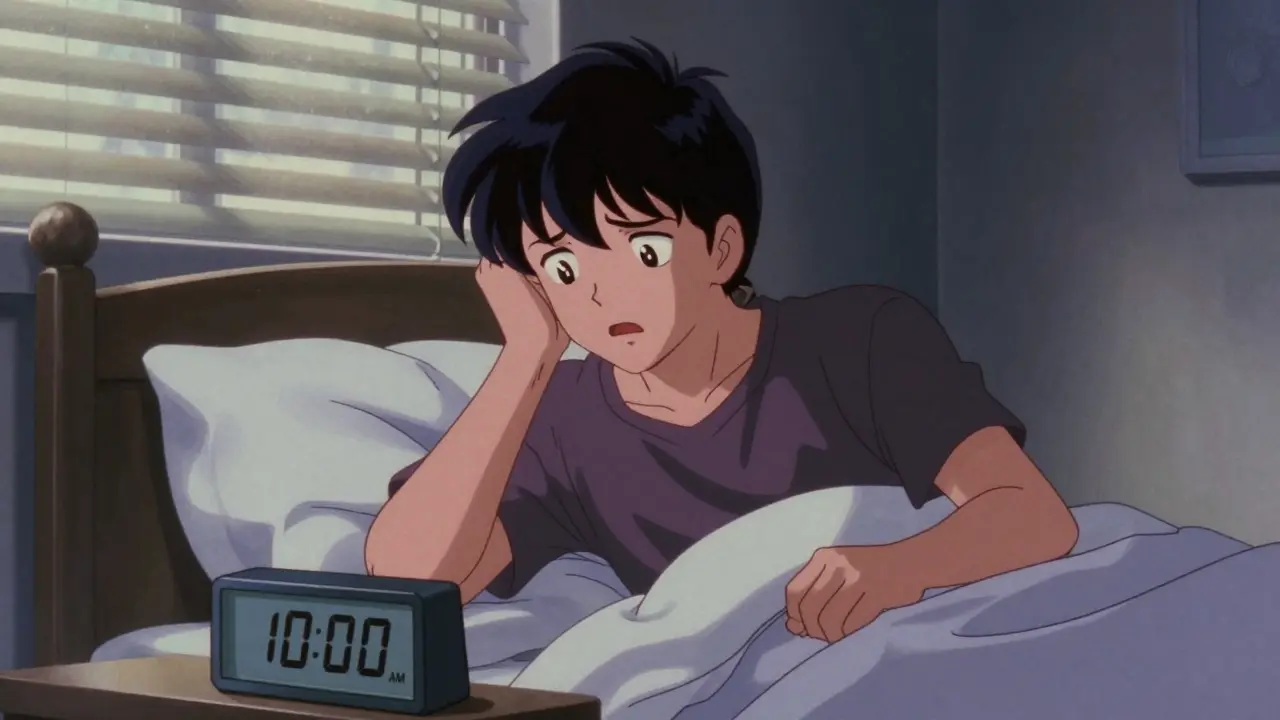
While jet lag is a temporary glitch, Delayed Sleep Wake Phase Disorder (DSPD) is a chronic condition where the internal clock is shifted significantly later than conventional social norms. We aren't talking about a few late nights of gaming; we're talking about a persistent pattern where sleep onset typically happens between 3 AM and 6 AM, and wake times fall between 10 AM and 1 PM. For people with DSPD, the quality of sleep is actually normal-provided they can sleep on their own schedule. The problem arises when society demands they be awake at 8 AM. This creates a permanent state of "social jet lag." A 2020 study showed that melatonin onset in DSPD patients occurs about 2 hours later than in others. This is often driven by genetics; variations in the PER3 and CRY1 genes account for nearly 40% of the variance in sleep timing among teenagers. Consider the struggle of a university student who is biologically wired to be productive at 2 AM but is forced to attend a lecture at 8 AM. They aren't being lazy; they are fighting their own DNA. When forced into a standard schedule, these individuals suffer from chronic fatigue and cognitive impairment, often leading to academic or professional failure despite their actual capability.

How to Realign Your Clock
The goal of treatment is "entrainment"-forcing the internal clock to sync with the external world. The most powerful tool for this is light. Your eyes tell your brain exactly where you are in the day. For circadian rhythm disorders, timed exposure to bright light is the gold standard.
For those dealing with DSPD, the American Academy of Sleep Medicine recommends a multi-pronged attack:
- Morning Bright Light: Use a light box providing 10,000 lux for 30-60 minutes within one hour of waking. This signals the brain to stop producing melatonin and "reset" the day to an earlier start.
- Micro-dose Melatonin: Instead of taking a huge dose of melatonin (like 5mg) right before bed, try 0.5mg about 5-7 hours before your desired bedtime. This acts as a chronological signal rather than a sedative.
- Strict Schedule: Waking up at 7 AM on Monday but sleeping until 11 AM on Saturday completely undoes your progress. Weekend consistency is the hardest but most important part.
For jet lag, the strategy depends on your direction. If you're heading east, seek bright light in the morning and avoid it in the evening. If you're heading west, do the opposite: get sunlight in the evening to delay your clock. If your trip is longer than four days, start shifting your bedtime by one hour every day for three to five days before you even leave your house.
The Danger of Ignoring Your Rhythm
It's easy to dismiss sleep issues as a lack of discipline, but the biological stakes are high. Chronic circadian misalignment puts a massive strain on your metabolic health. When you eat and sleep at times your body isn't prepared for, your glucose processing and blood pressure regulation suffer. Data from the UK Biobank suggests that people with untreated circadian disorders have a 29% higher risk of developing type 2 diabetes. Cardiovascular disease risk also jumps by 23%. This happens because hormones like cortisol and insulin are tied to the circadian clock; when the timing is off, these hormones don't work efficiently. This is why many Fortune 500 companies are now implementing shift work optimization protocols-they've realized that a tired, misaligned employee is a health risk and a productivity drain.
Modern Tools and the Future of Sleep
We are moving away from a one-size-fits-all approach to sleep. We now have personalized chronotherapy apps like Timeshifter, which use algorithms to tell you exactly when to seek light and when to avoid it based on your specific flight and sleep history. In trials, these tools helped people recover from jet lag 63% faster than using general advice. In the coming years, expect circadian medicine to move into primary care. Instead of just asking "how many hours do you sleep?" doctors will start asking "when is your natural wake time?" Wearable tech is also evolving to monitor circadian markers in real-time, allowing us to adjust our environments-like changing the color temperature of our home lighting-to match our biological needs.
Is Delayed Sleep Phase Disorder the same as insomnia?
No. People with insomnia struggle to fall or stay asleep regardless of the time. People with DSPD can fall asleep easily and stay asleep, but only during their own delayed window (e.g., 3 AM to 11 AM). If they are allowed to keep that schedule, they typically don't experience the typical symptoms of insomnia.
How long does it take to recover from jet lag?
Generally, it takes about 1 to 1.5 days of recovery for every time zone crossed. If you cross five time zones, expect it to take 5-7 days for your body to fully synchronize with the local time.
Can melatonin actually cure DSPD?
Melatonin alone is rarely a "cure." Only about 41% of patients find it effective on its own. It works best as part of a combined approach involving timed bright light therapy and strict sleep hygiene. The dose is also critical; a very low dose (0.5mg) taken hours before bed is often more effective for shifting the clock than a high dose taken right before sleep.
Why is traveling east harder than traveling west?
The human internal clock naturally runs slightly longer than 24 hours (averaging 24.2 hours). This makes it easier for us to stay up later (delaying the clock) than to force ourselves to go to bed earlier (advancing the clock). Traveling west mimics a natural delay, while traveling east requires a phase advance, which the body resists more strongly.
What is the 'rule of 15' for jet lag?
The 'rule of 15' is a guideline for adjusting light exposure. It suggests making small, incremental adjustments-roughly 15 minutes of light exposure shift per day-to gradually move your internal clock toward the target time zone before or after travel.
Next Steps for Improvement
If you suspect you have a circadian disorder, your first move should be keeping a sleep diary for two weeks. Note when you naturally fall asleep and wake up without an alarm. This data is invaluable for a doctor to determine if you have DSPD or another issue like sleep apnea. For the frequent traveler, the best approach is pre-adjustment. Don't wait until you land to start fixing your clock. Start shifting your meals and bedtime a few days early. If you struggle with morning wake-ups, invest in a 10,000 lux light therapy lamp-it's a game-changer for resetting your brain's internal clock and boosting your mood during the winter months.

Comments (14)
Tama Weinman April 16 2026
Sure, let's just trust the "science" that tells us to buy a 10,000 lux lamp from some corporation to fix our brains. It's funny how the pharmaceutical companies push melatonin micro-dosing just as they're starting to realize high doses don't work, meanwhile they're probably just mapping our sleep patterns for some larger data-harvesting project. Just a thought for those who actually like to think.
Maggie Graziano April 16 2026
lamps are just trackers for the government to know when you're awake
Anmol Garg April 16 2026
It is honestly so liberating to realize that some of us are just wired differently. For years I felt like a failure because I couldn't function at 8 AM, but understanding the biological reality of it removes so much guilt. We should really start questioning why our society is built solely around the early riser's clock when so many of us find our peace and creativity in the stillness of the night.
Nikki Grote April 17 2026
The role of the suprachiasmatic nucleus is fascinating, especially how it acts as the primary oscillator for the entire system. If you're struggling with entrainment, you might also look into the impact of blue light filtering in the evening, as it prevents the suppression of endogenous melatonin production and helps align the phase response curve more effectively.
Agatha Deo April 18 2026
Oh, look at us, finally discovering that traveling across the world in a metal tube for ten hours might mess with our sleep. Groundbreaking. I'm sure the "personalized chronotherapy apps" are just a marvelous way to pay a monthly subscription for a glorified alarm clock and some basic math. Pure genius.
Richard Moore April 19 2026
I've tried the light box and it actually works ☀️ but you have to be super disciplined about the timing or it's useless! Respect the process and your body will eventually follow along 👊
Nell O'Leary April 20 2026
Totally agree! Integrating a circadian-aligned protocol can really mitigate the phase-shift lag and optimize the sleep-wake architecture 🌙✨
Dana Chichirita Nicoleta April 20 2026
Oh my goodness, the sheer revelation that our biological rhythms are intricately tied to the celestial dance of the sun is simply breathtaking! I cannot even begin to describe the immense relief I felt discovering that my lifelong struggle with early mornings was not a moral failing of my character, but rather a magnificent symphony of genetic proteins dancing in a slightly different tempo than the rest of the world! It is truly a miracle of modern science that we can now utilize light therapy to gently coax our internal clocks back into harmony with the social world, allowing us to flourish in a society that has for too long ignored the beauty of the night owl's soul!
Cheryl C April 21 2026
USA is the only place where we actually got the tech to fix this stuff 🇺🇸 love my light lamp it's lit af and makes me feel way bettr in the morning lol ☀️✨
Nathan Berlin April 21 2026
Imagine thinking the US has the best tech for this when India has understood the rhythm of life for millennia 🇮🇳 absolute joke that people believe these little apps over ancient wisdom 🙄🤡
Rob Schlautman April 21 2026
honestly the whole idea of a sleep diary is just such a chore who actually has the energy to write down when they woke up while they're still half asleep and fighting a biological war against their own dna its just too much effort for a result that basically tells you that you're a night owl which we already knew because we're awake at 3am
Sophia Rice April 22 2026
I tried the melatonin thing but I think I took too much by mistake and slept through my whole first day of vacashun lol!! Still, the light tips are realy helpful for someone like me who travels a lot to visit family
Kim Hyunsoo April 24 2026
The idea of a 24.2 hour clock is just wild 🌀 it's like our bodies are slightly out of tune with the planet itself! I wonder if some people have a clock that's even longer or shorter... just thinking about the kaleidoscopic variety of human biology is so trippy 🌈
Theresa Griffin MEP April 24 2026
Strict adherence to these schedules is mandatory for success. Consistency is the only path to wellness.