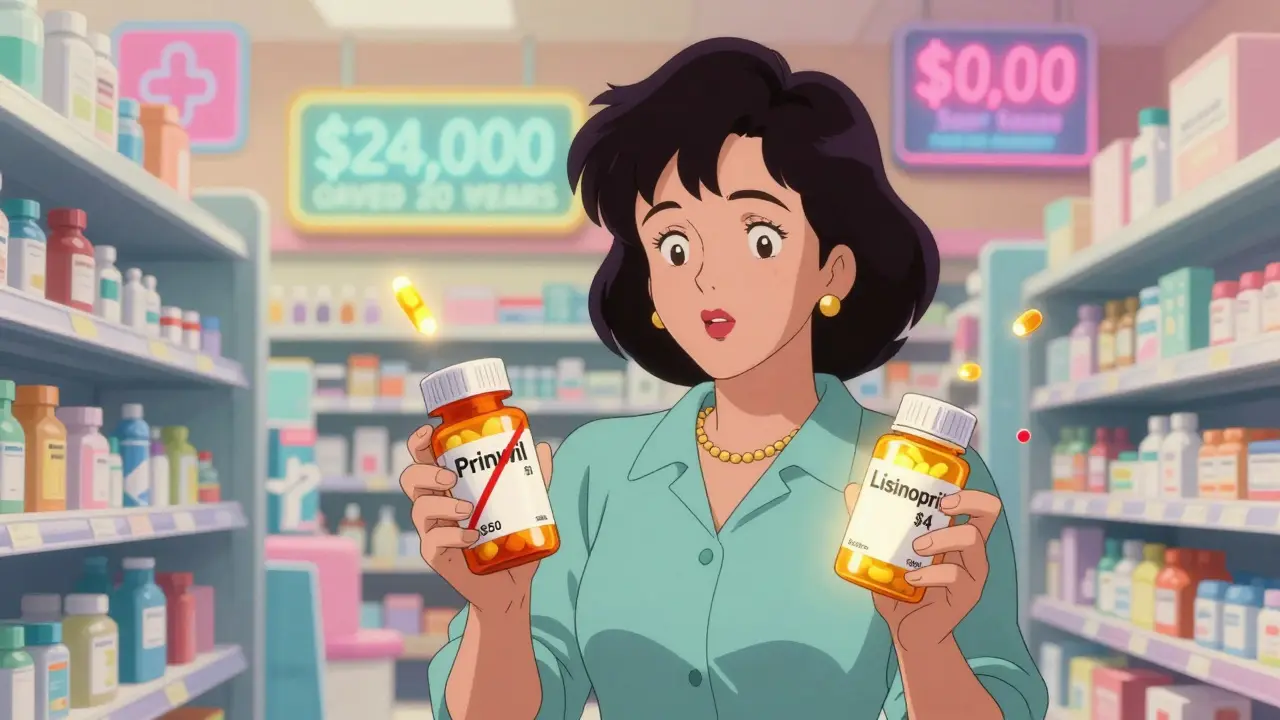
For millions of Americans managing chronic conditions like high blood pressure, diabetes, or asthma, the real cost of medication isn’t just the price on the bottle-it’s what you pay over 10, 20, or 30 years. A pill that costs $50 a month might seem manageable until you add up the years. But switch to the generic version, and that same pill drops to $5. That’s not a small change. It’s a lifetime savings that can mean the difference between sticking with treatment and skipping doses because you can’t afford it.
What Exactly Are Generic Drugs?
Generic drugs aren’t knockoffs. They’re the exact same medicine as the brand-name version, just without the marketing budget. The FDA requires them to have the same active ingredient, strength, dosage form, and route of administration. They work the same way in your body. The only differences? The color, shape, or inactive ingredients like fillers or dyes-and those don’t affect how the drug works. The legal backbone for this system? The Hatch-Waxman Act of 1984. It let generic manufacturers enter the market as soon as brand-name patents expired. Before that, patients had no choice. After? Prices plummeted. Today, 97% of all prescriptions filled in the U.S. are generics-when they’re available.How Much Do You Really Save?
Let’s break it down with real numbers. Take lisinopril, a common blood pressure drug. The brand-name version, Prinivil, costs about $40 to $50 a month. The generic? Around $4. That’s $1,200 to $2,000 saved per year. Over 20 years? That’s $24,000 to $40,000-money that could go toward groceries, rent, or even a vacation. Same story with metformin for type 2 diabetes. Brand-name Glucophage? $150 a month. Generic metformin? $10 to $25. That’s $1,500 to $1,800 saved every year. Multiply that by 15 years? You’re looking at $22,500 to $27,000 in savings. And it’s not just one drug. Most people with chronic conditions take multiple medications. A patient managing hypertension, diabetes, and high cholesterol might be paying $500 a month for brand-name drugs. Switching to generics? That drops to $75. That’s $5,100 saved every year. Over a decade? More than $50,000.Why Generics Are Just as Safe-and More Effective
A lot of people worry: “If it’s cheaper, is it weaker?” The answer is no. The FDA doesn’t approve generics unless they’re bioequivalent to the brand-name drug. That means the amount of active ingredient absorbed into your bloodstream must fall within 80% to 125% of the brand’s levels. That’s a tight window. It’s not guesswork-it’s science. And here’s the kicker: lower cost leads to better adherence. People who start on generics are 18% to 22% more likely to keep taking their meds than those on brand-name versions. Why? Because they don’t have to choose between medicine and rent. When patients stick with their treatment, hospital visits drop by 20% to 30%. Fewer ER trips. Fewer complications. Fewer surgeries. That’s not just saving money-it’s saving lives.The Bigger Picture: How Generics Cut System-Wide Costs
It’s not just about individual savings. In 2020, generics made up 90% of all prescriptions filled in the U.S. But they accounted for only 18% of total drug spending-$63 billion out of $350 billion. That means the rest of the money went to brand-name drugs, which made up just 10% of prescriptions. That gap added up to $338 billion in savings for the U.S. healthcare system in 2020 alone. Over the last decade, generics saved the country nearly $2.4 trillion. Think about that. That’s enough to cover the annual healthcare costs of every person in Texas. And it’s getting bigger. About $150 billion in brand-name drug sales are set to lose patent protection between 2023 and 2027. That means more generics will hit the market. More savings. More access.
What About Biosimilars? The Next Wave
Some chronic conditions-like rheumatoid arthritis, Crohn’s disease, or certain cancers-are treated with biologic drugs. These are complex proteins made from living cells. They’re expensive-often $10,000 to $20,000 a year. Enter biosimilars. They’re not exact copies like traditional generics, but they’re proven to work the same way. The FDA has approved dozens already. And they’re cutting costs by 15% to 35%. One study estimated biosimilars could save the U.S. $300 billion over the next decade. They’re not everywhere yet. But they’re growing fast. And for patients on lifelong biologic treatments, this is the next big leap in lifetime savings.Why Don’t More People Use Them?
If generics are cheaper, safer, and just as effective, why do some patients still pay more? One reason: misinformation. Some believe generics are “inferior.” But that’s a myth. The FDA inspects generic manufacturing plants just as strictly as brand-name ones. Many are even made in the same factories. Another reason: insurance. Some plans still favor brand-name drugs by putting generics in higher tiers or requiring prior authorization. Pharmacists can help here. Medication Therapy Management (MTM) programs-covered under Medicare Part D-let pharmacists review your entire drug list and switch you to generics when possible. Patients in these programs report 25% higher satisfaction and 30% lower out-of-pocket costs. And then there’s the placebo effect. A few people swear their brand-name pill “works better.” But studies show it’s often psychological. When patients are switched to generics and told what’s happening, the perceived difference vanishes.How to Start Saving Today
You don’t need a degree in pharmacology to start saving. Here’s how:- Ask your doctor: “Is there a generic version of this drug?” If they say no, ask why. Sometimes it’s just habit.
- Call your pharmacy. Ask for the cash price of the generic. Sometimes it’s cheaper than your copay.
- Check the FDA’s Orange Book online. It lists approved generics and patent status.
- Sign up for MTM if you’re on Medicare. A pharmacist will review all your meds and find savings.
- Use manufacturer coupons or patient assistance programs. Even brand-name companies offer discounts if you qualify.

Real Stories, Real Savings
In India, generic HIV drugs cut treatment costs by 90% between 2005 and 2015. Adherence jumped 40%. Deaths fell 25%. In Brazil, government policies pushed generics for diabetes and hypertension. Access rose 35%. Annual healthcare costs dropped by $1.2 billion. Closer to home, a 68-year-old woman in Ohio switched from brand-name insulin to generic. Her monthly cost dropped from $450 to $45. She stopped skipping doses. Her A1C dropped from 9.2 to 7.1. She’s now able to travel to see her grandchildren without worrying about running out of meds.What’s Next?
The FDA’s Generic Drug User Fee Amendments (GDUFA) III, running through 2027, is speeding up approvals for complex generics-especially those for chronic diseases. Meanwhile, the Inflation Reduction Act caps insulin at $35 a month for Medicare patients-and that includes generics. The trend is clear: generics aren’t just a cost-cutting trick. They’re a public health tool. For anyone managing a chronic condition, choosing generics isn’t about settling. It’s about smart, sustainable care.Frequently Asked Questions
Are generic drugs really as effective as brand-name drugs?
Yes. The FDA requires generics to have the same active ingredient, strength, and dosage as the brand-name version. They must also prove they’re bioequivalent-meaning they work the same way in your body. Thousands of studies confirm they’re just as effective. The only differences are in inactive ingredients, which don’t affect how the drug works.
Why are generic drugs so much cheaper?
Brand-name companies spend billions on research, marketing, and advertising. Generic manufacturers don’t have to repeat those costs. They only need to prove their drug is equivalent. That cuts their expenses dramatically, and those savings get passed on to patients.
Can I switch from a brand-name drug to a generic without asking my doctor?
In most cases, yes. Pharmacists can substitute generics unless your doctor writes “dispense as written” or “no substitution.” But it’s still a good idea to check with your doctor or pharmacist first, especially if you’re on multiple medications or have sensitivities to inactive ingredients.
Do insurance plans cover generics?
Almost always-and at lower costs. Most insurance plans put generics in the lowest copay tier. Some even waive copays entirely for certain generics. Always ask your pharmacy to compare the cash price versus your insurance copay. Sometimes paying out-of-pocket is cheaper.
Are there any downsides to using generics?
Very few. In rare cases, people report feeling different after switching, usually due to changes in inactive ingredients. If you notice new side effects, talk to your doctor or pharmacist. But this doesn’t mean the generic doesn’t work-it just means your body may react slightly differently to the filler. The active ingredient is unchanged, and the drug’s effect remains the same.
What if my doctor says there’s no generic available?
Ask if the patent has expired. Many drugs still have brand-name pricing simply because the patent hasn’t lapsed yet. You can check the FDA’s Orange Book to see if a generic is approved. If it is, your doctor may be unaware. If no generic exists yet, ask if a biosimilar is an option-for conditions like arthritis or diabetes, these are becoming more common.
How do I know if a generic is right for me?
Talk to your pharmacist. They can review your entire medication list, check for interactions, and confirm whether a generic is available and appropriate. For chronic conditions, they can also help you enroll in Medication Therapy Management (MTM) programs-free services that find savings and improve adherence.

Comments (9)
Laia Freeman January 30 2026
OMG I JUST SWITCHED MY BLOOD PRESSURE MED TO GENERIC AND MY MONTHLY BILL DROPPED FROM $120 TO $8?? LIKE, I’M NOT EVEN KIDDING-I’VE BEEN USING THIS STUFF FOR 7 YEARS AND NEVER EVEN THOUGHT TO ASK!!! NOW I CAN ACTUALLY AFFORD GROCERIES AND NOT JUST MY MEDS!!!
Robin Keith February 1 2026
It’s fascinating, isn’t it? The entire pharmaceutical-industrial complex is built on the illusion of necessity-brand names aren’t better, they’re just better at marketing, at manipulating perception, at convincing you that your health is a commodity to be purchased at premium prices… and yet, the science is unequivocal: identical molecules, identical mechanisms, identical outcomes-only the label changes, and with it, the price tag by an order of magnitude. It’s not medicine, it’s capitalism with a stethoscope.
Sheryl Dhlamini February 1 2026
I had no idea generics were this much cheaper. My mom’s been on metformin for 15 years and she’s been paying $180/month… I just called her pharmacy and found out the generic is $12. She cried. I cried. We both just sat there for five minutes. That’s not savings-that’s dignity restored.
LOUIS YOUANES February 1 2026
Let’s be real-most people who take generics don’t even know what bioequivalence means. They just see the price and assume it’s junk. Meanwhile, the people who actually understand pharmacology? They’re the ones paying full price because they’re too proud to admit they don’t need the fancy bottle. It’s not about health-it’s about social signaling.
Andy Steenberge February 1 2026
For anyone reading this and thinking, ‘I don’t know if I can trust generics’-please talk to your pharmacist. They’re trained to help you, not upsell you. I’ve worked in community pharmacy for 12 years, and I’ve seen patients switch from brand-name insulin to generic and go from HbA1c of 10.5 to 6.8 in six months. The drug works. The only thing that’s different is the patient’s ability to breathe again because they’re not choosing between rent and refills. This isn’t a niche tip-it’s public health 101.
paul walker February 2 2026
just switched my asthma inhaler to generic and my wallet is crying happy tears 😭
DHARMAN CHELLANI February 2 2026
USA still thinks generics are magic? In India, we’ve had cheap meds since the 80s. Your system is broken, not the drugs.
kabir das February 4 2026
But… what if… the generic makes you feel… different? Like… tired? Or… weird? I mean, I swear my brand-name one… it just… worked better…
Keith Oliver February 5 2026
Oh please. You’re all acting like this is some revolutionary discovery. The Hatch-Waxman Act was passed in 1984. People have known this for 40 years. The fact that you’re only learning this now proves how disconnected the average American is from basic healthcare literacy. If you needed a PhD to understand that generics = same drug, then you shouldn’t be managing your own meds.