
When you’re flying across time zones with medication, a simple label can mean the difference between staying healthy and ending up in a foreign hospital. It’s not just about remembering to pack your pills. It’s about reading them correctly-understanding what the words mean, how they apply to your new time zone, and whether they’ll even be allowed in the country you’re landing in.
What’s Actually on Your Prescription Label?
Your prescription label isn’t just a receipt. It’s a legal document with seven key pieces of information you need to check before you leave:- Your full name, exactly as it appears on your passport
- The medication’s brand name and generic name (like "Lipitor" and "atorvastatin")
- The dosage strength (e.g., 10 mg, 500 mg)
- Directions for use-how often, when, and how to take it
- The prescribing doctor’s name and contact info
- The pharmacy’s name, address, and license number
- The prescription number
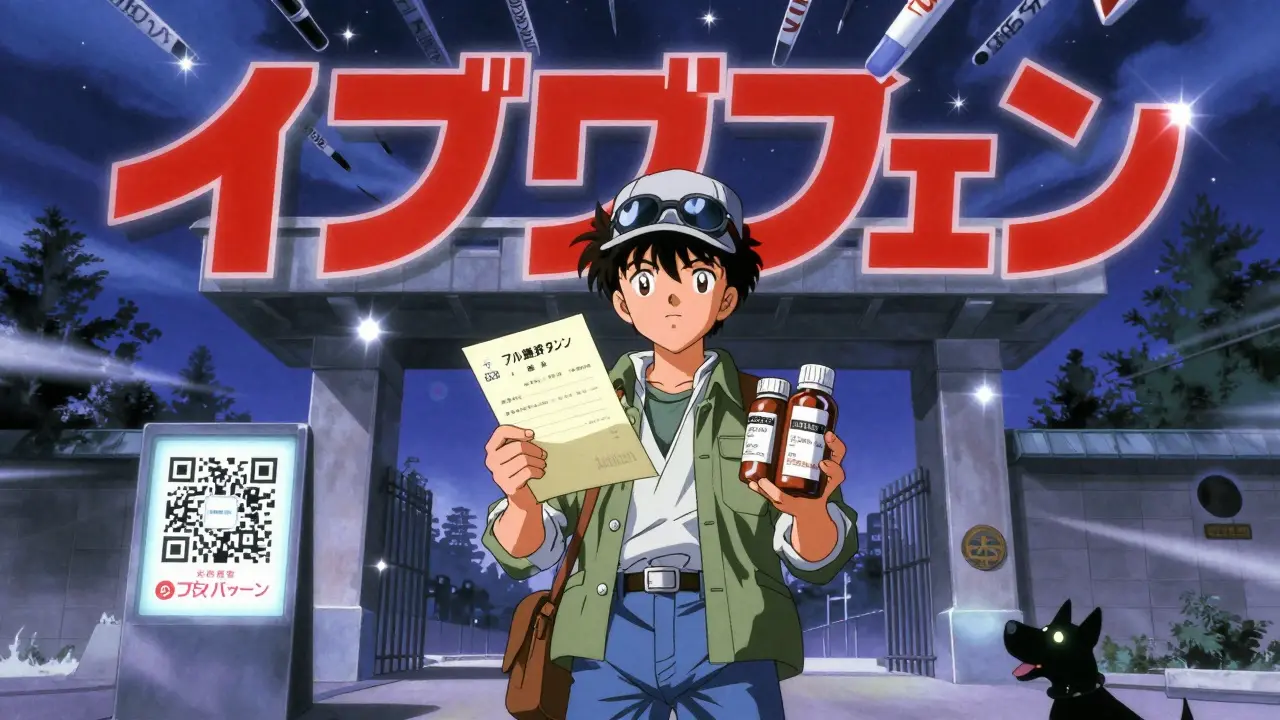
Many travelers assume the brand name is enough. It’s not. In Japan, Thailand, and Saudi Arabia, customs officers require the generic name in the local language. If your label says "ibuprofen" but the country expects "イブプロフェン" (Japanese) or "อิบูโพรเฟน" (Thai), you could be stopped at security-even with a doctor’s note.
Time Zones Aren’t Just About Jet Lag
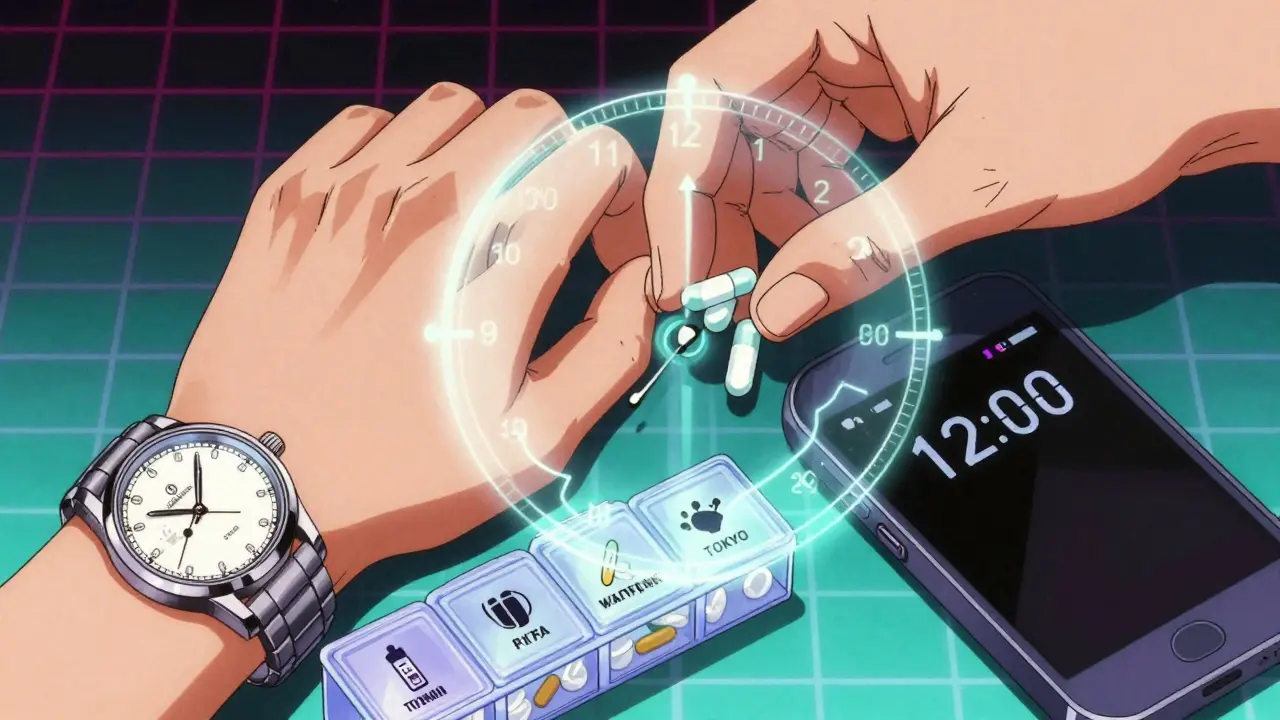
Your body doesn’t care about your watch. It cares about when your medication hits your bloodstream. If you take a pill every 12 hours at 8 a.m. and 8 p.m. in New York, and you fly to Tokyo, your body still thinks it’s 8 a.m. in New York. That means you might accidentally take your next dose at 11 p.m. Tokyo time-which is 11 a.m. New York time. You’re now dosing 15 hours apart, not 12.That’s why experts recommend converting all your medication times to Coordinated Universal Time (UTC). If your label says "take one tablet every 12 hours," write down: "Take at 12:00 UTC and 00:00 UTC." Then, when you land, convert UTC to local time. No guessing. No confusion.
For time-sensitive meds like insulin, blood thinners (warfarin), or thyroid pills, timing matters even more. A 2024 study in the Journal of Clinical Pharmacy and Therapeutics found that 71% of travelers on warfarin messed up their dosing after crossing time zones-even when the label had instructions. Why? Because they didn’t account for the drug’s half-life. If a drug lasts 4 hours, you need to adjust fast. If it lasts 24 hours, you can stick to your home schedule for a couple of days.
Global Rules Are Not the Same
There’s no universal prescription label. Every country has its own rules:- Japan: All medication labels must include kanji for the active ingredient. U.S. labels often don’t. That’s why 68% of medication seizures at Narita Airport in 2023 were due to labeling issues.
- Thailand: Labels must have both English and Thai. Many travelers get fined $500-$5,000 for not having it.
- Saudi Arabia: Arabic names for active ingredients are mandatory. Without them, your pills may be confiscated.
- European Union: Labels must be in the local language of the country you’re entering, but they follow a standardized format across 27 nations.
- United States: No requirement for multilingual labels. Your pharmacy won’t add them unless you ask.
And here’s the kicker: TSA says you don’t need original packaging. But customs officers in other countries don’t care what TSA says. If your pills are in a plastic pill organizer, and the label doesn’t clearly show your name and the drug’s generic name, you’re at risk.
What to Do Before You Leave
Start 4-6 weeks before your trip. Here’s what to do:- Call your pharmacy and ask them to add UTC times to your label. Example: "Take one tablet at 08:00 UTC (03:00 EST)." Most major U.S. pharmacies now do this for free.
- Ask for a printed copy of your medication list with both brand and generic names, dosages, and instructions.
- If you’re on insulin, blood thinners, or seizure meds, schedule a visit with a travel medicine specialist. They’ll help you plan a transition schedule over 2-3 days.
- Download the WHO’s free Medication Time Zone Converter app. It lets you input your meds and automatically converts times to your destination.
- Create a physical chart: Write your meds, times in UTC, local time at destination, and whether they need to be taken with food or on an empty stomach. Color-code it. Keep it in your wallet.
One traveler on Reddit took double the dose of levothyroxine because she thought "take on empty stomach" meant "first thing in the morning local time." She ended up in a Prague hospital. Her label said "take at 07:00 UTC." She didn’t check.
What to Pack
Don’t just toss your pills into a ziplock. Pack smart:- Keep meds in original bottles with labels intact. Even if TSA doesn’t require it, other countries do.
- Bring a copy of your prescription on paper, signed by your doctor.
- Carry a letter from your doctor explaining why you need the meds-especially if they’re controlled substances like opioids or stimulants.
- For liquids: Make sure the concentration (mg/mL) is listed on the label. IATA requires this for carry-ons.
- For insulin or other injectables: Bring syringes in original packaging, with a doctor’s note.
Pro tip: If you’re flying with multiple time zones (e.g., New York → Dubai → Singapore), set your phone to UTC and use it as your medication alarm. Don’t rely on your local time.
What Happens If You Get Stopped?
If customs asks about your meds:- Stay calm. Don’t argue.
- Hand them your original label and doctor’s letter.
- If they don’t recognize the drug name, show them the generic name.
- If they ask why you have so many pills, explain your trip length and dosage schedule.
Don’t lie. Don’t hide. Don’t say "it’s just vitamins." Countries like Japan and Saudi Arabia have zero tolerance. They use drug-sniffing dogs and X-ray scanners. A single misstep can mean fines, detention, or deportation.
What’s Changing in 2025?
The World Health Organization is pushing for a global standard. By the end of 2025, all prescription labels for international travelers must include a "travel supplement" section with:- UTC dosing times
- Active ingredient names in English, French, Spanish, and Arabic
- A QR code linking to multilingual safety info
Some airlines already use the Universal Medication Travel Card (UMTC), which scans your label and cross-checks it with your destination’s rules. Singapore and Dubai are testing AR labels that adjust timing instructions based on your GPS location.
But until then, you’re on your own. The system isn’t perfect. And the stakes are high.
Real Consequences
International SOS reports that medication errors during travel cause 70% of all preventable medical evacuations. Those cost between $15,000 and $250,000. In 2023, Thailand fined 83 travelers for improper labeling. Japan seized over 1,200 medication packages. A single missed dose of warfarin can cause a stroke. A double dose of levothyroxine can trigger a heart rhythm problem.You wouldn’t fly without checking your passport. Don’t fly without checking your prescription label.
Do I need to keep my pills in the original bottle when flying?
Yes, especially when traveling internationally. While the TSA in the U.S. allows pills in pill organizers, many countries require original packaging with clear labels showing your name, drug name, and dosage. Customs officers in Japan, Saudi Arabia, and Thailand often refuse to recognize medications in unlabeled containers-even if you have a doctor’s note. Keep them in the original bottles, and bring a printed copy of your prescription as backup.
Can I bring my prescription meds in my carry-on?
Absolutely. Always keep your medications in your carry-on. Checked luggage can be lost, delayed, or stolen. If you’re on insulin, blood thinners, or daily heart meds, losing them could be life-threatening. Airlines and the WHO recommend carrying at least a 10-day supply in your carry-on, even for short trips.
What if my medication isn’t available in the country I’m visiting?
Don’t assume you can just buy it there. Many countries ban or restrict common U.S. and European medications. For example, codeine is illegal in Japan, and pseudoephedrine is tightly controlled in Thailand. Always research your destination’s drug laws before you go. If you’re unsure, contact the country’s embassy or use the WHO’s Travel Health Portal. Bring enough to last your entire trip.
How do I know if my medication has a narrow therapeutic index?
Medications with a narrow therapeutic index have a small difference between a helpful dose and a toxic one. Common examples include warfarin, lithium, digoxin, and phenytoin. Your pharmacist can tell you if your medication falls into this category. If it does, you must be extra careful with timing and dosage when crossing time zones. Don’t adjust the schedule yourself-consult a travel medicine specialist.
Should I adjust my medication schedule immediately when I land, or wait a few days?
It depends on the drug. For medications with a short half-life (4-8 hours), like antibiotics or insulin, adjust immediately to local time. For drugs with a long half-life (24+ hours), like thyroid pills or some antidepressants, you can stick to your home schedule for 2-3 days. The CDC recommends waiting 72 hours for most non-critical meds. But if you’re on a time-sensitive drug, follow your doctor’s advice. Use the WHO app to calculate the safest transition.

Comments (10)
Jhoantan Moreira February 3 2026
Just got back from Bali and I nearly got arrested because my ibuprofen bottle didn’t have the Thai script. 😅 Learned the hard way - now I print out the generic names in local language before every trip. Life saver.
Amit Jain February 4 2026
Keep meds in original bottle. Always. I work in a hospital in Delhi and see people get fined every week because they put pills in a pillbox. No label = trouble. Simple.
rahulkumar maurya February 6 2026
Let me be blunt - most travelers are lazy and think ‘it’s just medicine,’ like it’s a snack. You don’t fly with expired yogurt, so why treat life-saving drugs like they’re disposable? The fact that 71% of warfarin users mess up timing after crossing zones? That’s not ignorance - it’s negligence wrapped in a vacation mindset. And no, ‘I forgot’ is not a valid defense when your INR spikes in a Tokyo ER.
And for the love of all that’s holy, stop relying on ‘the app.’ If your phone dies, are you just gonna wing it? Print the damn chart. Color-code it. Tape it to your passport. This isn’t rocket science - it’s survival.
The WHO’s 2025 standard? Cute. But until then, you’re on your own. And if you think TSA rules apply globally, you’re not just uninformed - you’re dangerous.
Alec Stewart Stewart February 7 2026
Big thanks for this post - seriously. I took my dad to Mexico last year and we had no clue about the Arabic names thing. We were lucky they just gave us a warning. Now I use the WHO app religiously. 🙏
Also, if you're on insulin? Set your phone to UTC and make three alarms. One for UTC, one for local, one for ‘don’t be dumb.’
Demetria Morris February 7 2026
People who don’t read labels before traveling are a liability to public health. I don’t care if you’re ‘just going for a week.’ One missed dose of warfarin could kill someone on your flight. This isn’t a suggestion - it’s a moral obligation.
Geri Rogers February 8 2026
OMG YES. I’m a nurse and I’ve seen so many people panic because their pills were in a Ziploc. 😤 I even had a guy try to convince customs his ‘vitamins’ were ‘just for anxiety’ - it was Adderall. In Saudi Arabia. He got deported. Don’t be that guy. Bring the bottle. Bring the letter. Bring the chart. Bring the peace of mind. 💪💊
Alex LaVey February 9 2026
As someone who’s lived in 8 countries, I can say this: every culture treats meds differently. In Japan, they’ll ask for the kanji like it’s a sacred text. In Brazil, they just want to see your doctor’s name. The key? Be humble. Be prepared. Don’t assume your way is the right way.
And if you’re traveling with kids or elderly relatives? Print out a one-pager with meds, times, and emergency contacts. They might not be able to explain it themselves. You’re their advocate.
caroline hernandez February 10 2026
From a clinical pharmacy standpoint, the critical oversight here is pharmacokinetic adaptation. Medications with narrow therapeutic indices (NTIs) require chrono-pharmacological recalibration - not just temporal conversion. The half-life-based adjustment protocol outlined is accurate, but insufficient without pharmacogenomic context. For example, CYP2C9 polymorphisms significantly alter warfarin clearance in Southeast Asian populations. Always consult a pharmacogenomics-certified provider before transcontinental dosing. The WHO app is a start, but it’s not a substitute for individualized care.
Joseph Cooksey February 11 2026
Look. I’ve been flying since the 90s. Back then, you just tossed your pills in your pocket and prayed. Now? We got QR codes, UTC timers, AR labels, and WHO mandates. It’s ridiculous. And honestly? It’s making people soft. You think your body can’t handle a 2-hour shift in dosing? It’s not a robot. It’s a biological marvel that survived ice ages and plagues.
But fine. If you want to turn your medicine cabinet into a NASA mission control, go ahead. Print your charts. Color-code your pills. Download every app. Just don’t act like the rest of us who’ve been taking our meds for 30 years without a GPS tracker are idiots.
That said - I still carry my original bottles. And a doctor’s note. Because even if I think it’s overkill, I don’t wanna get locked up in Dubai for having ‘unauthorized substances.’ So yeah. I do the thing. But I roll my eyes the whole time.
Justin Fauth February 12 2026
Why the hell are we letting foreign countries dictate how we take our medicine? This is America. We don’t need no Thai script on our ibuprofen. TSA says it’s fine - so why are we kissing the boots of some bureaucrat in Riyadh? This is cultural surrender. Just pack your pills and fly. If they take ‘em? Good. Maybe they’ll learn what real freedom looks like.